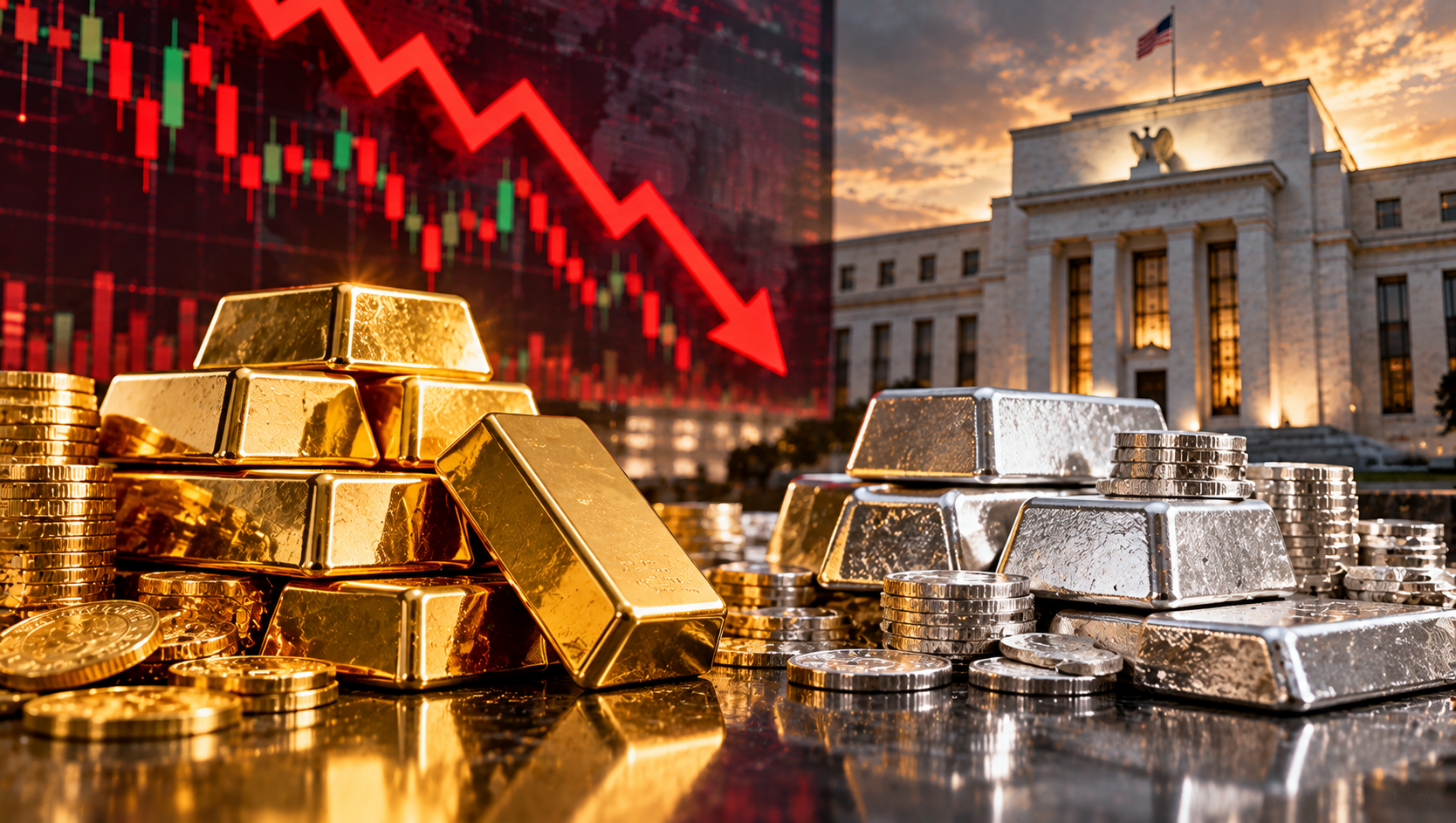
MCX December gold futures traded at ₹1,42,806 per 10 grams, while silver futures stood at ₹1,94,700 per kg on Tuesday. Global bullion prices also weakened as investors assessed the US Federal Reserve’s upcoming policy decision, interest-rate expectations and movements in the US dollar.
Gold and silver prices declined in domestic and international markets on Tuesday, October 27, as investors adopted a cautious approach ahead of the US Federal Reserve’s monetary policy announcement. Expectations surrounding US interest rates, the strength of the dollar and elevated crude oil prices remained key factors influencing sentiment in the precious metals market.
On the Multi Commodity Exchange (MCX), December gold futures opened ₹492 lower at ₹1,42,581 per 10 grams, compared with the previous close of ₹1,43,073. The contract subsequently recovered some of its opening losses but was still trading ₹267 lower at ₹1,42,806 per 10 grams at the time of reporting.
Silver futures also opened sharply lower. The benchmark December contract started the session at ₹1,93,789 per kg, down ₹2,004 from its previous close of ₹1,95,793. At the time of reporting, silver was trading at ₹1,94,700 per kg, representing a decline of ₹1,093.
US Federal Reserve Decision Takes Centre Stage
The upcoming policy decision from the US Federal Reserve is a major near-term trigger for bullion prices. Investors are assessing the central bank’s likely approach to interest rates and its assessment of inflation, economic growth and financial conditions.
Gold is a non-interest-bearing asset, meaning it does not generate regular income. Consequently, expectations of higher interest rates can reduce its relative attractiveness compared with interest-bearing investments such as government bonds. Conversely, expectations of monetary easing may support bullion by lowering the opportunity cost of holding the metal.
The US dollar is another important variable. A stronger dollar generally makes dollar-denominated commodities more expensive for buyers using other currencies, potentially weighing on international demand. A weaker dollar can have the opposite effect.
Investors will therefore look beyond the immediate policy announcement to the Federal Reserve’s accompanying guidance. Any indication that interest rates could remain elevated for longer may put pressure on gold and silver, while a more accommodative outlook could help prices recover.
International Gold and Silver Prices Remain Under Pressure
In international trading, gold futures on the Comex opened at $4,032.80 per ounce, against the previous close of $4,038.40. At the time of reporting, prices were down $10.90 at $4,027.50 per ounce.
Comex silver futures opened at $54.07 per ounce, compared with the previous close of $54.34. The contract was subsequently trading at $53.80 per ounce, down $0.54.
The latest declines come after both precious metals recorded substantially higher levels earlier in the year. According to the supplied market data, gold had previously touched $5,586.20 per ounce internationally, while silver had reached $121.79 per ounce.
In the domestic market, gold futures had earlier touched ₹1,80,779 per 10 grams, while silver futures had reached ₹4,20,048 per kg. These historical peaks highlight the considerable price volatility witnessed in bullion markets.
However, comparisons with earlier highs should be treated cautiously because futures prices depend on the specific contract, trading date and market conditions. Investors should also distinguish exchange-traded futures prices from retail jewellery rates, which can include making charges, taxes and other costs.
Gold Technical Outlook: ₹1,42,320 Support in Focus
According to Ajay Kedia, director of Kedia Advisory, gold was witnessing technical short covering. The supplied data indicated that prices had risen by ₹1,049 during the period under consideration, while open interest declined 1.39% to 15,996 contracts.
Short covering occurs when traders who previously sold or held short positions buy back contracts to close those positions. It can support a temporary recovery, although it does not necessarily signal the beginning of a sustained upward trend.
The following technical levels were highlighted for MCX gold:
-
Immediate support: ₹1,42,320 per 10 grams
-
Next support: ₹1,41,560 per 10 grams
-
Immediate resistance: ₹1,43,600 per 10 grams
-
Potential upside level: ₹1,44,120 per 10 grams
A sustained move above ₹1,43,600 could improve the short-term technical outlook and open the possibility of a move towards ₹1,44,120.
On the downside, a decisive break below ₹1,42,320 could increase selling pressure, bringing ₹1,41,560 into focus.
These levels are technical reference points rather than guaranteed price targets. Movements around the Federal Reserve announcement could cause prices to move rapidly through support and resistance zones.
Silver Technical Outlook: ₹1,93,140 Is the Key Support
Silver was also showing signs of short covering, according to the technical assessment cited in the supplied report. Prices had risen by ₹74 during the period under consideration, while open interest declined 1.15% to 16,683 contracts.
Silver's price movements are influenced not only by monetary policy and investment demand but also by its industrial applications. Demand expectations from sectors such as electronics, solar energy and manufacturing can affect its performance relative to gold.
The technical levels identified for MCX silver are:
-
Immediate support: ₹1,93,140 per kg
-
Next support: ₹1,90,490 per kg
-
Immediate resistance: ₹1,97,820 per kg
-
Potential upside level: ₹1,99,840 per kg
If silver sustains above ₹1,97,820, the contract could attempt a recovery towards ₹1,99,840.
However, a break below ₹1,93,140 could intensify selling pressure and expose the next support at ₹1,90,490.
Given silver's dual role as an investment asset and industrial commodity, its performance may also depend on broader growth expectations and demand prospects.
Crude Oil, Inflation and the Dollar Add to Market Uncertainty
Beyond the Federal Reserve meeting, investors are monitoring crude oil prices and their implications for inflation. Elevated oil prices can increase transportation and production costs, potentially complicating the outlook for central banks seeking to bring inflation under control.
For India, movements in international crude oil prices are particularly important because the country imports a substantial share of its energy requirements. Higher oil prices can increase the import bill and put pressure on the rupee, depending on broader currency and capital-flow conditions.
Currency movements can influence domestic bullion prices because international gold and silver prices are quoted in US dollars. Even if international prices remain relatively stable, a weaker rupee can increase the domestic cost of imported precious metals. A stronger rupee may provide some relief to domestic prices.
The combination of monetary-policy uncertainty, currency fluctuations and commodity-price volatility is therefore likely to keep bullion traders attentive to developments in global markets.
What Should Bullion Investors Watch Next?
The immediate focus remains on the Federal Reserve's policy announcement and any signals about the future direction of US interest rates. Investors should also track movements in the dollar, US bond yields and crude oil prices for clues about the next direction of precious metals.
For gold, the ability to hold above ₹1,42,320 will be important for near-term stability. A recovery above ₹1,43,600 could improve momentum, while a break below support would raise the risk of a deeper correction.
For silver, the ₹1,93,140 level is an important downside reference, while ₹1,97,820 represents the first significant resistance highlighted in the technical assessment.
Traders should be cautious about interpreting short covering as confirmation of a durable recovery. Sudden changes in interest-rate expectations can trigger sharp price movements in either direction, particularly around major central-bank announcements.
Retail buyers should also distinguish between exchange-traded futures prices and the actual prices charged by bullion dealers and jewellers. Local prices may vary according to purity, taxes, premiums and other transaction costs.
Market Outlook
Gold and silver remain sensitive to global monetary-policy expectations, dollar movements and inflation risks. Tuesday's decline reflects cautious positioning ahead of the US Federal Reserve's decision, although short covering and technical support levels could influence near-term price action.
For gold, ₹1,42,320 and ₹1,43,600 are the immediate levels to monitor. For silver, ₹1,93,140 and ₹1,97,820 could help indicate whether prices are stabilising or facing further pressure.
The next sustained move will depend on how the Federal Reserve's decision and forward guidance influence interest-rate expectations, the dollar and bond yields. Until greater clarity emerges, volatility is likely to remain an important consideration for bullion traders and investors.