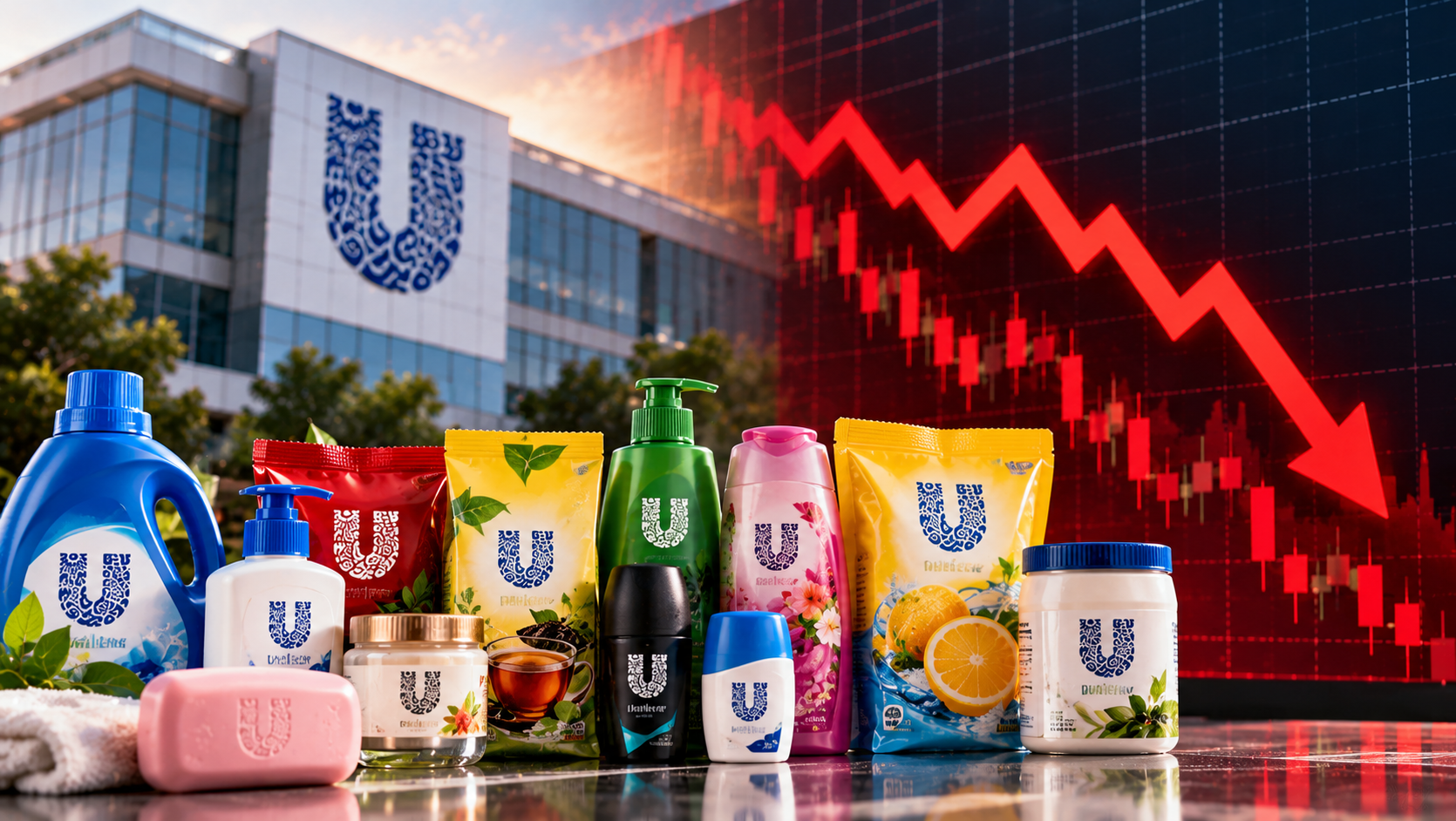
Hindustan Unilever shares have underperformed the broader market in 2026 as investors assess slowing volume growth, higher input costs and the impact of price increases. Analysts expect double-digit revenue growth in Q2 FY27, but margin contraction and the sustainability of consumer demand remain key concerns.
Shares of Hindustan Unilever Limited (HUL), one of India's largest fast-moving consumer goods (FMCG) companies, declined nearly 3% on Tuesday, October 27, ahead of the company's September-quarter earnings announcement. The stock touched an intraday low of ₹1,758.60 on the BSE, marking its lowest level in more than six years as investors remained cautious about the company's near-term earnings outlook.
The decline came a day before HUL's board was scheduled to consider its financial results for the second quarter of FY27. The company was also expected to consider an interim dividend, if any, for the financial year ending March 31, 2027.
At around 10:50 AM, HUL shares were trading at ₹1,765.55 on the BSE, down approximately 3% for the session. Trading activity increased, with a combined 2.32 million shares changing hands on the NSE and BSE, around 1.5 times the average trading volume cited in the report.
The stock's weakness stood out against a relatively stable broader market, highlighting investor concerns about the company's earnings growth, input costs and valuation.
HUL Shares Underperform the Broader Market in 2026
HUL has experienced sustained pressure in 2026, with its share price declining substantially more than the benchmark index.
The stock fell nearly 10% over the preceding month, compared with a decline of approximately 2% in the BSE Sensex. On a calendar-year basis, HUL shares had lost around 24%, while the benchmark index had declined approximately 13.6%, according to the figures cited in the report.
The stock's recent performance reflects concerns about the balance between revenue growth, consumer demand and profitability. While price increases can help FMCG companies offset rising input costs, excessive reliance on pricing may affect affordability and reduce the pace of volume growth.
For a company with HUL's extensive presence across household products, personal care and packaged consumer goods, investors are particularly attentive to whether growth comes from higher sales volumes or higher prices.
The upcoming results are therefore expected to provide important clues about the company's ability to protect profitability while maintaining demand across its product categories.
Q2 FY27 Results on October 28: What Investors Should Watch
HUL's board is scheduled to meet on Wednesday, October 28, 2026, to consider the unaudited standalone and consolidated financial results for the quarter and half-year ended September 30, 2026.
The board will also consider a proposal for an interim dividend, if any, for FY27.
Ahead of the announcement, analysts expect the company to report double-digit revenue growth, supported by price increases implemented across selected product categories. However, the earnings outlook remains complicated by rising commodity prices and the possibility that higher prices could moderate consumer volumes.
Investors are likely to focus on four major areas:
-
Revenue growth: Whether price increases can sustain double-digit revenue growth.
-
Volume growth: Whether consumers continue purchasing products at higher prices or shift towards cheaper alternatives.
-
Operating margins: Whether higher input costs reduce the benefits of pricing actions.
-
Management commentary: The company's assessment of demand conditions, commodity inflation and growth prospects for the second half of FY27.
The results will also help investors assess whether HUL's recent share-price decline reflects temporary cost pressures or more persistent concerns about its earnings trajectory.
Elara Capital Flags Commodity Inflation and Margin Risks
Elara Capital expects the demand environment across the FMCG sector to remain broadly stable in Q2 FY27, although volume growth could moderate sequentially.
The brokerage estimates that volume growth for its FMCG coverage universe, excluding ITC, could decline to approximately 9% in Q2 FY27 from 9.5% in Q1 FY27.
According to the brokerage, several companies implemented additional price increases during the September quarter after raising prices in the preceding quarter. While these increases are expected to support revenue growth, their impact on consumer demand and margins remains an important consideration.
Elara Capital expects revenue across its FMCG coverage universe, excluding ITC, to increase 15% year-on-year.
However, the brokerage anticipates a sequential gross-margin contraction of approximately 51 basis points, partly because companies have increasingly consumed lower-cost inventory and are facing higher replacement costs.
The pressure is expected to affect both food companies and home and personal care manufacturers.
Elara identified Hindustan Unilever, Colgate-Palmolive India, Britannia Industries, Dabur India and Emami among the companies that could report year-on-year EBITDA margin contraction in Q2 FY27.
For its broader FMCG coverage universe, the brokerage expects EBITDA margins to decline approximately 17 basis points year-on-year and 86 basis points quarter-on-quarter.
These estimates relate to the brokerage's sector coverage and should not be interpreted as HUL-specific financial guidance.
Rising Raw Material Prices Could Weigh on Profitability
Commodity inflation remains a key challenge for FMCG manufacturers, particularly those that rely on agricultural commodities, edible oils and petroleum-linked inputs.
The commodity trends cited in the Q2 earnings preview indicate significant cost increases across several categories.
Sugar prices rose approximately 18% year-on-year, while milk prices increased 3%. Palm oil and palm fatty acid distillate prices were up around 21% year-on-year each. Copra prices increased 8.7% quarter-on-quarter during Q2 FY27, although they remained significantly below their earlier peak.
Crude oil prices also rose approximately 47% year-on-year, potentially increasing costs for manufacturers that use petroleum-derived ingredients, packaging materials and transportation services.
The impact on individual FMCG companies varies according to their product mix, procurement strategy, inventory levels and ability to pass higher costs on to consumers.
For HUL, the challenge is to balance pricing actions with competitive positioning. Passing on all cost increases may protect margins but could weaken affordability, while absorbing a larger portion of the inflation may affect profitability.
The extent to which the company can manage this trade-off will be a key determinant of its quarterly performance.
Antique Stock Broking Expects Double-Digit Revenue Growth
Antique Stock Broking expects sequential improvement in revenue growth across the FMCG sector, excluding Varun Beverages, supported by pricing actions.
The brokerage noted that price increases have helped offset some moderation in consumer volumes. Companies have also used trade incentives to support sales ahead of the festive season.
However, Antique expects higher input costs to remain a drag on gross margins.
For HUL, the brokerage anticipates double-digit revenue growth, largely driven by pricing. It expects volume growth to remain around the mid-single-digit range, indicating that higher realisations may contribute more significantly to revenue growth than volume expansion.
Antique also expects HUL's EBITDA margin to contract by approximately 21 basis points quarter-on-quarter because of input-cost pressures.
The estimates suggest that HUL could continue to report healthy headline revenue growth even as its underlying volume momentum and profitability face challenges.
The actual results will determine whether pricing gains are sufficient to offset higher costs and whether volume growth remains resilient across the company's major product categories.
Pricing Versus Volume Growth: The Central Earnings Question
For FMCG companies, revenue growth can come from higher sales volumes, price increases or changes in product mix.
While price increases can support revenue and protect margins during inflationary periods, sustained growth ultimately depends on consumers continuing to purchase products at higher prices.
If price increases outpace consumers' willingness or ability to pay, companies may experience slower volume growth. Consumers can respond by reducing consumption, shifting towards lower-priced products or choosing competing brands.
This makes the quality of revenue growth particularly important when evaluating HUL's Q2 performance.
Mid-single-digit volume growth, as anticipated by Antique Stock Broking, would indicate continued demand expansion. However, investors will need to assess the figure alongside pricing growth, product-category performance and the company's ability to maintain market share.
A stronger volume performance could help reassure investors about the underlying health of the business. Conversely, weak volumes combined with margin contraction could intensify concerns about the sustainability of earnings growth.
Can Festive Demand Support the Second Half of FY27?
The performance of consumer demand during the second half of FY27 will be another important factor for HUL and the wider FMCG sector.
Festive-season purchases can support demand across packaged foods, personal care, household products and other consumer categories. Companies may also use promotional offers and improved distribution to increase sales.
However, stronger festive demand alone may not be sufficient to offset persistent input-cost inflation.
Elara Capital highlighted the durability of demand during H2 FY27 and movements in raw material prices as key factors to monitor.
For HUL, the combination of volume recovery, pricing discipline and cost management will be important in determining whether earnings momentum improves in the coming quarters.
Investors will also look for management commentary on consumer spending patterns, competitive intensity and the company's strategy for balancing growth with profitability.
Key Risks for HUL Investors
Despite its established brands and extensive distribution network, HUL faces several near-term challenges that could influence its financial performance and share-price trajectory.
Margin compression: Higher costs for palm oil, petroleum-linked inputs and other commodities could reduce operating profitability if price increases do not fully compensate for inflation.
Slower volume growth: Pricing-led revenue growth may become less sustainable if consumers reduce purchases or switch to cheaper alternatives.
Competitive pressure: FMCG companies must balance price increases with affordability and brand positioning, particularly in price-sensitive categories.
Uncertain demand recovery: The durability of consumer demand during the second half of FY27 remains an important variable for sector earnings.
Share-price weakness: HUL's significant underperformance in 2026 indicates that investors are reassessing its near-term growth and profitability outlook. The upcoming results and management commentary could influence expectations further.
At the same time, the company's established brand portfolio and distribution network remain important competitive strengths. The key question is whether these advantages can translate into stronger volume growth and sustainable earnings in the current cost environment.
Market Outlook
Hindustan Unilever enters its Q2 FY27 earnings announcement amid heightened investor caution, with the stock trading near a multi-year low. Analysts expect double-digit revenue growth, supported by price increases, but anticipate pressure on margins from rising raw material costs and moderation in volume growth.
The October 28 results will be important in assessing whether HUL can maintain revenue momentum without sacrificing profitability or market share. Investors will closely monitor volume growth, pricing contributions, gross margins and management's outlook for the second half of FY27.
A stronger-than-expected volume performance and signs of stabilising margins could help improve sentiment. Conversely, weak volumes combined with persistent cost inflation may prolong pressure on earnings expectations.
For the broader FMCG sector, commodity prices, consumer affordability and festive-season demand will remain central drivers. HUL's next share-price direction is likely to depend on the quality of its reported earnings and the outlook provided by management rather than revenue growth alone.