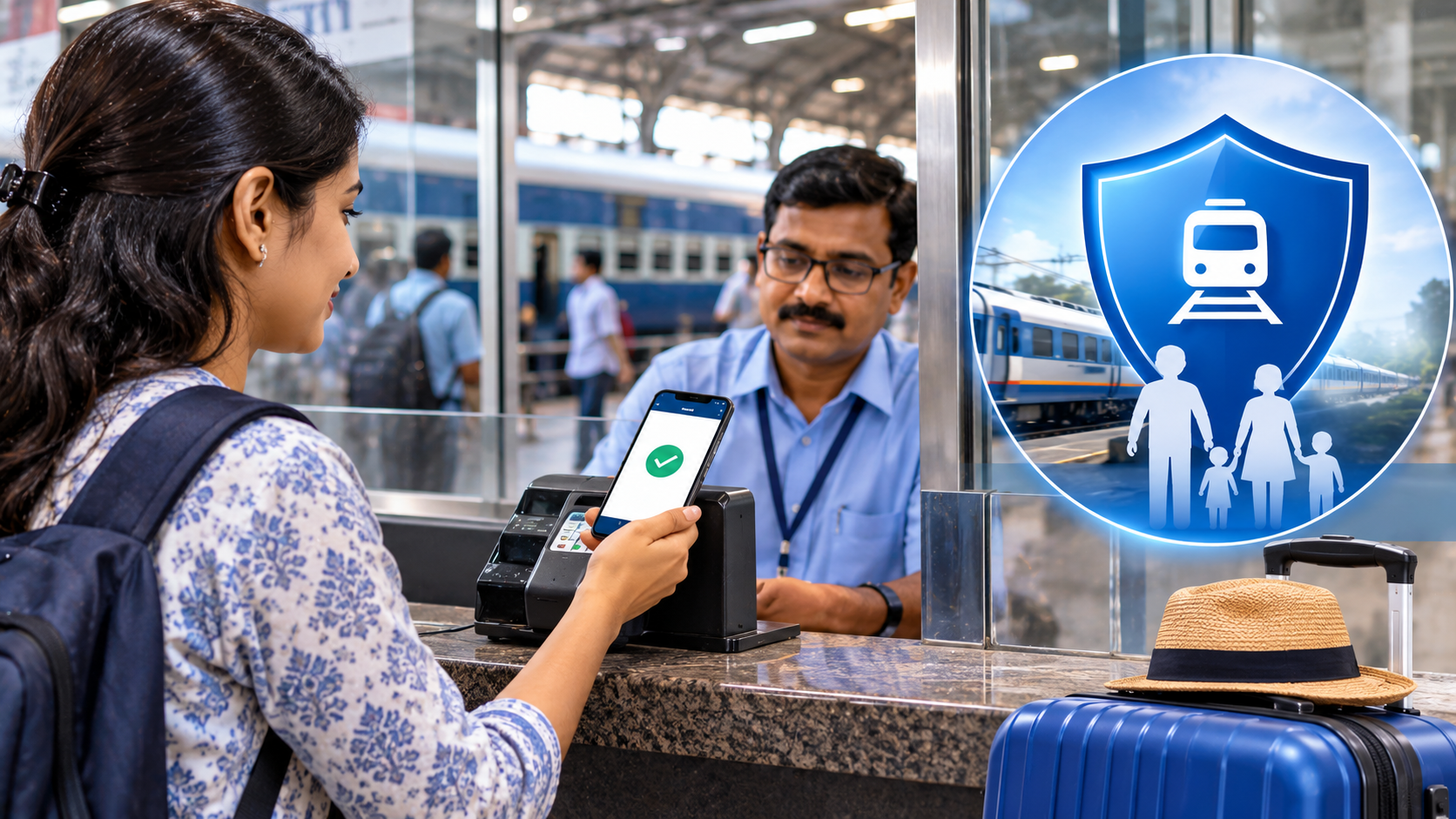
Passengers booking reserved train tickets at railway reservation counters must pay digitally for the entire transaction if they opt for travel insurance from October 27. The optional cover offers up to ₹10 lakh for death or permanent total disability, with additional benefits for injuries and related expenses.
Indian Railways has extended its optional travel insurance facility to passengers purchasing reserved train tickets at Passenger Reservation System (PRS) counters, bringing counter bookings in line with the insurance facility available for online reservations. Under the new arrangement, passengers who choose the cover must make a digital payment for the entire transaction, including the ticket fare and insurance premium.
The change took effect on Tuesday, October 27, 2026. The insurance premium is fixed at 45 paise per passenger, inclusive of taxes, and cannot be paid separately in cash along with the ticket fare.
The Railway Board has directed zonal railways to ensure that reservation counters are equipped to implement the facility. According to a report by PTI, the extension follows a Supreme Court order dated October 6.
The insurance remains entirely optional. Passengers who do not wish to purchase the cover can continue booking tickets without opting for it.
Why Has Indian Railways Introduced Digital Payments for Insurance?
The mandatory digital payment requirement is linked to the nominal amount charged for the insurance premium.
At 45 paise per passenger, the premium cannot conveniently be collected through the coins currently in circulation as legal tender. The Railway Board has therefore directed that the amount be collected digitally when passengers choose the insurance facility.
The Centre for Railway Information Systems (CRIS), which manages the railway reservation technology infrastructure, has made the necessary software changes to facilitate the implementation. The work is being carried out in coordination with the Indian Railway Catering and Tourism Corporation (IRCTC).
Under the new arrangement, passengers opting for insurance at a reservation counter must be prepared to pay the combined ticket fare and premium through an accepted digital payment method.
The change also reflects the broader adoption of digital payment systems across railway services. By extending the facility to counter bookings, the railways are seeking to provide passengers purchasing tickets in person with access to the same optional insurance arrangement available through online reservations.
What Does the 45-Paise Travel Insurance Cover?
The Optional Travel Insurance Scheme (OTIS) provides financial protection against specified incidents associated with train travel. Despite its nominal premium, the policy provides several categories of benefits, subject to its applicable terms and conditions.
The coverage outlined for the scheme includes:
-
Death or permanent total disability: Insurance cover of up to ₹10 lakh.
-
Permanent partial disability: Cover of up to ₹7.5 lakh.
-
Hospitalisation expenses for injuries: Cover of up to ₹2 lakh.
-
Transportation of mortal remains: Benefit of up to ₹10,000.
The premium of 45 paise per passenger, inclusive of taxes, has been in effect since February 17, 2024, according to the Railway Board.
For passengers travelling together, the premium remains linked to the number of people included in the booking. For example, a booking covering four passengers would attract a combined insurance premium of ₹1.80 if all four passengers opt for the cover.
However, the amount of insurance benefit payable in the event of an incident will depend on the policy's provisions, the nature of the incident and the insurer's claim assessment.
Passengers should not assume that every accident, injury or travel-related inconvenience automatically qualifies for compensation. They should review the policy wording, exclusions, eligibility conditions and claim procedures before opting in.
Who Can Purchase the Optional Travel Insurance?
The facility is available for tickets carrying the following reservation statuses at the time of booking:
Confirmed (CNF): Passengers with confirmed reservations can opt for the insurance.
Reservation Against Cancellation (RAC): Passengers whose reservations are classified as RAC are also eligible under the stated conditions.
Partially Confirmed (PartCNF): Bookings with partially confirmed reservation status can also qualify.
The Railway Board has clarified that the existing terms and conditions applicable to online ticket bookings will also apply to insurance policies issued against tickets purchased through PRS counters.
A booking can include passengers with different reservation statuses. For instance, a ticket booked for four people may have one confirmed berth and three passengers on the waiting list. According to the railway official cited by PTI, all four passengers may receive insurance coverage if they decide to travel and the applicable eligibility conditions are satisfied.
The important distinction is that eligibility for insurance does not itself guarantee a confirmed berth or permission to travel in circumstances where railway reservation rules do not permit it. Passengers must continue to follow the applicable ticket and travel regulations.
Mobile Number Is Mandatory for Policy Issuance
Passengers choosing the insurance facility must provide their mobile numbers along with the other required booking information.
Reservation staff have been instructed to record the details correctly so that the relevant information can be transmitted to the insurer for policy issuance.
Providing an accurate mobile number is therefore an important step in the booking process. Passengers should check the details entered at the counter before completing the transaction.
They should also retain their ticket and any policy confirmation or insurance-related communication received after booking. These records may be useful if they need to verify the policy details or initiate a claim later.
Passengers should check the insurer's specified process for accessing policy documents and submitting claims rather than assuming that the railway ticket alone contains all the information needed.
What Happens to the Insurance Premium if You Cancel the Ticket?
Passengers cancelling their tickets should be aware that the entire insurance premium is not refundable.
According to information attributed to a CRIS official in the report, 9 paise will be deducted from the 45-paise insurance premium when a ticket is cancelled. This leaves a refundable insurance-premium portion of 36 paise per passenger, subject to the applicable cancellation process.
The insurance-premium deduction is separate from railway ticket cancellation charges.
Railway cancellation charges depend on the applicable reservation category, timing of cancellation and other relevant rules. Consequently, passengers should not calculate their total refund by considering only the insurance premium.
Before cancelling a ticket, travellers should check the refund amount and the applicable conditions. The insurance premium is small, but understanding the cancellation process helps avoid confusion about the final amount credited.
How Will the New Rule Affect Passengers Booking at Railway Counters?
The most immediate change concerns passengers who traditionally prefer cash payments at railway reservation counters.
Under the new arrangement, choosing insurance means using a digital payment method for the entire transaction, rather than paying the ticket fare in cash and adding the premium separately.
Passengers planning to opt for insurance should therefore carry a suitable digital payment option, such as an accepted electronic payment method, and ensure that sufficient funds are available.
Those who do not wish to use digital payments can choose not to purchase the optional insurance, subject to the normal ticket-booking requirements.
The rule does not make travel insurance compulsory for every reserved ticket. Instead, it establishes a digital collection mechanism for passengers who voluntarily select the cover.
This distinction is important because travellers should not assume that the 45-paise premium is automatically added to every counter-booked ticket.
What Passengers Should Check Before Booking
Passengers purchasing reserved tickets at railway counters can prepare for the new arrangement by following a few practical steps.
Keep a digital payment option ready. If you intend to purchase travel insurance, be prepared to pay both the ticket fare and the premium digitally.
Confirm that you want the insurance. The cover is optional, so make your decision before completing the booking.
Provide accurate contact information. Check that the mobile number entered by the reservation staff is correct.
Understand the benefits and exclusions. Review the policy conditions to understand which incidents qualify for coverage and what documentation may be required for a claim.
Check the reservation status. Confirm whether the ticket is confirmed, RAC or partially confirmed, and understand that insurance eligibility does not change the underlying reservation status.
Retain the relevant records. Keep the ticket and any policy confirmation or insurer communication for future reference.
Understand cancellation deductions. Remember that the stated 9-paise deduction from the insurance premium is separate from any railway cancellation charges.
A Small Premium With Important Conditions
The extension of optional travel insurance to railway reservation counters broadens access to the facility for passengers who do not book online. The ₹10 lakh cover for death or permanent total disability is the headline benefit, while additional provisions cover permanent partial disability, injury-related hospitalisation and transportation of mortal remains.
At the same time, the new digital payment requirement means passengers who opt for insurance must plan their payment accordingly. The cover is not compulsory, and the value of the protection depends on the policy's terms, exclusions and claim requirements.
For travellers, the key is to make an informed choice: understand the benefits, provide accurate booking details and retain the relevant documentation.
Market Outlook
The extension of optional travel insurance to railway reservation counters represents a further step in integrating digital payments into India's railway booking system. The immediate impact will be operational, affecting how passengers pay when they voluntarily choose the 45-paise insurance cover.
The move could make the facility more accessible to passengers who book tickets in person, while encouraging greater use of digital payment methods at reservation counters. The effectiveness of the rollout will depend on smooth implementation, clear communication by railway staff and passengers' understanding of the policy conditions.
For travellers, the main takeaway is straightforward: insurance remains optional, but passengers choosing the cover at reservation counters must make a digital payment for the entire booking transaction.