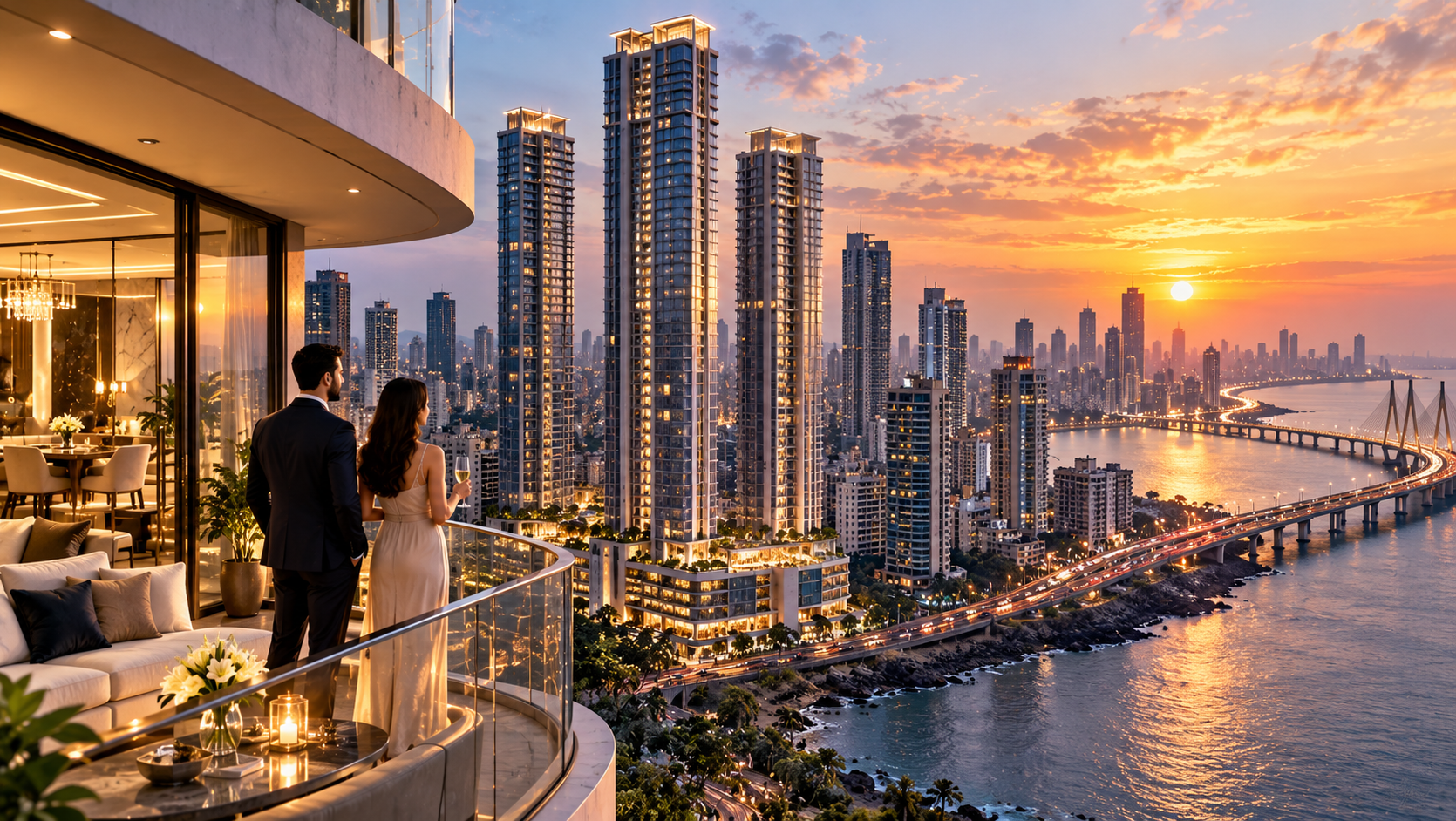
Mumbai’s top 10 luxury residential projects recorded ₹6,116 crore in registered sales between April and September 2026, while Worli retained its position as the city’s largest luxury housing market by transaction value.
Mumbai’s luxury residential property market continued to attract substantial buyer interest in the first half of FY27, with Godrej Trilogy Seafront in Worli emerging as the city’s leading project by registered home sales value. The development recorded 54 home sales worth a combined ₹1,199 crore between April and September 2026, highlighting the continued demand for premium residences in Mumbai’s established luxury neighbourhoods.
Oberoi Elysian secured the second position, recording sales worth ₹899 crore across 67 homes, while Rustomjee Crown ranked third with ₹622 crore from 51 transactions. Collectively, the top 10 luxury residential projects generated ₹6,116 crore in registered sales across 496 transactions during the six-month period.
The findings are based on The Luxury Real Estate Market Decoded, a report by Lighthouse Luxury, powered by property registration intelligence platform Zapkey. The report analyses registered residential property transactions worth ₹5 crore and above across the Mumbai region.
Godrej Trilogy Tops Project-Wise Sales Rankings
Godrej Trilogy’s performance reflects the significant value generated by high-end residential developments in Mumbai’s premium property corridors. With 54 homes sold for ₹1,199 crore, the project recorded an implied average transaction value of approximately ₹22.2 crore per home.
Oberoi Elysian recorded a higher number of transactions at 67 homes but generated a lower total sales value of ₹899 crore. Its implied average transaction value was approximately ₹13.4 crore per home. Rustomjee Crown reported 51 transactions worth ₹622 crore, translating into an average of approximately ₹12.2 crore per home.
The comparison illustrates how luxury housing rankings can differ depending on whether projects are measured by transaction volume or total sales value. Developments with larger ticket sizes can lead the market in value even when they register fewer transactions than competing projects.
The ₹6,116 crore combined sales value of the top 10 projects also indicates that a substantial share of high-value transactions is concentrated in a relatively small group of developments.
Worli Remains Mumbai’s Largest Luxury Housing Market
Worli retained its position as Mumbai’s largest luxury housing micro-market, recording 275 home sales with a combined transaction value of ₹5,558 crore. The average transaction price stood at approximately ₹20.2 crore, among the highest across the leading micro-markets.
The area’s transaction value increased 9.9% between the first and second quarters of FY27, indicating continued activity in one of Mumbai’s most established premium residential locations.
Worli’s appeal is supported by its coastal location, access to major business districts, connectivity to other parts of the city and concentration of high-end residential developments. Its combination of relatively high average property values and a substantial number of transactions gives it a leading position in the city’s luxury housing market.
Mahalaxmi ranked second by micro-market transaction value, recording ₹1,891 crore across 201 homes at an average price of ₹9.4 crore. Andheri West and Versova followed with ₹1,837 crore from 221 transactions, with the average home price at ₹8.3 crore.
Bandra West recorded ₹1,747 crore across 159 transactions, at an average price of ₹11 crore. Malabar Hill generated ₹1,385 crore from 84 homes, with the average transaction value reaching ₹16.5 crore.
Juhu recorded ₹1,281 crore across 93 transactions, while Tardeo registered ₹1,280 crore from 104 homes. Lower Parel, Prabhadevi and Goregaon East recorded sales values of ₹1,165 crore, ₹1,111 crore and ₹1,110 crore, respectively.
Top 10 Micro-Markets Account for 56% of Luxury Home Sales
Mumbai’s luxury residential market remains concentrated in a limited number of neighbourhoods. The top 10 micro-markets recorded a combined transaction value of ₹18,365 crore between April and September 2026, accounting for 56% of the total ₹32,623 crore in registered sales of homes priced at ₹5 crore and above.
This concentration highlights the importance of established premium locations in shaping the city’s high-end property market. While newer developments and emerging residential clusters are attracting buyers, established neighbourhoods continue to command a substantial share of registered transaction value.
The figures also reveal differences between average property prices and overall market size. Malabar Hill, for example, recorded an average transaction value of ₹16.5 crore, higher than several other leading micro-markets. However, its lower number of transactions meant that its overall sales value remained below Worli’s.
Worli’s combination of a high average ticket size and a larger transaction base helped it maintain its leadership position.
Andheri West–Versova and Tardeo Record Sharp Growth
Andheri West and Versova recorded one of the strongest increases in transaction value among the leading luxury housing markets, with a 100.8% rise from Q1 to Q2 FY27. Tardeo recorded a 125% increase over the same period, the sharpest growth highlighted in the report.
The report attributed more than half of the increase in Andheri West and Versova to new launches by Sri Lotus Developers and Viceroy. New project offerings can increase transaction activity by expanding the supply of premium homes available to buyers and bringing additional developments into the registration pipeline.
Puravankara’s Purva Estrella was the area’s largest project by reported sales, with 42 homes sold for a combined ₹255 crore.
Other established neighbourhoods also reported positive quarterly momentum. Malabar Hill recorded 46.5% growth in transaction value, while Lower Parel rose 44.3% and Bandra West increased 33%. Juhu registered growth of 19.6%, while Mahalaxmi recorded a more moderate increase of 4.5%.
The divergence across locations suggests that Mumbai’s luxury property market is not moving uniformly. New launches, project availability, pricing, buyer preferences and the timing of registrations can all influence quarterly performance in individual micro-markets.
Prabhadevi and Goregaon East Witness Declines
Despite the broader strength in several premium locations, some micro-markets recorded a contraction in transaction value between Q1 and Q2 FY27.
Prabhadevi reported a 17.6% decline, while Goregaon East recorded a 10.2% fall. These reductions contrast with the strong gains in Andheri West–Versova, Tardeo and Malabar Hill.
Quarterly changes in registered transaction value should be interpreted carefully. They can reflect variations in the number of homes registered, the mix of properties sold, the availability of new projects and the timing of registrations. A decline over one quarter does not necessarily indicate a sustained fall in underlying demand.
For developers and investors, the differences between locations reinforce the importance of examining project-level sales, inventory, pricing and future launches rather than relying solely on citywide growth figures.
What the Luxury Housing Numbers Mean for Developers
The latest figures underline the role of premium residential projects in Mumbai’s property market. Developments that combine desirable locations, differentiated amenities and high-value homes can generate substantial sales value even when transaction volumes are relatively limited.
For developers, the concentration of sales in established luxury neighbourhoods highlights the importance of project positioning, execution and pricing strategy. At the same time, the sharp growth recorded in certain locations suggests that new supply can materially influence short-term market activity.
However, high registered sales values do not automatically translate into higher profitability for developers. Construction costs, land acquisition expenses, financing costs, sales and marketing expenditure, project timelines and the pace of cash collections all influence financial outcomes.
For investors tracking listed real estate companies, project-level sales data can provide useful context, but it should be assessed alongside company-wide pre-sales, cash flows, debt levels, launch pipelines and execution performance.
Market Outlook
Mumbai’s luxury residential market entered the second half of FY27 with strong activity across several premium locations, supported by high-value transactions and the performance of select new developments. Godrej Trilogy’s leadership in project-wise sales and Worli’s position as the largest luxury housing micro-market highlight the continuing importance of established premium locations.
Going forward, the sustainability of this momentum will depend on buyer demand, affordability at higher price points, the pace of new launches, property price trends and broader economic conditions. Locations such as Andheri West–Versova and Tardeo will merit attention to determine whether their sharp quarterly increases translate into sustained activity.
For real estate investors, the key indicators to monitor include registered transactions, developer pre-sales, unsold inventory, new project launches and the conversion of bookings into cash flows. While the latest data point to continued strength in parts of Mumbai’s luxury housing segment, performance is likely to remain uneven across projects and neighbourhoods.