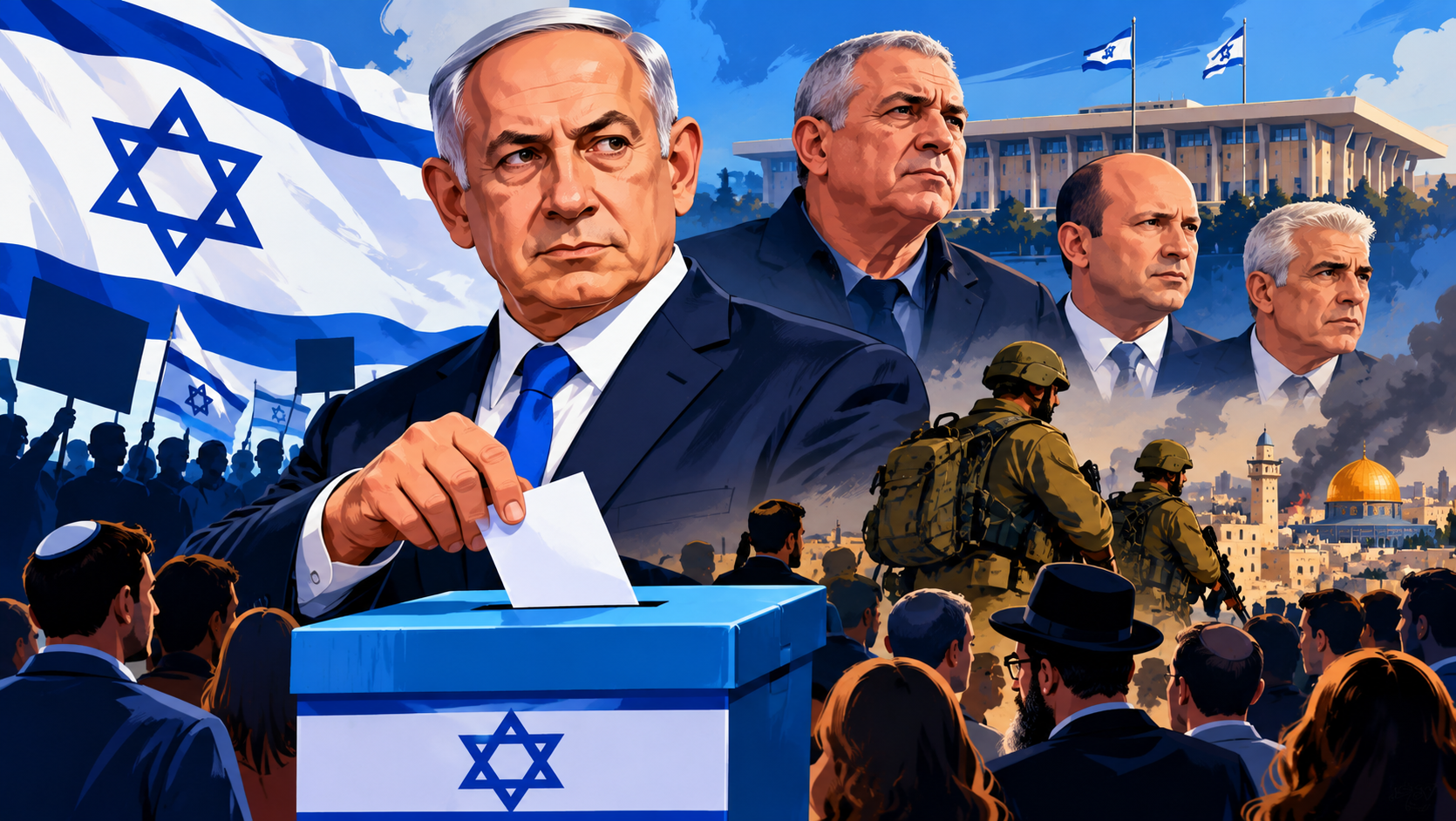
Israel’s high-stakes election puts Prime Minister Benjamin Netanyahu’s leadership under renewed scrutiny, with security failures, military-service disputes, ethnic tensions and economic pressures shaping a closely contested battle for power.
Election Becomes a Referendum on Netanyahu’s Leadership
Israel’s parliamentary election is emerging as a critical test for Prime Minister Benjamin Netanyahu, whose political future is being challenged by the consequences of the October 7, 2023, Hamas attack, prolonged military conflict and growing demands for accountability.
The election is the first since the October 7 assault, which killed approximately 1,200 people in Israel and resulted in 251 people being taken hostage to Gaza. The attack exposed major security failures and fundamentally altered Israel’s political and security environment.
Netanyahu, the country’s longest-serving prime minister, is seeking another term amid criticism over the government’s preparedness for the attack, its subsequent handling of the war and its refusal to establish an independent state commission of inquiry into the failures.
Opinion polls suggest a competitive contest between Netanyahu’s Likud party and opposition forces led by former military chief Gadi Eisenkot. Former prime minister Naftali Bennett is also leading a separate opposition alliance with Yair Lapid.
Neither political camp is assured of the parliamentary majority required to form a government. Under Israel’s proportional representation system, the outcome will depend not only on the number of seats won by individual parties but also on their ability to negotiate a coalition commanding the support of at least 61 members of the 120-seat Knesset.
October 7 Security Failures Remain at the Centre of the Campaign
Security has traditionally been one of Netanyahu’s strongest political credentials. However, the scale of the October 7 attack has weakened his carefully cultivated image as a leader capable of protecting the country.
Public anger has intensified over the absence of an independent investigation into the security and intelligence failures preceding the assault. Netanyahu has resisted calls for a state commission of inquiry, while critics argue that accountability is necessary to establish what went wrong and prevent a recurrence.
Hundreds of thousands of Israelis have participated in demonstrations demanding answers from the government. At a rally in Tel Aviv ahead of the election, organisers said more than 100,000 people attended, with protesters renewing calls for an independent investigation.
The prolonged conflict has also imposed a continuing human cost on Israeli society. Military personnel, reservists and their families have faced repeated deployments, while communities affected by the conflict continue to deal with displacement, insecurity and the loss of loved ones.
For Netanyahu, the election represents a test of whether voters continue to prioritise his experience and security-focused leadership or believe the failures surrounding October 7 require a change in government.
Gadi Eisenkot Emerges as a Major Challenger
Former Israel Defence Forces chief Gadi Eisenkot has become one of the principal challengers to Netanyahu. His military background gives him credentials on national security, while his criticism of the government’s handling of the conflict has helped position him as an alternative for voters seeking political accountability.
Eisenkot’s campaign has also been shaped by personal tragedy. His son and two nephews were killed while serving in the military during the Gaza conflict, bringing a deeply personal dimension to his criticism of the government’s decisions.
The opposition, however, faces its own challenge: converting dissatisfaction with Netanyahu into a unified parliamentary majority. With multiple parties competing for support, disagreements over coalition arrangements and policy priorities could complicate government formation even if the ruling Likud bloc loses ground.
Naftali Bennett and Yair Lapid represent another important part of the opposition landscape. Their ability to coordinate with other parties after the election could prove as significant as their individual electoral performance.
Ethnic Identity and Political Representation Return to the Spotlight
Ethnicity has re-emerged as a sensitive issue in Israel’s political debate, particularly in discussions involving Mizrahi and Ashkenazi Jewish communities.
Mizrahi generally refers to Jews whose family origins are in the Middle East and North Africa, while Ashkenazi refers to Jews with historical roots in Central and Eastern Europe. The distinction has influenced Israeli politics for decades, including support for Likud among sections of Mizrahi and traditional Jewish voters who have historically expressed grievances over discrimination and unequal representation.
Netanyahu himself has an Ashkenazi background, but Likud has developed a substantial base among voters from diverse ethnic and socioeconomic groups.
Eisenkot, whose family has Moroccan Jewish roots, has brought these questions into sharper focus. A controversial televised remark by pro-Netanyahu commentator Yinon Magal, who used an insulting term about Eisenkot, triggered criticism and renewed debate over ethnic prejudice in public discourse. Netanyahu also condemned the remark as inappropriate.
The episode has drawn comparisons with the 1981 election campaign, when a derogatory term used against Mizrahi voters became a prominent symbol of ethnic tensions in Israeli politics.
Whether the latest controversy changes voting behaviour remains uncertain. Nevertheless, it highlights how questions of identity, representation and social equality can influence political loyalties alongside security and economic concerns.
Military Service Dispute Deepens Secular–Religious Divide
The question of compulsory military service has become another major fault line in Israeli politics.
Most Jewish Israeli men are subject to compulsory military service, but ultra-Orthodox Jewish men, known as Haredim, studying in religious seminaries have historically benefited from broad exemptions or deferments.
The prolonged conflict has intensified opposition to the arrangements, particularly among reservists and families whose relatives have repeatedly been called up for military duty. Critics argue that the burden of defending the country is not being distributed fairly.
The issue is no longer limited to a debate about social equality. Manpower shortages and extended reserve deployments have made military recruitment an operational concern.
Israel’s Supreme Court ruled in 2024 that blanket exemptions for Haredi men could not continue without a legal basis. The resulting dispute has placed pressure on Netanyahu’s coalition, which has relied on ultra-Orthodox parties for political support.
Haredi leaders want to protect religious study and maintain financial support for their institutions, while opponents are demanding a more equitable system of national service.
The disagreement creates a difficult political calculation for Netanyahu. Preserving the support of ultra-Orthodox coalition partners could help him retain power, but it may also deepen public frustration over the distribution of responsibilities during wartime.
Judicial Overhaul Continues to Influence Political Sentiment
The government’s proposed judicial reforms remain another source of division. The proposals, which sought to increase elected politicians’ influence over judicial appointments and limit aspects of judicial review, triggered mass protests in 2023.
Critics argued that the changes threatened the independence of the judiciary and weakened institutional checks on executive power. Supporters, meanwhile, maintained that the reforms were necessary to rebalance authority between elected representatives and the courts.
Although security and military service have dominated the current campaign, the judicial dispute remains part of the broader argument about Israel’s democratic institutions and the character of its political system.
The controversy has also contributed to a wider loss of trust between opposing political camps. Efforts to form a unity government face this legacy, as previous power-sharing arrangements have collapsed amid disputes over budgets, leadership rotations and governing priorities.
Economy and Cost of War Become Critical Voter Concerns
The economy is another important consideration as Israelis assess the government’s record.
Prolonged military operations have increased demands on public finances and imposed costs on businesses, households and workers called up for reserve duty. The effects of conflict can extend beyond direct military spending, affecting business confidence, investment decisions, tourism and consumer activity.
The allocation of public funds has also become politically contentious. Government spending on ultra-Orthodox institutions is part of the wider debate over whether public resources and national responsibilities are being shared fairly.
For voters, economic concerns are closely connected to questions of security and governance. Higher household costs, uncertainty over employment and the disruption caused by prolonged conflict can influence how citizens evaluate the government’s performance.
A new administration would face the challenge of balancing defence requirements with economic stability, public services and longer-term fiscal priorities. Any coalition agreement could therefore have implications for government spending, taxation and the broader business environment.
Donald Trump’s Endorsement Adds an International Dimension
US President Donald Trump has publicly endorsed Netanyahu ahead of the election, adding an international element to an already consequential domestic contest.
The United States remains a central strategic partner for Israel, particularly on defence, intelligence and regional security. Public support from Washington can carry political significance, especially during a campaign focused on national security and the conduct of the wars.
However, the electoral impact of Trump’s endorsement remains uncertain. Netanyahu’s domestic standing will also depend on voters’ assessment of the October 7 failures, the handling of subsequent military operations and the government’s response to social and economic pressures.
The result could influence the tone of Israel’s engagement with Washington and its approach to regional diplomacy, although substantial policy changes would depend on the priorities of the incoming government and the broader strategic environment.
Arab Voters Could Influence Coalition Formation
Arab citizens account for approximately 21 per cent of Israel’s population, making their participation potentially significant in a closely contested election.
The Arab-led Joint List and Ra’am are contesting separately. The Joint List brings together Hadash, Ta’al and Balad, while Ra’am, led by Mansour Abbas, is an independent Islamist party.
Political leaders from Arab communities have sought to encourage higher turnout and strengthen their influence over the formation of the next government. Pollsters have anticipated an increase in participation compared with the 2022 election, although actual turnout and its impact on the final seat distribution remain uncertain.
Crime and public safety are major concerns for Arab voters, alongside questions of discrimination, public services and political representation. An Israel Democracy Institute survey conducted in late August and early September found that crime in Arab society ranked as the most important consideration for Arab respondents when deciding which party to support.
Arab parties could become important in post-election negotiations if neither major political bloc secures a majority independently. However, the prospect of their supporting an opposition-led government remains uncertain because some non-Arab opposition leaders have been reluctant to form a coalition with Arab parties. Parliamentary support without formal coalition membership may offer an alternative, depending on the final numbers and political negotiations.
Palestinian Statehood Remains on the Margins of the Main Campaign
Despite the continuing conflict and its regional consequences, the prospect of a two-state solution has received limited attention in the main Jewish-party campaign.
The principal contenders have focused largely on security, leadership, military service and domestic governance. Arab parties continue to raise Palestinian statehood and the occupation as important political concerns, but these issues have not occupied the same central position among the leading Jewish parties.
Public opinion also reflects deep scepticism about the possibility of a peaceful settlement. A Pew Research Center survey published in September found that 56 per cent of Israelis did not believe Israel and an independent Palestinian state could coexist peacefully, while 17 per cent believed they could.
These findings indicate the difficulty facing any government seeking to revive negotiations. Nevertheless, the Israeli-Palestinian conflict remains a major regional issue, and the next administration’s policies could influence diplomatic relations, security arrangements and the prospects for a longer-term political settlement.
Why the Election Matters Beyond Israel
The election’s immediate outcome will determine Israel’s leadership, but its implications could extend to regional stability and international economic conditions.
Israel’s security policies and relations with neighbouring countries can affect diplomatic calculations across the Middle East. Changes in the governing coalition may influence approaches to military operations, negotiations, regional partnerships and relations with the United States.
For global markets, the election is one of several political developments investors may monitor when assessing geopolitical risk. However, the direct market impact will depend less on the election result alone than on subsequent policy decisions and whether the political transition changes the regional security outlook.
Energy prices, shipping routes, insurance costs and investor sentiment can respond to developments in the wider Middle East. Any escalation in regional tensions could add to uncertainty, while signs of de-escalation could ease some risk premiums. These effects are not automatic and would depend on the scale and duration of any change in the security environment.
What Happens After the Vote?
The decisive question is whether either political camp can assemble a coalition supported by at least 61 lawmakers. Winning the largest number of seats does not automatically guarantee the premiership in Israel’s parliamentary system.
If the results produce a fragmented Knesset, negotiations with smaller parties could determine the next government. Disputes over military-service exemptions, judicial reform, budget allocations and the handling of security failures could complicate those negotiations.
A narrow coalition could also face challenges in maintaining stability, particularly if its partners have sharply different positions on religious policy, military recruitment and relations with Arab parties.
The election may therefore mark the beginning of a prolonged political negotiation rather than an immediate resolution of Israel’s leadership crisis.
Market Outlook
Israel’s election is an important geopolitical event, but investors should distinguish between campaign rhetoric, the final parliamentary arithmetic and the policies implemented by the next government. The result could influence perceptions of regional security, diplomatic relations and fiscal priorities, although the direction and magnitude of any economic or market impact remain uncertain.
For global investors, developments in the Middle East may affect oil prices, shipping and insurance costs, and broader risk sentiment if they alter expectations for regional stability. A fragmented government or renewed security tensions could prolong uncertainty, while a credible path towards political stability and de-escalation could help reduce some concerns.
The key indicators to monitor after the election will be coalition negotiations, decisions on military-service policy, the government’s approach to accountability for October 7, and any changes in regional security or diplomatic engagement.
This article is for informational purposes only and does not constitute investment advice.