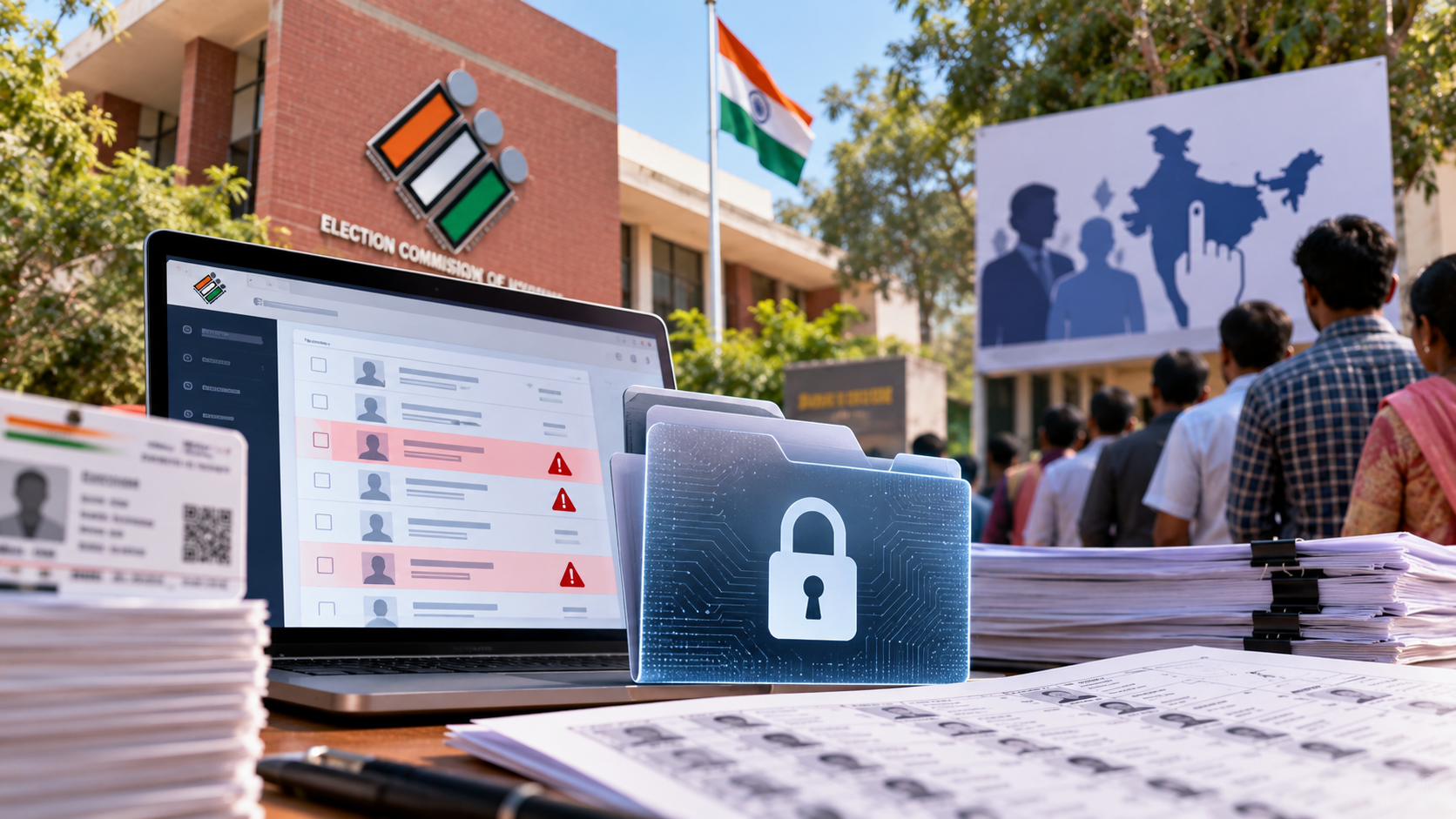
Poll Body Says No New Software Was Developed or Procured for Voter Roll Revision; Questions on AI-Based Flagging and Error Detection Remain Unanswered
The Election Commission of India (ECI) has declined to disclose details of the software used during the Special Intensive Revision (SIR) of electoral rolls, citing commercial confidence, trade secrets and intellectual property rights. While the poll body stated that it had neither developed nor procured any new software specifically for the exercise, it did not reveal the name or version of the technology used.
The response has drawn attention to questions surrounding the technological processes involved in updating electoral rolls, particularly whether automated systems were used to identify errors, inconsistencies or potentially incorrect voter records.
The Election Commission provided its response to a Right to Information (RTI) application filed by M A Mujeeb Ayyub on July 27. In a letter dated October 16, the commission said the requested software information was exempt from disclosure under Section 8(1)(d) of the Right to Information Act, 2005.
The response also clarified the statutory responsibility for decisions involving the inclusion or exclusion of voters, placing that responsibility with Electoral Registration Officers (EROs).
EC Says No New Software Was Developed for SIR
The RTI applicant sought the name and version of the software, application, algorithm or artificial intelligence platform used during the Special Intensive Revision of electoral rolls.
The application also sought information on whether the system automatically identified voter records containing errors, anomalies or inconsistencies for further verification, correction or deletion.
In its response, the Election Commission said that no new software had been developed or procured for the SIR exercise. However, it declined to disclose the specific software details, invoking provisions of the RTI Act relating to commercial confidence, trade secrets and intellectual property rights.
The distinction is significant: the commission stated that no new software was developed or procured, but it did not identify the existing technology or explain in detail how it was used during the revision process.
Consequently, the response does not establish whether the exercise relied exclusively on conventional data-processing systems or involved more advanced analytical tools.
RTI Application Raises Questions About AI and Automated Screening
The application sought clarity on whether artificial intelligence, machine learning, predictive analytics or automated decision-support systems were used at any stage of the SIR process.
It also asked whether software automatically flagged voter records for verification, correction or deletion and what safeguards were in place to prevent genuine electors from being incorrectly identified.
The Election Commission did not directly confirm or deny the use of these technologies. Instead, it said that questions seeking clarification about automated flagging, AI deployment and safeguards against incorrect identification did not qualify as requests for information under Section 2(f) of the RTI Act.
Section 2(f) defines the types of information that public authorities are required to provide under the law. In general, the RTI framework covers information held by or under the control of a public authority, rather than requiring it to create explanations or answer hypothetical questions.
The commission's response therefore leaves unresolved the applicant's specific questions about whether automated systems were involved and, if so, how they operated.
Importantly, the absence of disclosure does not establish that AI or automated decision-making tools were used. It means the response, as described in the report, did not provide a definitive answer on that issue.
Trade Secrets and Transparency: The Core Issue
The Election Commission's reliance on Section 8(1)(d) of the RTI Act places the question of disclosure within the framework governing commercially sensitive information, trade secrets and intellectual property.
The provision allows certain information to be withheld where disclosure could harm the competitive position of a third party, subject to the terms and exceptions provided under the law.
The issue in this case concerns the extent to which information about software used in a public electoral process can be disclosed without compromising legitimate intellectual property or commercial interests.
On one side, software specifications, proprietary algorithms and technical details may involve intellectual property or security considerations. On the other, information about how voter records are processed can be important for public understanding of electoral administration.
The key distinction is between revealing protected technical details and providing sufficient information about the process, safeguards and accountability mechanisms used to maintain accurate electoral rolls.
The commission's response, as reported, does not provide further details about the specific technical grounds for withholding the software name and version or whether any parts of the requested information could be disclosed separately.
Electoral Registration Officers Retain Decision-Making Authority
The Election Commission stated that decisions concerning the inclusion or exclusion of electors are made by the Electoral Registration Officers on the basis of facts and records.
It also referred to Sections 13B(1) and 13B(2) of the Representation of the People Act, 1950, identifying the ERO of the relevant Assembly constituency as the statutory authority responsible for preparing and revising the electoral roll.
This clarification is important because the identification of a potentially inconsistent record and the final decision on a person's electoral status are separate functions.
A data-processing system may help organise records or identify discrepancies, but any such flag would not, by itself, establish that a person is ineligible to vote. Electoral decisions must be made under the applicable legal framework and on the basis of the relevant facts and records.
The commission's response emphasises the formal role of EROs in decisions about voter inclusion and exclusion. However, the available details do not explain whether software-generated flags, if any, are used in the revision process or what review procedures apply before a record is changed.
Safeguards Against Incorrect Voter Identification Remain a Key Question
The RTI application also sought details of safeguards designed to prevent false positives and the wrongful flagging of genuine voters.
This issue is important in any large-scale electoral roll revision, where records may need to be checked for inconsistencies, duplication, outdated information or other discrepancies.
An apparent mismatch in a database does not necessarily mean that a voter record is incorrect. Differences in spelling, changes of address, variations in personal details and data-entry errors can create inconsistencies that require careful verification.
Where digital tools are used to assist record verification, the reliability of the process depends on the quality of the underlying data, the criteria used to identify anomalies and the procedures followed to review flagged records.
Clear information about these safeguards can help explain how errors are identified and corrected while protecting eligible voters from wrongful exclusion.
The commission's reported response did not provide the specific safeguards requested by the applicant. It also did not establish whether automated systems were used to flag records in the first place.
Applicant Can Appeal Against the RTI Response
The Election Commission informed the applicant that an appeal could be filed before the first appellate authority within 30 days of receiving the response.
The first appeal mechanism provides an opportunity to challenge an RTI response when an applicant believes that requested information has been incorrectly withheld or that the response does not adequately address the application.
The outcome of any appeal, if filed, could provide further clarity on the disclosure question. However, the available report does not indicate whether an appeal has been submitted or what the appellate authority may decide.
Any further disclosure would depend on the applicable legal provisions and the assessment of the information sought.
Why the Issue Matters for Electoral Administration
Electoral rolls form the foundation of the voting process. Their accuracy affects the ability of eligible citizens to exercise their voting rights and helps election authorities maintain reliable voter records.
As public administration increasingly relies on digital systems, questions about data processing, transparency and human oversight have become more important.
The present case raises several distinct issues: what software was used, whether automated analytical tools played a role, what safeguards were applied and how decisions affecting individual voter records were reviewed.
The Election Commission has clarified that no new software was developed or procured for the SIR exercise and that EROs retain statutory responsibility for decisions on voter inclusion and exclusion. However, the specific technology used and the questions concerning automated flagging remain unanswered in the reported response.
Further clarification through the appeal process or additional official disclosures could help establish the precise scope of the software's role and the procedures followed during the revision exercise.
For now, the available information does not support a definitive conclusion about whether AI or automated decision-support systems were used in the SIR process.