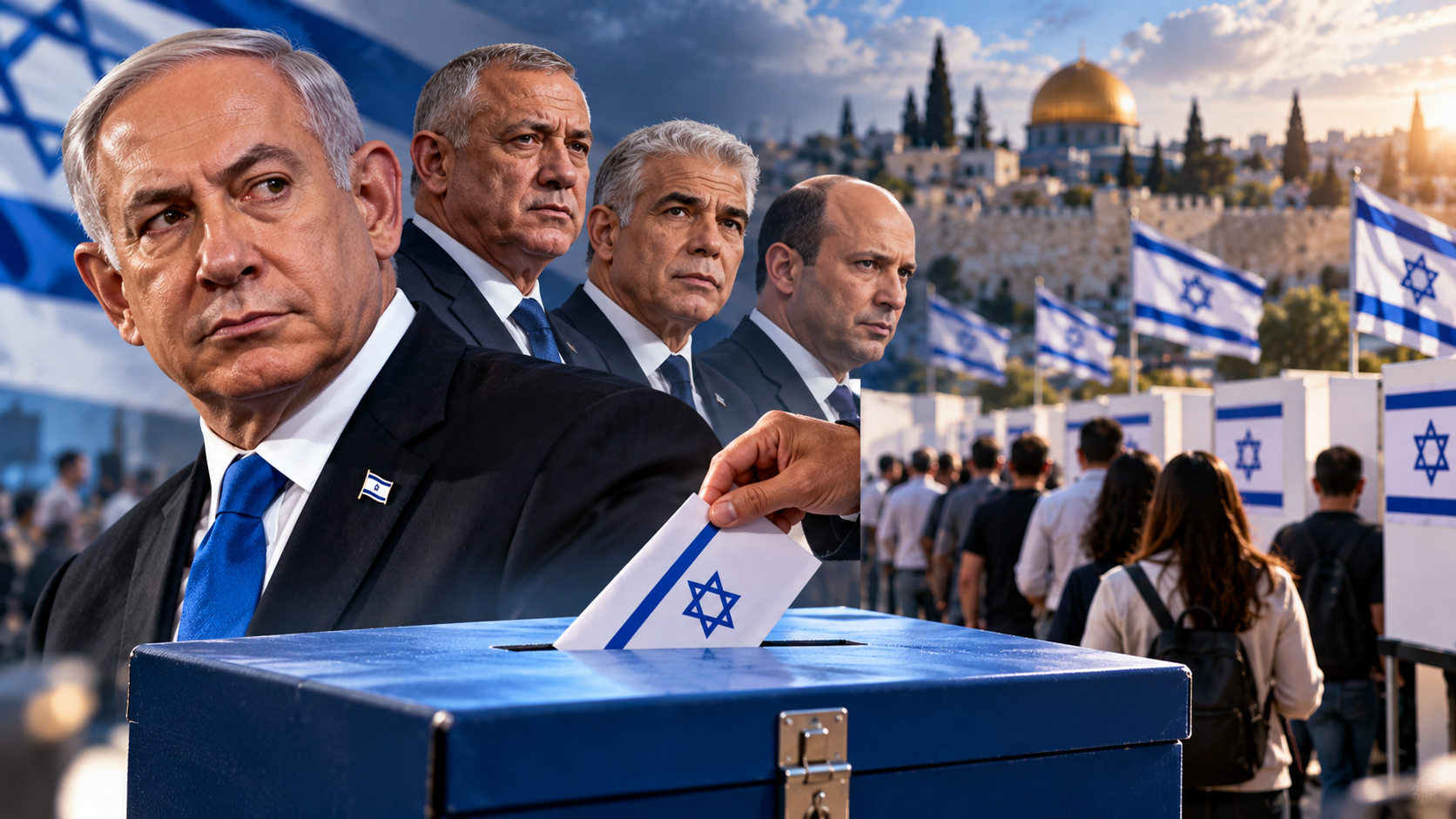
Final opinion polls point to a possible political deadlock, with neither Prime Minister Benjamin Netanyahu’s right-wing coalition nor the opposition projected to secure a majority in the 120-member Knesset. Security failures, the Gaza war, military service and the cost of living dominate the campaign.
Israel is heading into a closely contested parliamentary election on Tuesday, October 27, 2026, with Prime Minister Benjamin Netanyahu facing a significant challenge from opposition leaders seeking to end his long-running political dominance. The election comes at a critical moment for the country, with national security, the consequences of the Gaza war, domestic political divisions and economic pressures shaping voter sentiment.
Final opinion polls suggest that neither Netanyahu’s governing coalition nor the opposition bloc is likely to win the 61 seats required to command a majority in the 120-member Knesset, Israel’s parliament. The projected outcome raises the possibility of difficult coalition negotiations, a prolonged political impasse or an attempt to form a broader government.
The contest is also being viewed as a referendum on Netanyahu’s leadership following the October 7, 2023, Hamas-led attack and the military campaign that followed. Questions about intelligence and security failures, the handling of the conflict and the government’s domestic policies have become central to the campaign.
Opinion Polls Point to a Hung Parliament
The final opinion polls published ahead of voting indicate that opposition parties could collectively secure more seats than Netanyahu’s coalition. However, the numbers suggest that the opposition may still struggle to assemble a stable governing majority.
A Channel 13 poll projected approximately 54 seats for the opposition or change bloc, compared with 50 for Netanyahu’s coalition and 16 for Arab-led parties. A Channel 12 poll put the opposition bloc at 56 seats, Netanyahu’s coalition at 50 and Arab-led parties at 14.
These projections indicate that smaller parties could play a decisive role in determining the next government. The actual outcome will depend on voter turnout, the performance of individual parties and the final distribution of parliamentary seats.
Israel follows a proportional representation system in which voters cast ballots for party lists rather than directly electing the prime minister. Parties must generally receive at least 3.25% of the national vote to qualify for representation in the Knesset.
Consequently, winning the largest number of seats does not automatically guarantee the right to govern. The prime minister must be able to secure sufficient parliamentary support, usually through negotiations among several parties.
Netanyahu Faces a Challenge From Gadi Eisenkot
Netanyahu’s Likud party faces a major challenge from Gadi Eisenkot, a former military chief whose Yashar party has emerged as a significant contender in the final opinion polls.
Eisenkot has sought to attract voters dissatisfied with the government’s handling of national security and the failures preceding the October 7 attack. His campaign has emphasised accountability, military-service obligations and domestic issues, including education and the rising cost of living.
His background in the military gives him a prominent position in debates over security and defence policy. The election is taking place amid continued public scrutiny of the decisions made before and after the October 7 attack, making questions of responsibility particularly important.
For Netanyahu, the challenge is to convince voters that his leadership and security policies remain necessary despite criticism over the handling of the conflict and the country’s wider political divisions.
The final result will show whether the electorate prefers continuity under Netanyahu or a change in leadership, although the composition of the next government may ultimately depend on post-election negotiations.
Naftali Bennett and Yair Lapid Strengthen the Opposition
Former prime minister Naftali Bennett is another important figure in the opposition campaign. He is contesting the election in an alliance with Yair Lapid, another former prime minister and a leading opposition politician.
The alliance seeks to consolidate support among voters who want a change of government. Cooperation between opposition parties could improve their collective chances of assembling a parliamentary majority, but differences over security policy, religious issues and coalition arrangements could complicate negotiations.
Even if opposition parties collectively outperform Netanyahu’s bloc, they will need to agree on a common political programme and identify a leader capable of commanding sufficient support in parliament.
The challenge is particularly significant because Israel’s political system often requires several parties to cooperate in government. Ideological differences that can be managed during an election campaign may become more difficult to resolve when parties must negotiate ministerial positions, budgets and policy priorities.
Netanyahu Relies on Right-Wing and Religious Parties
Netanyahu’s coalition-building strategy depends on support from right-wing and religious parties, including Shas, United Torah Judaism, Religious Zionism and Otzma Yehudit, led by far-right politician Itamar Ben-Gvir.
These parties have played important roles in Netanyahu’s political alliances and could remain influential if his bloc secures enough seats to negotiate a new government.
Their priorities include religious affairs, national security, military policy and the status of ultra-Orthodox communities. However, disagreements over military service, public spending and the future direction of the Gaza conflict could complicate coalition discussions.
A narrow parliamentary majority would leave the government vulnerable to internal disputes. In Israel’s coalition-based system, even a small party can exercise considerable influence when its support is essential to keeping a government in office.
The final seat distribution will therefore be important not only for determining which bloc leads the negotiations but also for understanding how much influence smaller coalition partners may have over government policy.
October 7 Security Failures Remain Central to the Campaign
The October 7, 2023, attack and Israel’s subsequent military operations remain among the most consequential issues in the election.
Critics of Netanyahu have demanded accountability for the security and intelligence failures that allowed the attack to occur. They have also questioned the government’s decisions during the conflict and its approach to the hostage issue.
For many voters, the election represents an opportunity to express their views on the government’s responsibility for the security breakdown and the direction of Israel’s military response.
Netanyahu and his allies, meanwhile, must make the case for their approach to national security and the continuing challenges facing the country.
The election outcome could influence the direction of future investigations, the political accountability debate and the government’s priorities regarding military preparedness. However, the extent of any policy changes will depend on the composition of the next coalition and the agreements reached among its members.
Gaza, Hostages and Regional Security
The future of Gaza is expected to remain a major issue for the next government. Decisions concerning military operations, security arrangements, humanitarian conditions and relations with Palestinians will have implications for both Israel’s domestic politics and its international relationships.
The hostage issue has also been central to public debate, with disagreements over the government’s strategy and the balance between military objectives and negotiations.
Beyond Gaza, Israel faces a complex regional security environment. The next administration will have to assess threats, manage relations with regional powers and navigate diplomatic efforts that could affect the country’s long-term security.
These decisions will also influence Israel’s relationships with the United States and other international partners. Differences over military strategy, humanitarian concerns and the prospects for a political settlement could create challenges for diplomatic coordination.
A change of government could lead to adjustments in priorities or negotiating approaches, although major policy shifts would depend on the new coalition’s composition and the security situation at the time.
Military Service Exemptions Create Domestic Tensions
The question of compulsory military service has emerged as another major point of disagreement.
Many ultra-Orthodox men have historically received exemptions or deferments from military service under arrangements that have become increasingly controversial. The debate has intensified following prolonged military mobilisation, with critics arguing that the burden of service should be distributed more equally across society.
The issue has political significance because ultra-Orthodox parties are important potential partners in Netanyahu’s coalition. Any attempt to change existing arrangements could create friction between religious parties, secular voters and other political groups.
For families whose members have spent extended periods in military service, the question of fairness has become closely linked to the wider debate over national responsibility.
The next government will have to address competing demands involving military manpower, religious autonomy and equal obligations. Failure to reach an acceptable compromise could become a source of instability within a coalition.
Cost of Living and Education Add to Voter Concerns
Although security dominates the campaign, domestic economic issues are also influencing voter priorities.
The cost of living, housing affordability, education and pressure on household finances have become important considerations for voters evaluating the government’s record.
The economic consequences of prolonged conflict can extend across several areas, including public expenditure, business confidence, labour availability and government borrowing requirements. Defence spending and emergency requirements can also place pressure on budget priorities.
For households, the effects may be felt through prices, employment conditions and the availability of public services. The extent of these pressures varies across income groups and industries, making economic management an important challenge for whichever coalition takes office.
A new government could face difficult decisions over defence allocations, social spending, education and measures intended to support economic activity.
The election result may therefore influence not only Israel’s security policy but also the balance between military expenditure and domestic economic priorities.
Arab-Led Parties Could Hold the Balance of Power
Arab-led parties may become crucial to government formation if neither of the main political blocs secures a majority.
The final polls cited in the report projected a combined 14 to 16 seats for Arab-led parties. Their actual representation will depend on the final vote count and turnout among eligible voters.
Ra’am, led by Mansour Abbas, previously participated in a governing coalition, demonstrating that an Arab-led party can play a role in parliamentary negotiations. However, the possibility of relying on Arab-led parties remains politically contentious among sections of the Israeli opposition.
Some opposition leaders may be willing to seek parliamentary support from these parties to replace Netanyahu, while others may face political or ideological constraints.
Arab-led parties may also have their own priorities concerning public services, economic development, community safety and the treatment of Arab citizens. Their negotiating position would depend on the election outcome and whether their participation or external support proves necessary to establish a functioning government.
If neither major bloc can form a viable coalition without them, their decisions could become decisive.
Three Possible Outcomes After the Election
The election could produce several political scenarios.
1. Netanyahu retains power: If his coalition wins enough seats or secures support from additional parties, Netanyahu could remain prime minister. However, a narrow majority could expose the government to internal disagreements.
2. The opposition forms a government: Opposition parties could attempt to negotiate a coalition under a new leadership arrangement. Their success would depend on reaching agreement across political differences and securing enough parliamentary support.
3. Prolonged negotiations or a broader arrangement: If neither side can assemble a stable majority, coalition talks could become lengthy. A broader unity arrangement involving parties from different camps may be considered, although substantial disagreements could make such an agreement difficult.
The final distribution of seats will determine which scenario is most feasible. Until the results are confirmed and coalition negotiations progress, opinion polls should be treated as estimates rather than definitive predictions.
What the Election Means for Israel’s Future
The 2026 election is a critical test of public confidence in Netanyahu and the direction of Israeli politics after years of conflict and domestic division.
A decisive result could give the next government a clearer mandate to address security, military-service obligations and economic concerns. A fragmented parliament, by contrast, could prolong political uncertainty and limit the ability of the government to implement major reforms.
The election will also shape the political environment in which decisions on Gaza, regional diplomacy, defence expenditure and relations with international partners are made.
For Israel’s citizens, the stakes extend beyond the identity of the next prime minister. The outcome could influence how the country addresses accountability for the October 7 attack, distributes military obligations, manages household economic pressures and defines its long-term security priorities.
Market Outlook
Israel’s election could influence financial markets through changes in political stability, defence expenditure, fiscal priorities and regional geopolitical risk. However, the direct market reaction will depend on the final result, the speed of coalition formation and whether the next government signals continuity or a substantial shift in policy.
A prolonged political deadlock could add uncertainty to business and investment decisions, particularly if coalition negotiations delay important budgetary or economic measures. A stable government with a clear parliamentary majority could improve policy visibility, although it would not eliminate the risks associated with regional security developments.
Investors will also be watching the implications for the Israeli currency, government bond yields, equity-market sentiment and defence-related industries. Any sustained movement in these assets will depend on broader economic conditions and the government’s actual policy decisions rather than the election result alone.
The immediate focus remains on voter turnout, the final seat count and the ability of political leaders to assemble a viable coalition. Until those factors become clear, the prospect of a hung parliament is likely to keep political uncertainty elevated.