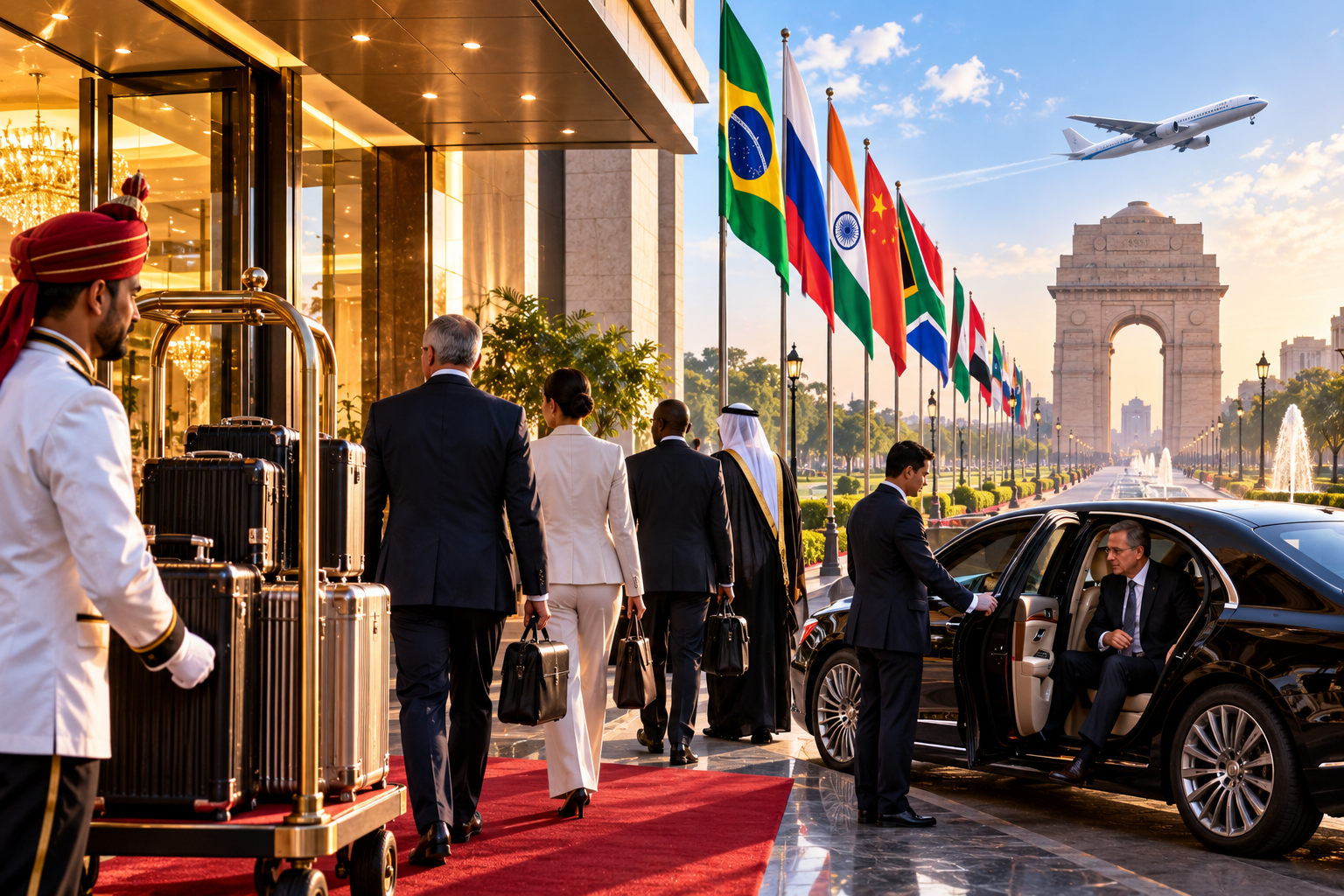
The upcoming BRICS Leaders’ Summit is driving a sharp surge in luxury hotel demand in the capital, with room rates touching ₹1 lakh–₹2.5 lakh a night and exposing Delhi’s shortage of quality mid-segment accommodation
BRICS Summit Drives Hotel Demand
Delhi's luxury hotel market is witnessing an extraordinary spike in demand ahead of the BRICS Leaders’ Summit scheduled for September 12–13, with premium room rates climbing to levels rarely seen in the capital's hospitality market.
Hotel room rentals are reportedly reaching between ₹1 lakh and ₹2.5 lakh per night, reflecting a combination of strong international demand and limited availability of high-end accommodation.
The BRICS Summit is the latest major global event to expose the gap between Delhi's growing ability to host international gatherings and the availability of hotel rooms across different price categories.
Luxury Inventory Remains Limited
Industry specialists point to a structural shortage of luxury hotel inventory as the primary reason behind the steep rise in room rates.
Delhi had approximately 21,000 branded hotel rooms as of 2025, significantly below established international hospitality markets.
For comparison, Bangkok has more than 69,700 branded rooms, giving the Southeast Asian tourism hub a much larger capacity to absorb international events and sudden demand spikes.
The relatively limited room inventory in Delhi means that even a major international summit can quickly absorb available premium accommodation.
Global Events Are Increasing Hotel Demand
The BRICS Summit follows the AI Summit held in February, another major international gathering that placed considerable pressure on Delhi's hotel capacity.
The capital has increasingly emerged as a venue for global conventions, diplomatic meetings, business events and international summits.
The G20 Summit and other high-profile international gatherings have similarly highlighted Delhi's growing importance as a global events destination.
Improved airports, roads, convention facilities and urban infrastructure have strengthened the city's ability to attract international visitors. However, hotel supply has not expanded at the same pace.
Missing Mid-Segment Creates Another Challenge
The problem is not limited to luxury hotels.
Industry experts have also highlighted the shortage of mid-segment branded accommodation, creating a gap between expensive luxury properties and more budget-oriented hotels.
This becomes particularly important during large international events, when demand comes from multiple categories of visitors, including government delegations, business executives, media professionals, support staff and international participants.
When premium hotels sell out, demand can spill over into lower-priced properties, pushing up rates across the wider market.
Why Room Rates Can Rise So Sharply
Hotel rooms are perishable inventory. A room that remains unsold tonight cannot be sold tomorrow for the same night.
As a result, hotels typically use dynamic pricing to adjust rates according to demand, availability and booking patterns.
During major international events, demand can rise sharply within a short period. With only a limited number of rooms available, hotels can command significantly higher prices.
The concentration of diplomatic delegations and corporate visitors in premium properties can further reduce the number of rooms available to ordinary travellers.
Delhi’s Hospitality Sector Gains Pricing Power
From the industry's perspective, the current surge demonstrates the pricing power that hotels can exercise when demand exceeds available supply.
Higher room rates can increase revenue per available room and improve profitability for hotel operators during peak periods.
However, the sustainability of such pricing power depends on the frequency of major events and the broader growth in business and leisure travel.
A city cannot rely solely on summits to maintain high occupancy and room rates. Long-term growth requires a wider base of corporate travel, tourism, exhibitions, conventions and international visitors.
Infrastructure Improving, Hotel Supply Lagging
Delhi and other major Indian cities have invested heavily in transport and urban infrastructure.
Better airports, highways, metro connectivity and convention facilities have made India increasingly attractive for international events.
However, the development of hotel inventory has not kept pace with the expansion of event infrastructure.
This mismatch can create a situation in which the city has the physical capacity to host large international gatherings but lacks sufficient accommodation to comfortably absorb the associated visitor demand.
Opportunity for Hotel Developers
The shortage presents a potentially attractive opportunity for hotel developers and hospitality companies.
Additional branded rooms, particularly in the mid-market and upscale segments, could help address demand from corporate travellers and international event participants who may not require ultra-luxury accommodation.
Developments around airports, convention centres, major business districts and transport hubs could be particularly well positioned.
The opportunity extends beyond Delhi, as other Indian cities hosting global conferences and sporting events could face similar supply constraints.
Wider Economic Benefits
Major international summits can generate economic activity well beyond hotel revenues.
Visitors spend on restaurants, transportation, retail, entertainment, event management, security, aviation and other services.
International delegates and business travellers can also create longer-term economic relationships, potentially encouraging future conferences, investments and tourism.
For Delhi, therefore, the hospitality shortage represents both a constraint and an opportunity.
Hospitality Investment Could Accelerate
The recurring pressure on hotel capacity during major events could encourage developers and investors to increase investments in India's hospitality sector.
Growing domestic travel, rising disposable incomes, expanding business tourism and India's increasing role in international diplomacy and trade could provide structural support for hotel demand.
However, developers will need to carefully assess the location, segment and pricing strategy of new properties. Simply adding more luxury rooms may not fully address the market's needs.
Focus Shifts to the Mid-Market
The biggest opportunity highlighted by the latest demand surge could be the missing middle of Delhi's hotel market.
A larger supply of professionally managed, branded mid-scale and upscale hotels could provide accommodation for visitors who are priced out of luxury properties but want more reliability and service quality than budget accommodation offers.
Such properties could also provide greater resilience outside major summit periods by catering to corporate travellers, domestic tourists and regular business demand.
Market Outlook
Delhi's latest hotel-room crunch highlights a broader structural issue in India's hospitality sector: demand generated by global events is growing faster than quality hotel supply.
The BRICS Summit has pushed luxury room rates to extraordinary levels, but the underlying opportunity extends beyond a single event. With Delhi increasingly hosting international summits, conventions and business gatherings, additional hotel capacity could become an important component of the city's global infrastructure.
For hospitality companies and investors, the strongest opportunity may lie not only in luxury hotels but also in expanding the mid-market and upscale branded room supply.
The current surge in room rates is therefore both a short-term windfall for existing hotel operators and a signal of the longer-term investment opportunity created by India's expanding international events and tourism economy.