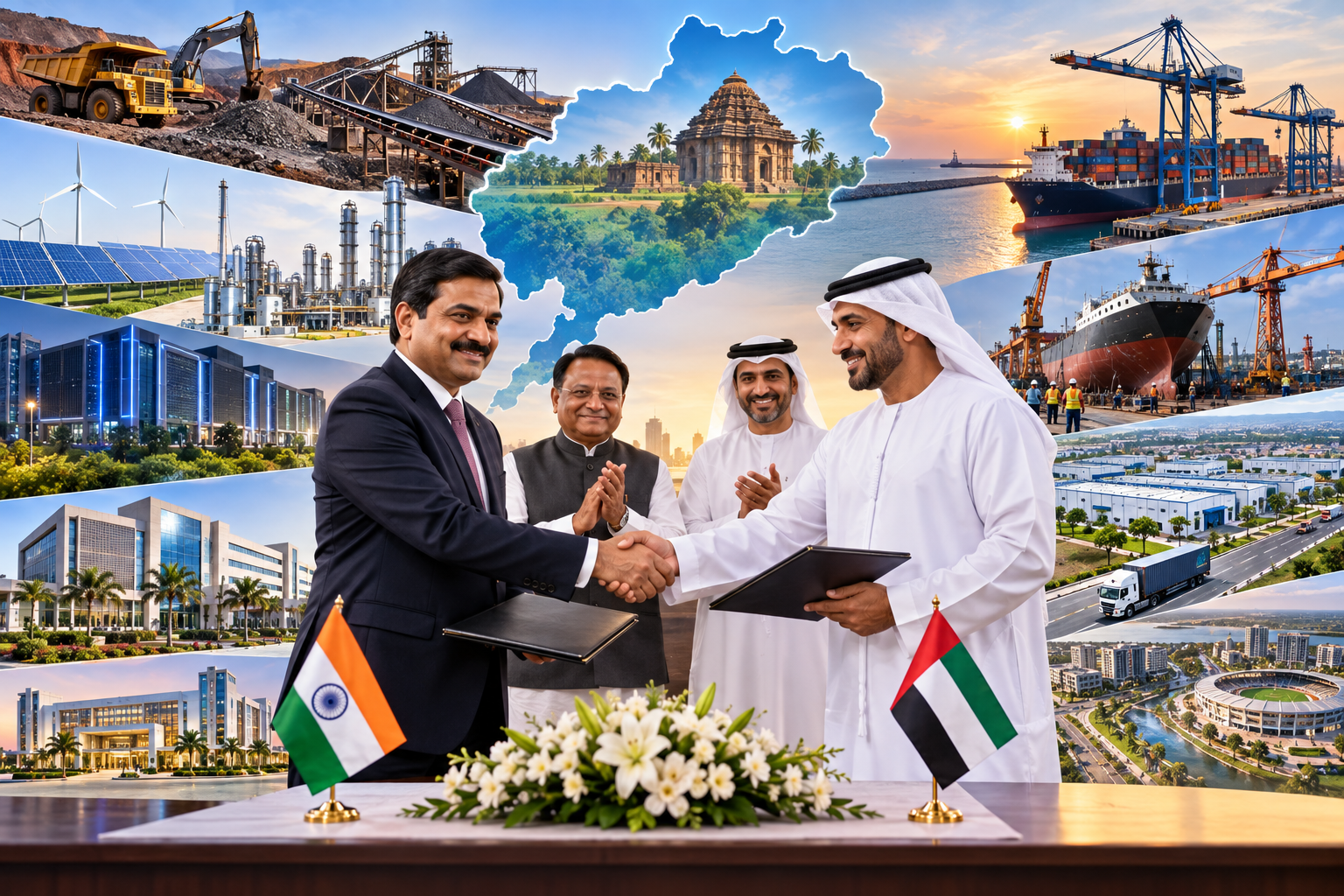
Fourteen proposed projects across AI data centres, critical minerals, green shipbuilding, petrochemicals, renewable energy and industrial infrastructure are expected to create nearly 1.9 lakh direct jobs in Odisha
Odisha Unveils Major UAE Investment Push
Odisha has secured a major investment pipeline during its overseas investor outreach, with the Adani Group and Abu Dhabi-based International Holding Company (IHC) signing agreements with the state government to explore projects worth an estimated ₹2,10,500 crore.
The 14 proposed projects span sectors ranging from mining and metals to artificial intelligence, renewable energy, shipbuilding, healthcare and sustainable urban development.
The proposed investments are expected to generate around 189,700 direct or on-site jobs, in addition to approximately 4.02 lakh indirect jobs and 2.77 lakh construction-related jobs, according to officials.
However, the state government clarified that the investment figures are indicative at this stage and will depend on feasibility studies, due diligence, statutory approvals and definitive agreements.
₹50,000 Crore AI Data Centre Hub Leads Investment Pipeline
The largest proposal is a ₹50,000 crore hyperscale AI data centre hub at Naraj.
The project reflects the growing demand for data-centre infrastructure as artificial intelligence, cloud computing and digital services expand rapidly.
A large-scale AI data-centre ecosystem could also generate demand for power, cooling systems, connectivity, construction, engineering and other supporting services, potentially creating a broader technology and infrastructure cluster around the investment.
₹40,000 Crore Coal-to-Chemicals Complex
The second-largest proposal is a ₹40,000 crore coal-to-chemicals complex at Bedabahal.
The project is expected to add value to Odisha's industrial and mineral resources while supporting downstream manufacturing capabilities.
Coal-to-chemicals technology can be used to convert coal into chemical feedstocks and other industrial products, potentially creating linkages with the state's existing mining and manufacturing ecosystem.
Large-Scale Iron Ore and Renewable Energy Projects
Two projects involving ₹25,000 crore each have also been proposed.
The first is a 60 million tonne per annum iron-ore beneficiation, slurry and pellet chain. The project could strengthen Odisha's position as a major minerals and metals manufacturing hub while increasing value addition closer to the source of raw materials.
The second is a renewable energy storage and equipment-manufacturing platform, aimed at supporting the expansion of clean-energy infrastructure and associated manufacturing capabilities.
With India's energy transition requiring substantial investment in storage and renewable equipment, the project could create opportunities across the clean-energy supply chain.
₹20,000 Crore Shipbuilding and Green Ship Recycling Cluster
A proposed ₹20,000 crore shipbuilding, ship repair and green ship recycling cluster is another significant component of the investment plan.
The project could add a new maritime manufacturing and services dimension to Odisha's port-led industrialisation strategy.
The proposed cluster is expected to benefit from the state's coastline and existing port infrastructure, while green ship recycling could create a more environmentally focused ecosystem for end-of-life vessels.
The development could also generate demand for engineering, fabrication, logistics, marine services and skilled manpower.
₹15,000 Crore Sustainable City and Wellness Project
An additional ₹15,000 crore integrated sports, wellness and sustainable city has been proposed, with an estimated 75,000 direct jobs.
The project is expected to combine urban development with sports, wellness and related infrastructure, potentially creating a new economic and services hub.
If implemented, such a development could generate demand across construction, hospitality, healthcare, tourism, retail and other service sectors.
Paradip to Get Petrochemical and Packaging Park
At Paradip, the proposed Adani-IHC joint venture plans to establish a ₹10,000 crore petrochemical downstream and packaging park.
The project is aimed at strengthening downstream industrialisation around Odisha's existing port and petrochemical infrastructure.
Developing downstream manufacturing capabilities could help the state move beyond the extraction and primary processing of raw materials towards higher-value industrial products.
Paradip's port connectivity could also support movement of raw materials and finished products to domestic and international markets.
UAE-Focused Industrial and Food Processing Projects
The investment package also includes a proposed ₹5,000 crore Adani-UAE Industrial Park and SEZ at Dhamra.
The project is intended to deepen industrial and commercial links between Odisha and the UAE while providing a platform for companies targeting Gulf markets.
A separate ₹5,500 crore UAE-focused integrated food and agro-processing park has also been proposed.
The facility could help Odisha's agricultural and processed-food products access overseas markets, particularly in the Gulf region. Areas identified for potential trade expansion include turmeric, ginger, seafood and processed food products.
Rare Earths and Critical Minerals in Focus
A proposed ₹5,000 crore Odisha Rare Earth Corridor and Critical Minerals Park is aimed at developing activities around strategically important minerals.
Critical minerals have become increasingly important globally because they are used in sectors such as electric vehicles, renewable energy, electronics, batteries and advanced manufacturing.
Building processing and value-added capabilities in this area could strengthen Odisha's role in India's efforts to develop domestic critical-mineral supply chains.
Ports to Support Mineral Trading
The investment proposals also include ₹5,000 crore of iron ore and coal trading operations through Dhamra and Gopalpur ports.
The proposed activity would complement Odisha's existing mineral resources and port infrastructure.
Greater utilisation of these ports could strengthen logistics connectivity and support the movement of minerals and industrial commodities to domestic and international markets.
Healthcare, Containers and Skill Development
The proposed investment portfolio extends beyond heavy industry.
The Adani-IHC partnership has proposed a ₹2,000 crore healthcare facility, along with a ₹1,500 crore container manufacturing facility at Gopalpur port.
Another ₹1,500 crore workforce development and skilling network has been proposed by IHC and Adani.
The skilling initiative could help address the requirement for trained manpower generated by large industrial and infrastructure projects while improving employment opportunities for local communities.
Employment Potential Could Be Significant
According to state officials, the proposed projects could create approximately:
-
1.90 lakh direct/on-site jobs
-
4.02 lakh indirect jobs
-
2.77 lakh construction jobs
The employment potential could be particularly important for Odisha as the state seeks to attract investment into manufacturing, technology, infrastructure and emerging industries.
However, the actual number of jobs will depend on project execution, scale and timelines.
Adani Group Highlights Odisha’s Manufacturing Potential
Karan Adani, managing director of Adani Ports and Special Economic Zone and director of Adani Cement, said the proposed projects reflect confidence in Odisha as a long-term manufacturing destination.
The partnership is expected to focus on creating an integrated industrial ecosystem, including value-added manufacturing, mineral processing and supporting infrastructure.
The state's existing ports, mineral resources, industrial base and connectivity provide a foundation for several of the proposed projects.
Odisha Targets Stronger UAE Economic Ties
Chief Minister Mohan Charan Majhi, who is leading the state's three-day UAE investor outreach, highlighted Odisha's natural resources, industrial capabilities, strategic location and infrastructure ecosystem.
The state is seeking investment particularly in critical minerals, metallurgy, port-led development and emerging industrial sectors.
The outreach also included interaction with the Indian Business and Professional Group (IBPG), aimed at strengthening trade, exports and business relationships between Odisha and the UAE.
Focus on Exports to Gulf Markets
Odisha and IBPG also signed a Memorandum of Cooperation to promote bilateral trade and explore investment opportunities.
The discussions included increasing exports of agricultural and marine products such as turmeric, ginger, seafood and processed foods.
The state also explored opportunities for contract manufacturing for UAE-based brands, which could potentially create additional avenues for Odisha-based manufacturers to participate in international supply chains.
Investment Commitments Still Subject to Approvals
Despite the headline investment figure of ₹2.1 trillion, the proposed projects should not be interpreted as immediately committed capital expenditure.
Officials have made it clear that the investment estimates remain subject to feasibility assessments, due diligence, statutory approvals and definitive agreements.
The eventual economic impact will therefore depend on how quickly individual projects move from MoUs to financial closure, construction and commercial operations.
Odisha’s Industrial Ambitions Get a Major Boost
The proposed Adani-IHC investment pipeline represents a broad diversification of Odisha's industrial strategy.
While mining and metals remain important, the proposals extend into AI infrastructure, renewable energy, shipbuilding, critical minerals, petrochemicals, food processing, healthcare and sustainable urban development.
If successfully executed, the projects could strengthen Odisha's position as a major destination for both resource-based and technology-driven industries, while deepening the state's economic relationship with the UAE.
For the state, the key challenge now will be converting the large investment pipeline into ground-level projects, productive capacity and sustainable employment.