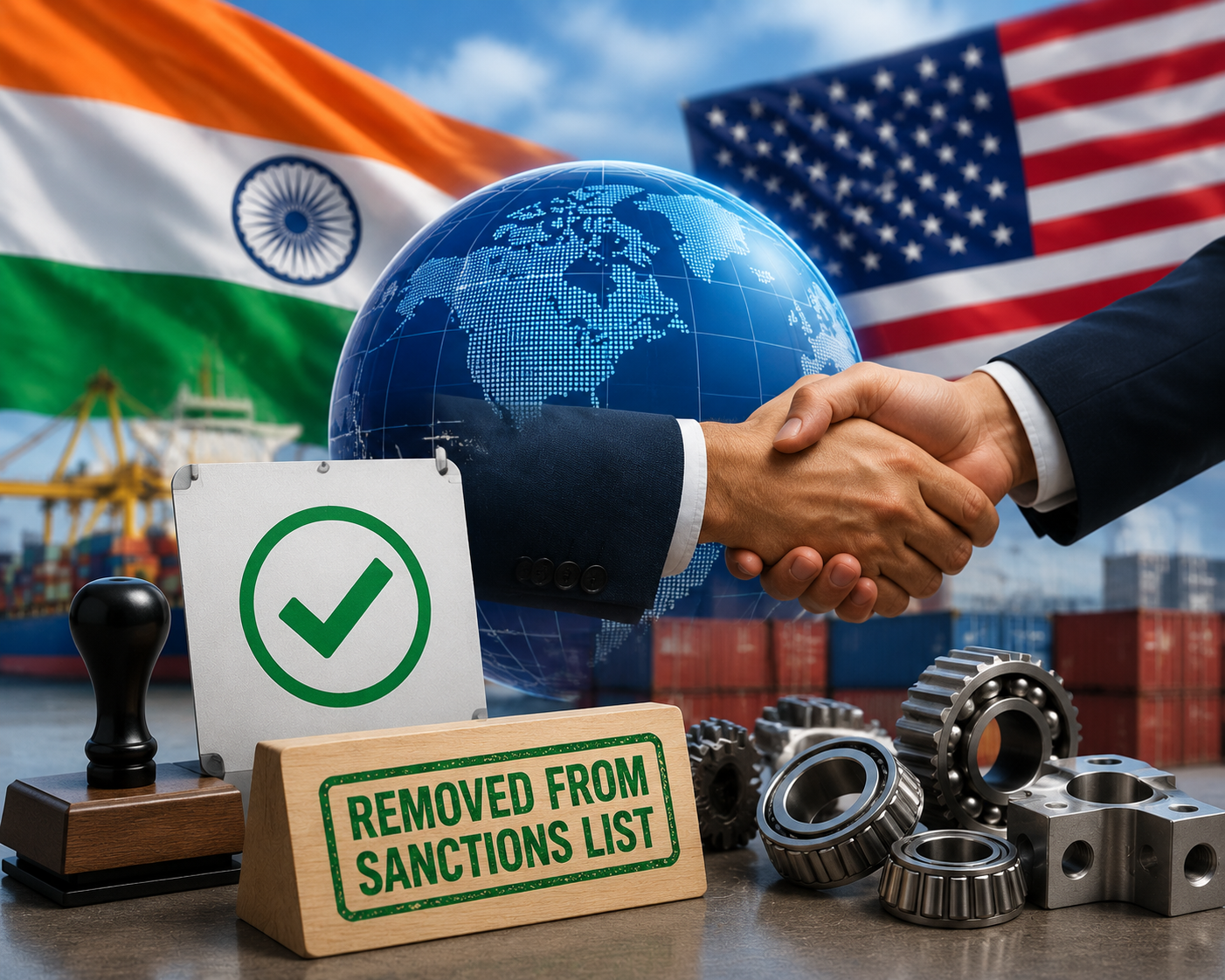
OFAC De-Lists Hyderabad, Ahmedabad and Delhi-Based Firms; Move Expected to Ease International Trade, Banking and Compliance Challenges
In a significant development for Indian businesses with international operations, the United States has removed four Indian companies from its Russia-related sanctions list, marking a positive step in India-US commercial relations. The decision, announced by the US Department of the Treasury's Office of Foreign Assets Control (OFAC), is expected to ease cross-border business operations and reduce compliance hurdles for the affected firms.
The companies have been removed from the Specially Designated Nationals and Blocked Persons (SDN) List, effectively lifting restrictions that had limited their ability to transact through the US financial system and engage with international business partners.
The move is being viewed as a welcome relief for India's engineering and manufacturing sector, particularly at a time when the country is positioning itself as a global manufacturing hub.
Four Indian Companies Receive Sanctions Relief
The companies removed from the sanctions list include:
- RRG Engineering Technologies Private Limited – Hyderabad
- Lokesh Machines Limited – Hyderabad
- Galaxy Bearings – Ahmedabad
- Shaurya Aeronautics Private Limited – New Delhi
These companies had previously been designated under US sanctions over allegations that they supplied advanced technology, industrial equipment, or engineering components linked to Russia's military-industrial ecosystem.
With their removal from the SDN List, they are no longer subject to the sanctions imposed under the earlier designation.
What Removal from the SDN List Means
The SDN List is one of the US government's primary sanctions tools, administered by the Office of Foreign Assets Control.
Entities included on the list typically face several restrictions, including:
- Limited access to the US financial system
- Restrictions on transactions involving US persons and institutions
- Asset blocking under US jurisdiction
- Increased scrutiny from global banks and financial institutions
- Challenges in international trade, financing and cross-border payments
Being removed from the list significantly reduces these operational barriers and allows companies to conduct business more freely, subject to applicable international regulations.
Background of the Sanctions
The four Indian companies were included in broader US sanctions targeting organisations allegedly connected to Russia's defence and industrial supply chains.
Following the escalation of geopolitical tensions involving Russia, the United States expanded sanctions against entities across multiple countries that were suspected of supplying machinery, industrial components, aerospace equipment, electronics, and advanced technologies that could support Russia's defence capabilities.
The inclusion of Indian firms had attracted attention because India has maintained trade relations with multiple global partners while pursuing an independent foreign policy.
Positive Signal for India-US Economic Engagement
The decision is widely seen as a constructive development in the evolving economic relationship between India and the United States.
The removal of these companies from the sanctions framework could improve confidence among overseas customers, international suppliers, financial institutions and multinational corporations that conduct business with Indian engineering firms.
It also demonstrates that sanctions are periodically reviewed and that entities may be removed when regulatory assessments determine that continued designation is no longer warranted.
Potential Benefits for the Companies
The de-listing is expected to provide several operational and financial advantages, including:
- Easier access to international banking and payment networks
- Reduced compliance costs associated with sanctions screening
- Improved export opportunities
- Greater confidence among global customers and suppliers
- Enhanced ability to participate in international supply chains
- Better access to overseas technology partnerships
For companies operating in engineering, precision manufacturing and aerospace-related industries, smoother international transactions can significantly improve business efficiency.
Support for India's Manufacturing Ambitions
The affected companies operate in sectors that are strategically important for India's industrial development, including:
- Precision engineering
- Machine tools
- Industrial bearings
- Aerospace components
- Advanced manufacturing
India has been actively promoting domestic manufacturing through initiatives such as Make in India, Production Linked Incentive (PLI) schemes, and export-focused industrial policies.
The easing of sanctions-related restrictions may help these companies expand their international presence and contribute to India's growing engineering exports.
Global Sanctions Landscape Continues to Evolve
Although the de-listing represents a positive development, the global sanctions environment remains dynamic.
Companies involved in international trade continue to face increasing regulatory requirements relating to export controls, anti-money laundering regulations, sanctions compliance and supply-chain due diligence.
Industry experts believe businesses must continue strengthening compliance frameworks to minimise legal and operational risks while expanding into overseas markets.
Limited Immediate Market Impact, Positive Long-Term Outlook
While the announcement is unlikely to have a significant immediate impact on India's broader equity markets, it removes an important regulatory overhang for the affected companies.
For listed entities such as Lokesh Machines, the development may improve investor sentiment by reducing uncertainty surrounding international operations and overseas business opportunities.
Over the longer term, smoother access to global financial systems and international markets could support revenue growth, improve business partnerships and strengthen export competitiveness.
Investor Outlook
The US decision to remove four Indian companies from the Russia-related sanctions list reflects the evolving nature of international regulatory frameworks and highlights the importance of continuous compliance and diplomatic engagement.
For investors, the development is a positive indicator for companies engaged in export-oriented engineering and manufacturing businesses. As India continues to strengthen its position in global supply chains, regulatory clarity and improved international market access are expected to play an increasingly important role in supporting long-term business growth.
Going forward, market participants will monitor whether the affected companies announce new international contracts, technology collaborations or export expansion plans following the lifting of sanctions-related restrictions.