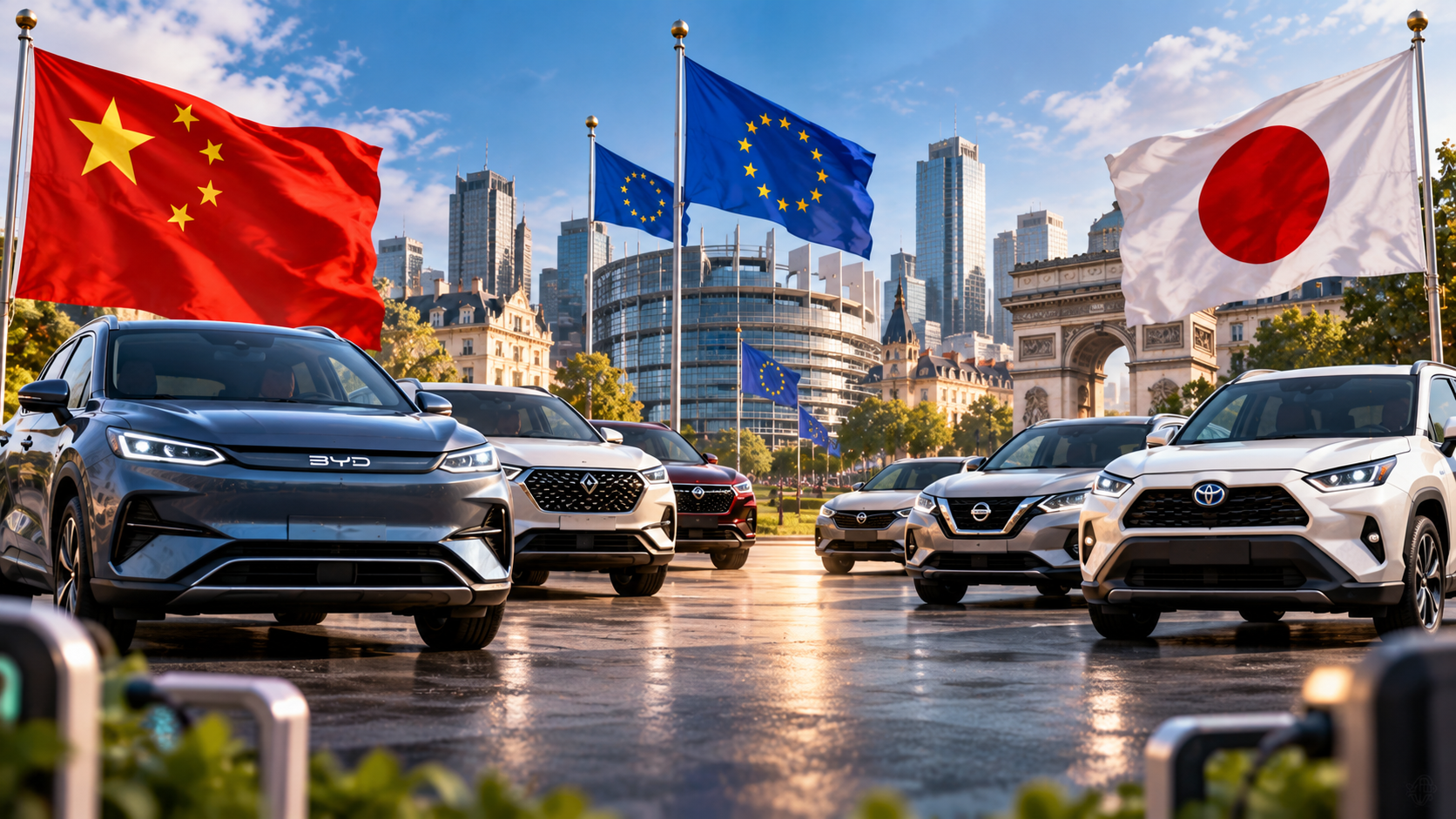
Chinese Automakers Make a Historic Breakthrough in Europe
Chinese carmakers have overtaken their Japanese counterparts in Europe for the first time over a full quarter, marking a significant shift in the region’s competitive automotive landscape.
According to market researcher Dataforce, registrations of Chinese-branded vehicles roughly doubled year-on-year in September 2026, lifting their share of total regional sales to 12.7%. Japanese manufacturers, including Toyota Motor Corporation, accounted for 11.9% during the same period.
The milestone reflects the rapid expansion of Chinese brands such as BYD, Chery and other emerging manufacturers, which have increased their presence through competitive pricing, frequent model launches and a growing range of hybrid and electric vehicles.
While established European manufacturers such as Volkswagen and Renault continue to command significant market positions, the speed at which Chinese brands have gained ground has surprised industry participants.
Five years ago, Chinese-branded vehicles accounted for barely 1% of European car sales. Their latest market share demonstrates how quickly the competitive balance is changing in a region where Japanese manufacturers spent decades building their reputations and distribution networks.
BYD, Chery and Other Brands Drive the Expansion
Chinese automakers are increasingly targeting European consumers with vehicles that combine modern technology, attractive equipment levels and competitive pricing.
BYD has expanded its international ambitions by offering electric vehicles and plug-in hybrids across several price segments. The company's growing product portfolio has helped it establish a stronger presence in markets where consumers are evaluating alternatives to traditional petrol and diesel vehicles.
Chery has also gained visibility through its expanding range of SUVs and associated brands. Its Jaecoo 7 has demonstrated the appeal of Chinese-made vehicles in the United Kingdom, where the model was reported to be the country's best-selling vehicle in March and September.
Other manufacturers, including Geely's premium electric-vehicle brand Zeekr and Zhejiang Leapmotor Technology, are adding to the competitive pressure by introducing new products and exploring partnerships with established automotive groups.
The growing variety of vehicles is giving European consumers more choices across conventional hybrids, plug-in hybrids and fully electric models.
Hybrid Vehicles Become a Key Growth Driver
One of the most important factors behind the latest increase in Chinese vehicle registrations is the growing popularity of hybrid models.
Although fully electric vehicles remain central to China's automotive ambitions, hybrids and plug-in hybrids can appeal to buyers who are not yet ready to rely entirely on charging infrastructure.
These vehicles can provide a transition between conventional combustion-engine cars and fully electric mobility. Plug-in hybrids combine an electric motor and battery with an internal-combustion engine, allowing some journeys to be completed using electric power while retaining the flexibility of conventional refuelling.
Higher fuel costs can also strengthen consumer interest in vehicles that offer the potential to reduce petrol consumption, although actual savings depend on driving patterns, charging access, vehicle efficiency and purchase prices.
Chinese manufacturers are using these technologies to broaden their appeal in Europe. At the Paris motor show earlier in October, companies including BYD, Chery and Zeekr presented new models aimed at European buyers.
BYD's Dolphin G DM-i, a compact plug-in hybrid developed for the European market, illustrates the industry's effort to tailor products to local consumer preferences.
The stronger performance of hybrids also highlights the importance of offering multiple powertrain options rather than relying exclusively on fully electric vehicles.
Why European Consumers Are Considering Chinese Cars
The rapid increase in Chinese brands' market share reflects several factors beyond pricing alone.
Competitive pricing: Chinese manufacturers have developed extensive supply chains and production capabilities, helping them offer vehicles at prices that can challenge established competitors. Lower purchase prices and attractive equipment packages can be particularly appealing to cost-conscious consumers.
Faster product development: Chinese automakers have demonstrated an ability to introduce and update models rapidly, allowing them to respond to changing consumer preferences and technological developments.
Technology and features: Infotainment systems, connected-car services, driver-assistance features and electrified powertrains are increasingly important in vehicle purchasing decisions. Chinese brands are competing aggressively in these areas.
Broader product portfolios: Expanding ranges of SUVs, compact cars, hybrids and electric vehicles enable manufacturers to target different customer groups.
International expansion: Slower growth and intensifying competition in China are encouraging manufacturers to seek additional markets. Europe offers a substantial customer base, established vehicle-financing systems and consumers increasingly interested in electrified mobility.
However, building a sustainable European business requires more than winning initial sales. Manufacturers must also establish dependable after-sales services, parts availability, dealer networks, resale values and customer confidence.
Japanese Carmakers Face a New Competitive Challenge
The rise of Chinese manufacturers is particularly notable because Japanese brands have long enjoyed a strong position in Europe.
Toyota has sold vehicles in the region since 1963 and operates manufacturing facilities across the continent. Nissan has also maintained a significant European manufacturing presence, including production at its Sunderland facility in the United Kingdom since 1986.
Japanese automakers built their reputations around reliability, manufacturing quality, fuel efficiency and extensive service networks. Their experience in hybrid technology has also helped them compete as consumers look for alternatives to conventional combustion engines.
However, the latest market-share figures indicate that historical brand strength may not be sufficient to protect market positions when new competitors combine attractive pricing with rapid product development.
Japanese manufacturers now face pressure to maintain competitive pricing, expand their electrified offerings and respond to consumer expectations around software and in-car technology.
The figures do not necessarily indicate that Japanese companies are losing their global competitive position. Rather, they highlight a changing balance within the European market, where competition is becoming more intense across powertrain technologies and price categories.
European Automakers Face Pressure on Multiple Fronts
The advance of Chinese brands comes at a challenging time for Europe's established automotive industry.
Manufacturers such as Volkswagen and BMW are dealing with intense competition, changing consumer preferences and the costs associated with developing electric vehicles and software-driven platforms.
They also face pressure in China, a major market where domestic manufacturers have gained ground by launching new models quickly and competing aggressively on price.
As demand shifts towards local brands in China, manufacturers such as BYD and Chery have stronger incentives to expand internationally. European markets provide an opportunity to diversify sales and use production capacity across a broader customer base.
This creates a two-sided challenge for European automakers: they must defend their domestic market while responding to competition in China and other international markets.
Established manufacturers also have to balance investment in electric vehicles, hybrids, battery technology, software and conventional models while managing costs and protecting profitability.
The competitive pressure could encourage faster innovation and more attractive products for consumers, but it may also compress margins and increase the financial burden of product development.
European Union Considers Stronger Trade and Industrial Measures
The rapid expansion of Chinese vehicle imports has prompted European policymakers to consider measures intended to protect the region's automotive manufacturing base.
The European Union has already imposed additional tariffs on China-made battery-electric vehicles, citing concerns related to subsidies and competitive conditions.
The bloc has also agreed in principle to measures aimed at curbing the rapid growth of Chinese hybrid-car imports, according to the report. The possibility of further restrictions has contributed to uncertainty for manufacturers planning their European sales strategies.
At the same time, the EU is considering rules that would give greater preference to vehicles manufactured locally when companies receive certain subsidies and other incentives.
One proposal under consideration would link some company-car tax benefits to European production. Such measures could be particularly significant in countries such as Germany, where corporate fleets and company vehicles represent an important part of the market.
Supporters of local-production incentives argue that they could protect industrial capacity, jobs and investment in Europe. Critics, however, warn that restrictions could increase costs, complicate supply chains and limit consumer choice.
Automotive manufacturing is highly internationalised. Vehicles assembled in one country may depend on components produced in several others, making the definition of local production commercially and politically important.
Rules that favour European manufacturing could therefore affect not only Chinese companies but also manufacturers in countries such as the United Kingdom, Turkey and Morocco that supply vehicles and components to the EU.
Chinese Carmakers Move Towards Local Manufacturing
Chinese manufacturers are not relying solely on exports to build their European businesses. Several are preparing to establish or expand local production facilities, a strategy that could help them respond to trade restrictions and strengthen their regional presence.
Chery is preparing production operations in Barcelona, while BYD is nearing completion of a manufacturing facility in Hungary, according to the report.
Leapmotor has also started producing its B10 SUV at Stellantis' plant in Zaragoza, Spain, under a partnership between the companies.
Local manufacturing can offer several advantages. It may reduce exposure to import tariffs, shorten delivery times and help manufacturers respond more quickly to regional demand. It can also create local employment and strengthen relationships with suppliers and governments.
However, establishing manufacturing facilities requires substantial investment, careful capacity planning and compliance with regional regulations. Production costs, labour expenses, supplier availability and the scale of future demand will influence whether these facilities deliver attractive returns.
Local production could also alter the competitive dynamics by allowing Chinese brands to combine their technology and cost structures with manufacturing operations closer to European customers.
What the Shift Means for Consumers and the Industry
For European consumers, stronger competition could translate into a wider selection of vehicles, more competitive prices and faster technological improvements.
Established manufacturers may respond by introducing more affordable electric and hybrid models, improving equipment levels or accelerating product launches. The resulting competition could benefit buyers, particularly in segments where vehicle prices have remained high.
Nevertheless, consumers will also need to consider longer-term ownership factors, including warranty coverage, service availability, replacement-parts access, software support and resale values.
For the automotive industry, the rise of Chinese manufacturers could reshape investment decisions, production strategies and supply-chain relationships. Companies may increase spending on battery technology, hybrid systems, software and manufacturing efficiency to remain competitive.
The transition could also have implications for employment and investment in European automotive hubs. While new manufacturing facilities may create opportunities, stronger import competition could put pressure on production volumes and profitability at existing plants.
The ultimate impact will depend on how manufacturers adapt and whether European policy measures change the relative economics of imported and locally produced vehicles.
Market Outlook
Chinese automakers' rise to a 12.7% share of European vehicle registrations in September, ahead of Japanese brands at 11.9%, signals a meaningful shift in the region's competitive landscape. The gains made by BYD, Chery and other Chinese manufacturers reflect a combination of pricing, rapid product development and growing consumer interest in hybrid and electric vehicles.
For the global automotive industry, the key factors to watch are the sustainability of Chinese brands' market-share gains, the pace of European trade-policy changes, the expansion of local manufacturing and the ability of established manufacturers to protect margins while investing in new technology.
Investors tracking automotive companies should pay attention to vehicle-registration trends, pricing strategies, capacity utilisation, research and development spending, trade restrictions and capital expenditure. Strong sales growth alone may not guarantee profitability if manufacturers need to discount vehicles heavily or invest substantially in production and distribution.
The broader trend suggests that competition in Europe's automotive market is moving beyond established brand loyalties towards a more technology-driven contest over price, product quality and manufacturing efficiency. The companies that balance growth with sustainable margins and reliable customer support are likely to be better positioned as the market evolves.