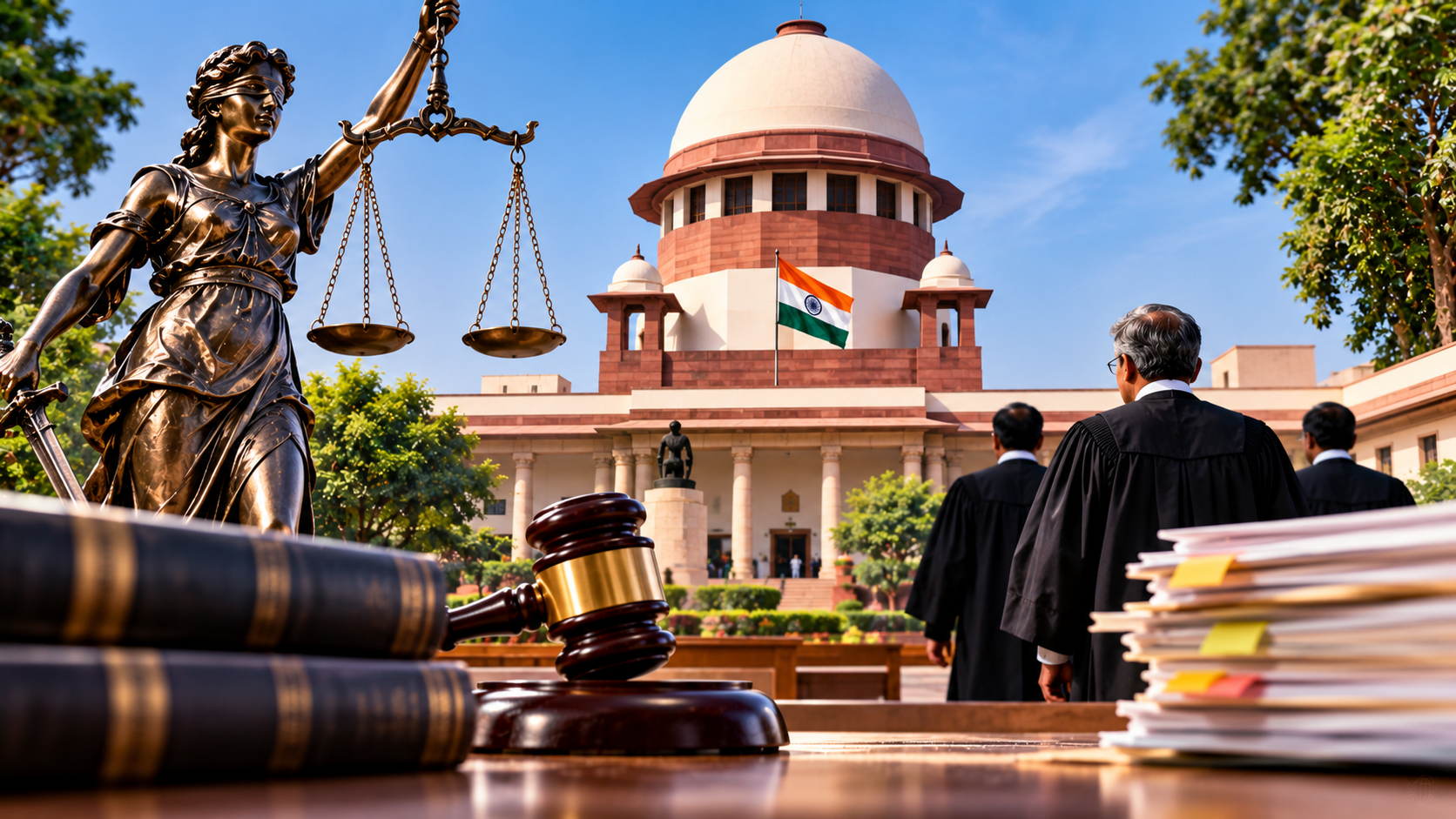
Supreme Court Welcomes Progress on Retirement Age Reform
The Supreme Court of India on Monday, October 26, expressed satisfaction that 14 states had agreed to increase the retirement age of district judicial officers from 60 to 62 years. The development follows the court's efforts to bring greater uniformity to retirement rules across the subordinate judiciary.
A bench comprising Chief Justice Surya Kant and Justices Joymalya Bagchi and V. Mohana said it hoped the remaining states and Union Territories would also reconsider their positions and support the proposed change.
The bench declined to list individual petitions filed by judicial officers who are approaching retirement or have recently retired, observing that the broader issue concerns the relationship between the Supreme Court and state governments rather than isolated service disputes.
Senior advocate Ranjit Kumar had sought an urgent hearing, pointing out that judicial officers were continuing to retire while the matter remained under consideration.
The court maintained that the central question should be addressed through the wider proceedings concerning retirement policy across the judicial system.
September 4 Direction Forms the Basis of the Reform
The latest development follows an order passed by the Supreme Court on September 4, when the bench directed states to raise the retirement age of judicial officers from 60 to 62 years.
The court had called on state governments to reconsider their positions and take the necessary administrative and legal steps to implement the change.
The objective is to establish a more consistent retirement framework for district-level judicial officers, while ensuring that decisions about continued service take account of individual suitability and performance.
Under the directions previously issued, the states that consented to the enhancement were required to amend their service rules. The amendments were expected to be completed preferably within two months, subject to the court's directions and the assessment requirements applicable to individual officers.
The court has also emphasised that the process should not be delayed simply because formal amendments to service rules have yet to be completed.
Seven States Have Specific Transitional Provisions
The Supreme Court's earlier directions included transitional arrangements for judicial officers in seven states: Chhattisgarh, Karnataka, Madhya Pradesh, Maharashtra, Sikkim, Tamil Nadu and West Bengal.
Judicial officers in these states who superannuated on or after March 31, 2026, were to be given the option of rejoining judicial service if they had not already taken up subsequent employment.
The arrangement is subject to an assessment by the relevant High Court of the officer's suitability and performance.
The bench had further directed that, while the required service-rule amendments remained pending, judicial officers in the states concerned who had reached the age of 60 should not be made to retire before turning 62, provided they satisfied the prescribed suitability and performance assessment.
These transitional measures are intended to prevent eligible judicial officers from losing the opportunity to continue in service solely because administrative amendments have not yet been completed.
However, the extension is not automatic for every officer. The applicable directions make continued service conditional on the assessment by the concerned High Court.
Supreme Court Asks Remaining States to Reconsider Their Position
The court had also directed a broad group of states and Union Territories to revisit their decisions on raising the retirement age.
The jurisdictions named in the earlier directions included Andhra Pradesh, Arunachal Pradesh, Assam, Bihar, Goa, Gujarat, Haryana, Himachal Pradesh, Jharkhand, Kerala, Manipur, Meghalaya, Mizoram, Nagaland, Odisha, Punjab, Rajasthan, Telangana, Tripura, Uttarakhand and Uttar Pradesh, along with the National Capital Territory of Delhi, Jammu and Kashmir, and Puducherry.
The Supreme Court has expressed hope that the remaining jurisdictions will follow the states that have agreed to the proposal.
The matter is significant because district courts form the foundation of India's judicial system. They handle a large volume of civil, criminal and other proceedings and are often the first point of contact for citizens seeking legal remedies.
Differences in service conditions across states can create inconsistencies in career progression and retirement arrangements for judicial officers performing comparable responsibilities.
Financial Burden Cannot Be the Sole Reason for Opposition
During the proceedings, the Supreme Court had said that states could not rely solely on financial considerations to oppose the proposed increase in the retirement age.
State governments are responsible for implementing judicial service rules and meeting the associated administrative and financial requirements. Extending the retirement age could affect salary budgets, pension liabilities, vacancies and recruitment schedules.
However, the court has indicated that these considerations must be weighed against the needs of the judicial system and the experience available within the district judiciary.
Experienced judicial officers possess knowledge of court administration, legal procedure and case management that can take years to develop. Retaining eligible officers for an additional two years could help preserve institutional experience, provided their performance and suitability meet the required standards.
At the same time, the extension could affect the timing of vacancies and promotions for younger judicial officers. Effective implementation will therefore require careful coordination between state governments, High Courts and judicial service authorities.
How the Proposal Differs From Existing Retirement Rules
Retirement ages differ across levels of India's judiciary.
Judges of the Supreme Court retire at 65, while High Court judges generally retire at 62. District judicial officers have traditionally retired at 60 under the service arrangements relevant to the present proceedings.
The proposed increase would bring the retirement age of eligible district judicial officers to 62, aligning it with the retirement age applicable to High Court judges, although the two categories remain governed by different service structures and constitutional provisions.
The issue has a long history. In 2002, the Supreme Court declined to accept a recommendation from the Justice K. Jagannatha Shetty Commission, which had proposed raising the retirement age of district judges to 62 years.
Since then, some states, including Telangana and Madhya Pradesh, have moved towards increasing the retirement age.
The current proceedings seek to address the question more broadly and encourage a more consistent approach across jurisdictions.
Potential Implications for the District Judiciary
An increase in the retirement age could have several implications for the functioning of district courts.
Retention of experienced judicial officers: Keeping eligible officers in service for an additional two years may help retain institutional knowledge and experience in handling complex cases.
Continuity in court administration: Experienced judges may contribute to smoother administration, particularly in courts dealing with heavy caseloads and procedural backlogs.
Changes in recruitment and promotion schedules: Extending service could alter the timing of vacancies, which may affect recruitment and career progression for other judicial officers.
Higher salary and service costs: State governments may need to account for the additional period of service in their budgets, although the Supreme Court has said financial burden alone cannot justify opposition.
Greater emphasis on performance assessment: The requirement for suitability reviews places responsibility on High Courts to determine which judicial officers should continue beyond the existing retirement age.
The ultimate effect will depend on how quickly states amend their rules and how consistently the eligibility and assessment requirements are applied.
Implementation and Next Steps
The immediate priority is for the states that have agreed to the increase to complete the necessary amendments to their judicial service rules and follow the Supreme Court's directions.
The remaining states and Union Territories will need to reconsider their positions in light of the court's observations.
High Courts will also have an important role in evaluating the suitability and performance of officers who seek to continue in service under the new arrangements.
The Supreme Court's refusal to urgently list individual retirement-related petitions does not mean that the broader matter has ended. Instead, the bench has indicated that the issue should be addressed through the main proceedings involving the states.
The effectiveness of the reform will ultimately depend on timely implementation, clear service rules and transparent assessments of individual judicial officers.
Broader Significance for Judicial Administration
The retirement-age issue highlights the challenge of balancing institutional experience, career progression, financial considerations and the efficient administration of justice.
District courts play a central role in delivering justice to citizens, but their performance also depends on adequate staffing, infrastructure, recruitment and effective case management. An increase in retirement age may help preserve experience, but it is not, by itself, a solution to judicial vacancies or delays.
The Supreme Court's intervention places renewed emphasis on coordination between the judiciary and state governments. A consistent framework could reduce differences in service conditions while allowing individual officers to continue only when they meet the required standards.
The next stage will be determined by the pace of rule amendments and the response of jurisdictions that have yet to agree to the proposal.