From the 2025 Tibet Earthquake to Nepal's Devastating 2015 Disaster, Repeated Tremors Expose the Vulnerability of Himalayan Communities
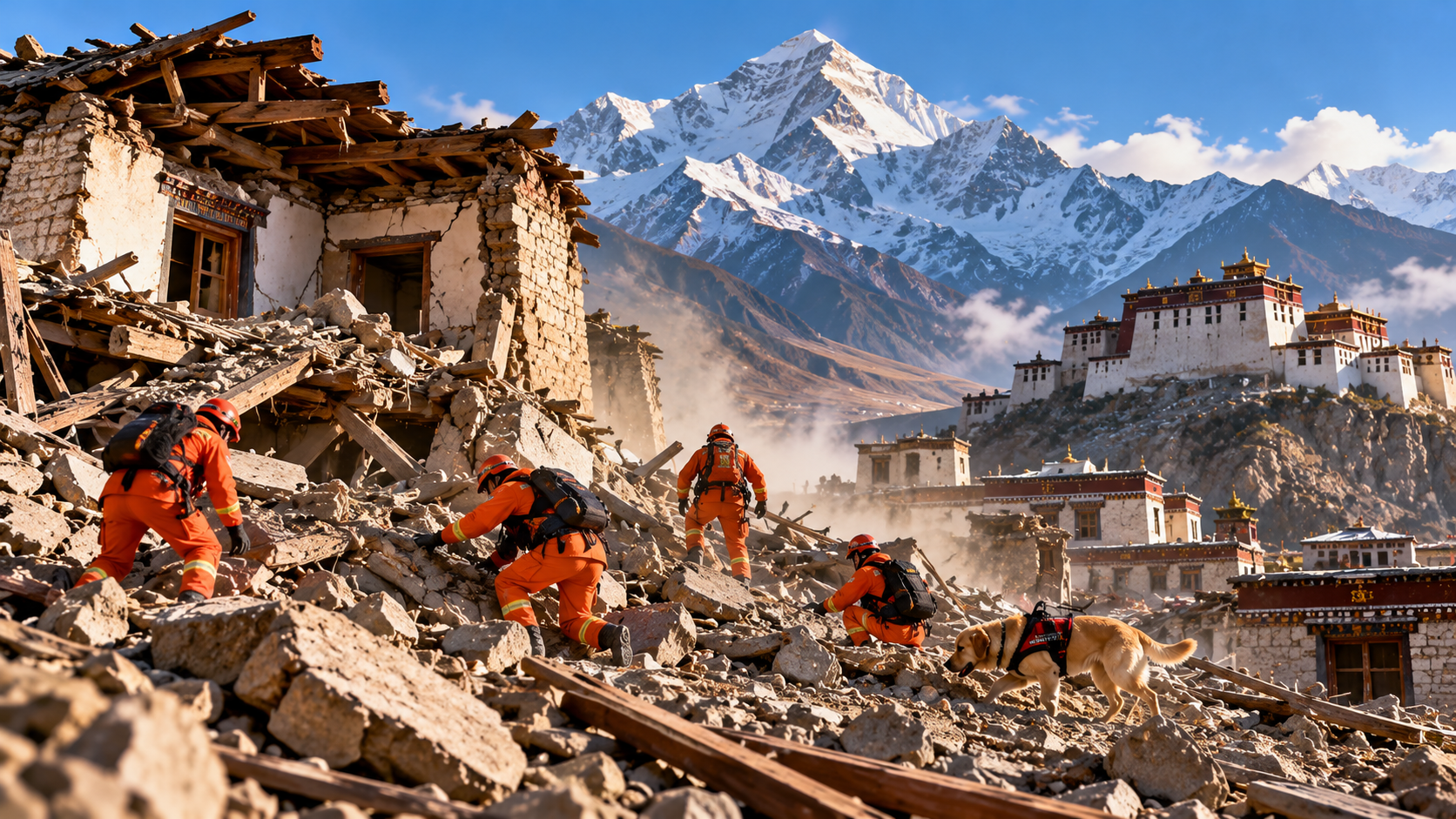
A powerful earthquake measuring magnitude 7 struck Tibet on Thursday evening, October 22, 2026, killing at least 16 people and injuring 46, according to the initial reports cited in the source. The tremor caused widespread damage, with hundreds of residential buildings and livestock sheds reportedly collapsing. Search and rescue operations continued as emergency teams worked to locate survivors and assess the extent of the destruction.
According to the report, at least 339 homes and 20 livestock sheds collapsed, prompting the deployment of more than 1,600 local personnel for rescue operations. The disaster has once again drawn attention to the seismic vulnerability of the Himalayan region, where powerful earthquakes have repeatedly caused significant loss of life, damaged infrastructure and displaced communities.
Stretching across parts of India, Nepal, Bhutan, China and Pakistan, the Himalayan region lies in one of the world's most seismically active zones. The ongoing collision between the Indian and Eurasian tectonic plates creates enormous geological pressure, which is periodically released through earthquakes.
From the devastating Nepal earthquake in 2015 to destructive tremors in 2023 and Tibet in 2025, the region's history demonstrates the importance of earthquake preparedness, resilient construction and effective disaster-response systems.
October 2026: Tibet Earthquake Leaves Homes Damaged and Communities at Risk
The latest earthquake in Tibet has renewed concerns about the safety of communities living in mountainous and seismically active areas.
The reported magnitude 7 tremor caused substantial structural damage, with hundreds of homes and livestock shelters collapsing. Rescue operations were launched to locate survivors, provide emergency assistance and evaluate damage to buildings and local infrastructure.
Earthquake response in mountainous regions can be particularly challenging. Narrow roads, steep terrain, long distances between settlements and difficult weather conditions may delay the movement of emergency personnel and supplies.
Buildings constructed without adequate earthquake-resistant features can also be vulnerable to severe structural damage. The risk is especially concerning where homes rely on construction methods that have not been designed to withstand strong ground movement.
The full extent of the damage and the final casualty figures may change as rescue operations progress and authorities complete their assessments.
The latest disaster serves as a reminder that earthquake preparedness must include not only emergency response but also safer buildings, public awareness and reliable communication systems.
January 2025: Tibet Earthquake Near Mount Everest Kills at Least 126
One of the region's most destructive recent earthquakes struck Tibet in January 2025 near Tingri county, close to Mount Everest.
The earthquake killed at least 126 people and injured more than 180, according to the figures cited in the report. Thousands of homes were damaged or destroyed, leaving residents in need of emergency shelter and assistance.
Rescue teams faced difficult conditions as they searched damaged buildings for survivors. Freezing temperatures and the region's rugged terrain complicated relief operations, increasing the urgency of providing shelter, food, medical support and other essential supplies.
Tremors were also felt in neighbouring Nepal and parts of India, illustrating how seismic events can affect areas beyond the immediate epicentre.
The disaster highlighted the particular risks facing communities in remote mountainous regions, where emergency services may have limited access and damaged roads can delay assistance.
It also reinforced the need for buildings to be designed according to appropriate seismic standards, especially in locations exposed to strong earthquakes.
November 2023: Nepal Earthquake Kills 154 and Destroys Thousands of Homes
Nepal experienced another devastating earthquake in November 2023 when a magnitude 6.4 tremor struck the country's Karnali province.
The earthquake had its epicentre near Ramidanda in Jajarkot district, approximately 65 kilometres northeast of Surkhet. It killed 154 people and injured more than 900, according to the reported figures.
Jajarkot and neighbouring Rukum West were among the worst-affected areas. Thousands of homes were damaged or destroyed, forcing many residents to seek temporary shelter as temperatures fell.
The earthquake was followed by hundreds of aftershocks, including a magnitude 5.8 tremor. These subsequent movements added to concerns about already weakened structures and created further challenges for residents and rescue workers.
According to figures cited from the United Nations, approximately 62,000 households were affected, while more than 26,000 homes were completely destroyed.
The disaster exposed the vulnerability of rural housing and the difficulties involved in delivering emergency support to isolated communities. It also highlighted the importance of preparing for aftershocks, which can damage buildings that have already been weakened by the initial earthquake.
April 2015: Nepal's Magnitude 7.8 Earthquake Kills Nearly 9,000
The April 2015 earthquake remains one of the deadliest disasters in Nepal's modern history.
The magnitude 7.8 earthquake struck central Nepal, with its epicentre approximately 80 kilometres northwest of Kathmandu. It killed nearly 9,000 people and injured more than 21,000.
The earthquake caused widespread destruction across the country, damaging or destroying hundreds of thousands of homes. Historic buildings and cultural landmarks were also affected, while landslides blocked roads and disrupted access to remote settlements.
The disaster triggered an avalanche on Mount Everest, killing climbers and other people in the mountain region. The destruction extended beyond residential buildings to roads, public infrastructure and facilities essential for emergency services.
The scale of the disaster demonstrated how a powerful earthquake can affect multiple aspects of daily life, from housing and healthcare to transport, education and local economic activity.
The 2015 earthquake also prompted renewed attention to seismic safety, building regulations, disaster preparedness and international cooperation in emergency response.
Reconstruction has been a long-term process, illustrating that the consequences of a major earthquake can continue long after the initial tremors have stopped.
Recent Earthquakes Across India, Bhutan and Pakistan
Seismic activity has continued across the wider Himalayan region in 2026, according to the earthquake events listed in the source report.
In India, a magnitude 4.9 earthquake was recorded in Chamoli, Uttarakhand, on October 6. Earlier in the year, Ladakh experienced a magnitude 5.5 earthquake on August 13, while Chamba in Himachal Pradesh recorded a magnitude 5.0 tremor on June 5.
A magnitude 5.0 earthquake was also recorded in Leh, Ladakh, on March 27.
Neighbouring countries experienced seismic activity as well. Bhutan recorded a magnitude 5.8 earthquake on June 7, while Pakistan experienced four earthquakes in June, including a tremor measuring magnitude 5.5.
Nepal also recorded a magnitude 5.3 earthquake in Mustang on September 8.
These events varied in magnitude and impact. Not every earthquake causes major destruction, and the consequences of a tremor depend on several factors, including its depth, distance from populated areas, local geology, building quality and the preparedness of affected communities.
The events nevertheless demonstrate the importance of monitoring seismic activity and improving preparedness across the region.
Why Is the Himalayan Region So Vulnerable to Earthquakes?
The Himalayas were formed through the ongoing collision of the Indian tectonic plate with the Eurasian plate. The Indian plate continues to move northwards, placing enormous pressure on the Earth's crust.
Over time, stress accumulates along faults and geological structures. When that stress is released suddenly, the resulting movement can generate an earthquake.
Because this tectonic process remains active, the Himalayan region faces a continuing risk of significant seismic events.
However, the impact of an earthquake cannot be determined by magnitude alone. A moderately strong earthquake close to a densely populated settlement with vulnerable buildings can cause severe damage, while a stronger earthquake in a sparsely populated area may result in fewer casualties.
Other important factors include:
-
Earthquake depth: Shallow earthquakes can produce strong ground shaking near the epicentre.
-
Building quality: Structures that lack adequate seismic resistance may collapse or suffer major damage.
-
Population density: More people and buildings near an earthquake's source can increase potential losses.
-
Local ground conditions: Certain soil types can amplify shaking or contribute to ground failure.
-
Infrastructure resilience: Roads, bridges, hospitals and communication networks influence how quickly emergency assistance can reach affected areas.
Understanding these factors is essential for reducing the human and economic costs of future earthquakes.
How Can Earthquake Preparedness Reduce Damage and Loss of Life?
Although earthquakes cannot currently be prevented or reliably predicted with precise timing, their impact can be reduced through preparation and safer construction.
1. Strengthen building standards: New buildings should comply with applicable seismic design requirements. Existing vulnerable structures, particularly schools, hospitals and essential public facilities, should be assessed and strengthened where necessary.
2. Improve public awareness: Residents should understand how to respond during an earthquake, including protecting their heads and necks, taking cover where appropriate and staying away from windows and unstable objects.
3. Prepare emergency supplies: Households should consider keeping drinking water, essential medicines, a torch, a first-aid kit, a power bank and basic emergency supplies readily available.
4. Establish evacuation and response plans: Local authorities should identify safe areas, maintain emergency communication arrangements and conduct preparedness exercises.
5. Protect critical infrastructure: Hospitals, transport networks, power systems and communication facilities need appropriate safety measures to support emergency response and recovery.
6. Improve monitoring and public alerts: Seismic monitoring networks, timely public information and coordinated emergency services can help authorities respond more effectively after an earthquake occurs.
Preparedness is particularly important in remote Himalayan communities, where difficult terrain can delay the arrival of rescue teams and relief supplies.
Economic Consequences of Major Himalayan Earthquakes
Beyond the immediate human tragedy, major earthquakes can have far-reaching economic consequences.
Damage to homes, roads, bridges, schools, hospitals and commercial buildings can disrupt economic activity and increase reconstruction costs. Businesses may experience temporary closures, while households can face the loss of property, income and access to essential services.
Agricultural communities may also suffer when livestock shelters, storage facilities and local transport routes are damaged. In tourism-dependent areas, earthquakes can disrupt travel, accommodation and other services.
Reconstruction can require substantial public expenditure and financial support from governments, insurers, charities and international organisations. The final economic cost depends on the scale of damage, the value of affected assets and the speed of recovery.
For households and businesses, appropriate insurance coverage, emergency planning and compliance with construction standards can help reduce financial vulnerability. However, insurance availability and coverage conditions vary, and not every earthquake-related loss will necessarily be covered.
The latest Tibet earthquake once again illustrates why disaster resilience should be treated as an essential part of infrastructure development and long-term economic planning.
Market Outlook
The latest earthquake in Tibet is primarily a humanitarian and disaster-management concern, but its broader consequences may also affect infrastructure, construction, insurance and regional economic activity if damage proves extensive.
In the short term, authorities will focus on rescue operations, medical assistance, temporary shelter and the restoration of essential services. As more information becomes available, attention is likely to shift towards damage assessments, reconstruction requirements and the funding needed to restore affected communities.
For businesses and investors, the potential implications will depend on the scale of infrastructure damage and the duration of disruption. Construction materials, engineering services and infrastructure contractors may become relevant to longer-term rebuilding efforts, but the disaster itself does not automatically translate into investment opportunities or higher company earnings.