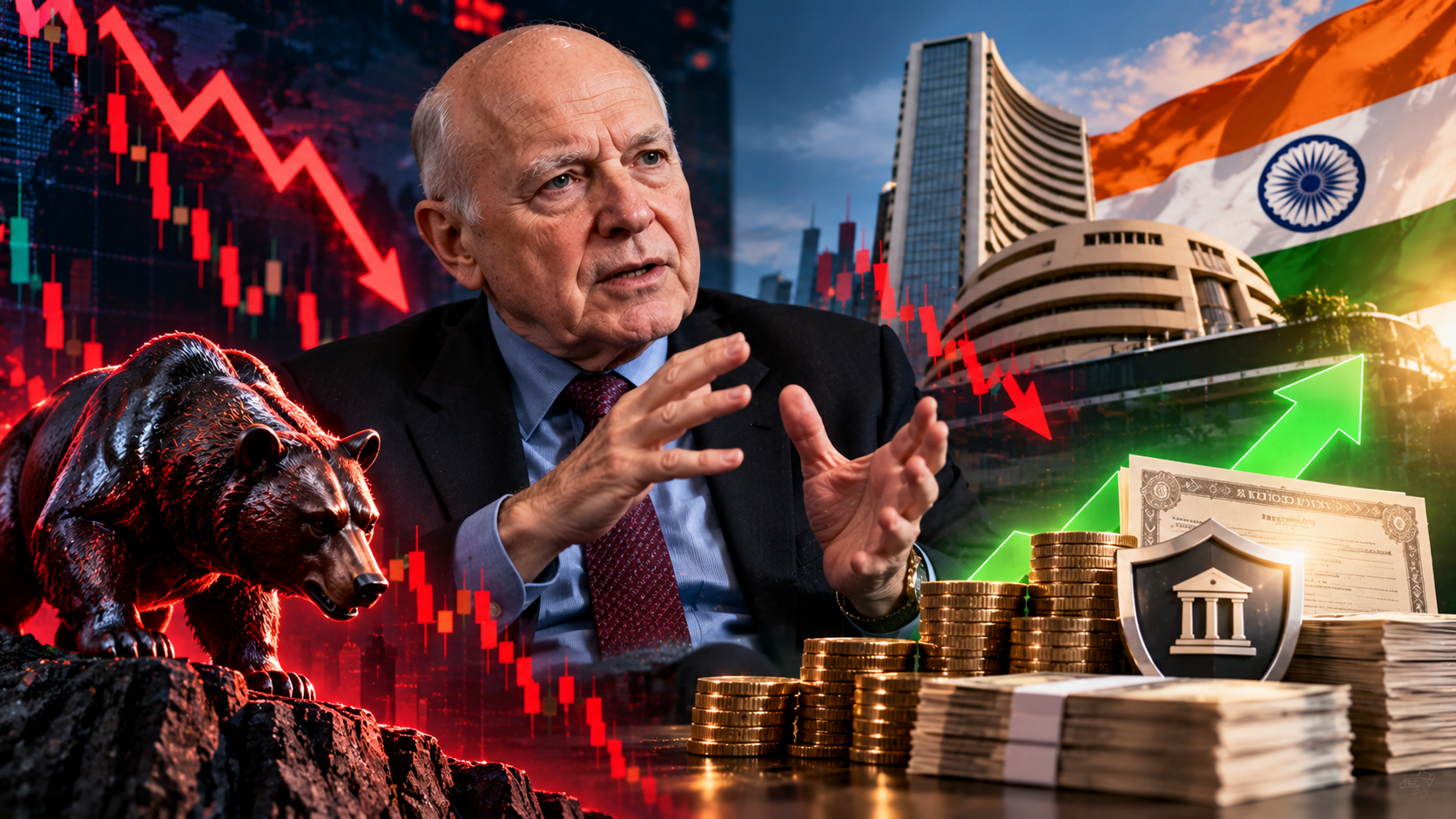
The veteran market commentator expects continued pressure on global equities, including India, as elevated interest rates, stretched technology valuations and foreign investor outflows challenge market returns; he sees US Treasury bonds and selected energy stocks as potential opportunities.
Global financial markets could be entering a prolonged period of weak equity returns, with India facing particular challenges after years of strong gains, according to veteran investor Marc Faber, editor and publisher of The Gloom, Boom & Doom Report.
Faber believes the long-running bull market in Indian equities, which began in 2003, has run its course. In his assessment, higher interest rates, tighter financial conditions and concerns about elevated valuations are creating an unfavourable environment for risk assets. He expects investors to become more selective, reduce their exposure to equities and increase their holdings of cash and bonds.
His outlook also reflects concerns about the concentration of gains in major US indices, where a relatively small group of highly valued technology companies has supported headline performance despite weakness elsewhere in the market.
Faber's views represent his personal assessment of market conditions rather than a certain prediction. Nevertheless, his comments highlight several issues investors are watching closely: the sustainability of AI-related valuations, the direction of interest rates, foreign institutional investor flows and the relative attractiveness of bonds and commodities.
Why Faber Believes India's Bull Market Has Ended
Faber argues that India's extended equity bull market has entered a bear-market phase. He points to the market's struggles since its September 2024 peak and the difficulty investors have faced in generating meaningful returns from broad market exposure over the subsequent period.
He also believes the current weakness extends beyond equities to other asset classes, reflecting tighter financial conditions and higher interest rates.
For investors, the distinction between a bull and bear market is important because it can influence portfolio allocation, risk management and expectations for future returns. During prolonged periods of market weakness, broad index exposure may become less rewarding, while differences between individual companies' financial performance and valuations can become more significant.
However, the outlook for Indian equities will also depend on domestic economic growth, corporate earnings, government policy, interest rates and the direction of global capital flows. A negative market forecast does not mean every company or sector will necessarily decline.
Foreign Investor Outflows Could Continue to Weigh on Equities
Faber does not expect a quick reversal in foreign investor selling. He believes international investors may reduce their exposure to equity markets across the world as they reassess risks and returns.
Sustained foreign portfolio investor outflows can put pressure on Indian shares, particularly large-cap stocks with significant foreign ownership. Selling can also affect the rupee, depending on broader currency flows and other economic factors.
Faber sees the US dollar as relatively attractive in this environment, despite acknowledging its shortcomings. His reasoning is that other major economic regions face their own challenges, making the dollar comparatively appealing during periods of uncertainty.
For Indian investors, foreign flows are only one part of the picture. Domestic institutional investors, household participation, corporate earnings and valuations can also influence market direction. The sustainability of any recovery will depend partly on whether domestic buying can offset overseas selling.
AI Valuations and US Market Concentration Raise Concerns
A central element of Faber's bearish outlook is his concern about the concentration of gains in US equities. He argues that major indices can continue rising even when a large number of constituent stocks are stagnating or declining, because a relatively small group of heavily weighted companies has a disproportionate influence on index performance.
He is particularly cautious about highly valued technology businesses whose future earnings may not justify current market expectations.
Faber believes the correction in AI-related investments has further room to run, with weakness potentially extending from semiconductor companies into cloud computing and other businesses associated with the AI ecosystem.
This does not mean AI adoption will necessarily slow over the long term. Rather, investors may need to distinguish between the commercial potential of the technology and the prices being paid for companies expected to benefit from it.
For markets, the critical issue is whether future revenue growth, margins and cash flows can support current valuations. Companies with strong fundamentals may continue to perform well, while businesses priced for exceptionally optimistic outcomes could face greater volatility if expectations weaken.
Why Faber Prefers US Treasury Bonds
Among the investment opportunities he discussed, Faber identified US 10-year Treasury bonds as particularly attractive on a risk-adjusted basis. He referred to yields of around 5% or slightly higher and suggested that the securities could offer meaningful returns over the next 12 to 24 months.
His reasoning combines the income available from bond yields with the possibility of capital gains if market yields decline. Bond prices generally move inversely to yields: when yields fall, existing fixed-rate bonds typically rise in value.
Faber also suggested that longer-dated US Treasury securities could rally if the US economy enters a recession and interest rates decline.
However, the outcome is not guaranteed. If inflation remains persistent or government borrowing pressures push yields higher, bond prices could fall further. Long-duration bonds are particularly sensitive to changes in interest rates, and investors can experience losses even when the securities offer regular coupon income.
The potential return figures cited by Faber are his expectations, not assured outcomes. Investors should consider bond maturity, duration, currency exposure, inflation and the possibility of capital losses before making allocation decisions.
Cash Could Become More Valuable in a Volatile Market
Faber recommends increasing cash holdings as investors navigate an uncertain market environment. Cash can help reduce portfolio volatility and provide liquidity for opportunities that emerge when asset prices decline.
Holding cash also allows investors to avoid selling other assets at unfavourable prices to meet short-term financial needs. In a falling market, liquidity can become especially valuable if attractive investments become available at lower valuations.
However, cash carries its own risks. Inflation can erode purchasing power, while returns may be lower than those available from equities or bonds during a sustained market recovery.
The appropriate cash allocation therefore depends on an investor's time horizon, financial obligations, risk tolerance and existing portfolio. A defensive position may be useful in uncertain conditions, but excessive caution can also mean missing a recovery.
Faber Sees Opportunities in Energy Stocks and Oil
Despite his cautious stance towards equities overall, Faber expressed a preference for oil and the energy sector. He argued that oil appeared relatively inexpensive compared with gold and silver and that investment exposure to energy stocks remained limited.
Geopolitical tensions and potential supply disruptions can support oil prices by increasing uncertainty over global availability. Energy companies may benefit when higher prices improve realised selling prices and operating cash flows, although outcomes vary depending on production costs, debt levels, hedging arrangements and the businesses in which they operate.
Oil prices can also fall sharply if global economic activity weakens, demand slows or supply increases. A recession could therefore create a difficult environment for some energy producers even if geopolitical risks remain elevated.
Faber also said he continued to own physical gold and buy platinum. His preference for these assets alongside oil illustrates that his strategy is not simply a rejection of all commodities, but a selective view based on relative valuations and macroeconomic risks.
Dividend Stocks and Utilities May Offer Selective Opportunities
Faber believes utility stocks could perform reasonably well if a US recession leads to lower interest rates. Utilities often have relatively predictable cash flows, and their dividend payments can appeal to investors seeking income during volatile markets.
High-dividend stocks may also attract interest as investors move away from companies whose valuations depend heavily on future growth expectations.
However, dividend yields should not be considered in isolation. A high yield can reflect a falling share price or concerns about the sustainability of a company's earnings. If cash flows weaken, a company may reduce or suspend its dividend.
Investors assessing income-oriented shares should therefore examine debt levels, free cash flow, payout ratios, earnings stability and the durability of the underlying business.
What Faber's Outlook Means for Indian Investors
Faber's comments point towards a more selective approach to investing rather than indiscriminate exposure to broad market indices. If equity returns remain weak, company fundamentals, purchase valuations and balance-sheet strength may become increasingly important.
Indian investors can monitor several factors when evaluating their portfolios:
-
Corporate earnings: Check whether profits and cash flows justify current valuations.
-
Foreign investor flows: Persistent selling may affect sentiment, liquidity and the rupee.
-
Interest rates and bond yields: Changes in borrowing costs can influence equity valuations and bond prices.
-
AI-related valuations: Assess whether expected growth is supported by actual business performance.
-
Portfolio diversification: Avoid excessive concentration in a single sector or investment theme.
-
Liquidity needs: Maintain sufficient cash or low-risk liquid assets for near-term obligations.
Investors should also recognise that market forecasts can be wrong and that sharp declines may be followed by recoveries. Portfolio decisions are generally better grounded in individual financial goals and risk capacity than in an attempt to predict every market turn.
Market Outlook
Marc Faber's assessment presents a cautious view of global markets, with Indian equities, highly valued US technology stocks and broad index-based strategies facing potential headwinds. His preference for cash, US Treasury bonds and selected energy investments reflects concerns about valuations, interest rates and the possibility of further market weakness.
For India, the key variables will include corporate earnings growth, foreign investor activity, domestic liquidity and the trajectory of interest rates. Globally, developments in AI valuations, US economic growth, bond yields and geopolitical risks could shape investor sentiment.
Faber's bearish stance is a reminder that strong historical returns do not guarantee future gains. Yet neither does a bearish forecast guarantee a prolonged decline. Investors should balance caution with a disciplined assessment of valuations, business quality, diversification and their own investment horizon rather than making abrupt portfolio changes based on a single market view.