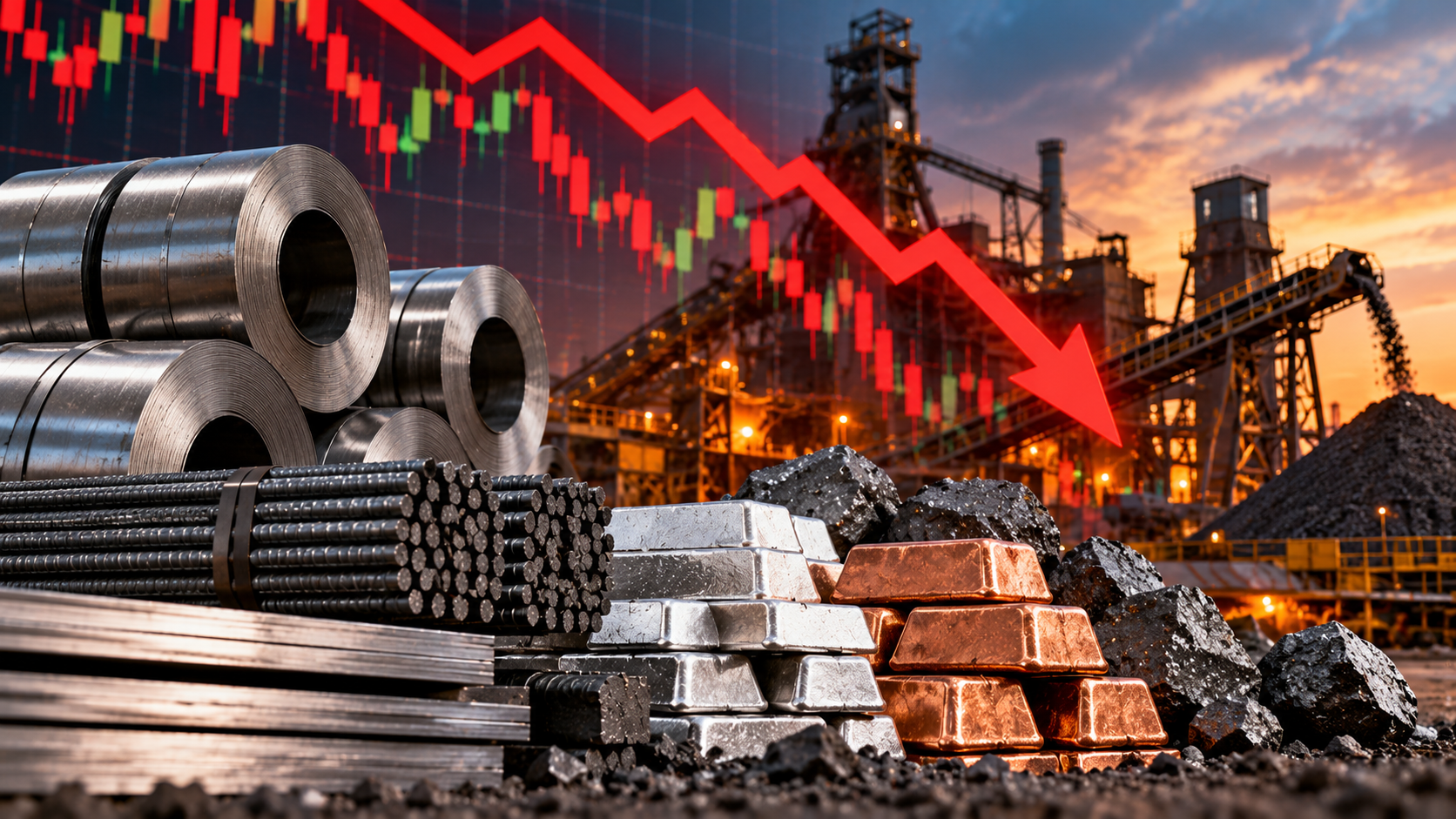
Indian metal stocks came under heavy selling pressure on Friday, October 23, 2026, as rising crude oil prices, global economic uncertainty and concerns about industrial demand weighed on investor sentiment. Shares of Vedanta Aluminium Metal, National Aluminium Company (NALCO), Vedanta and Hindustan Copper declined sharply, while the Nifty Metal index emerged as the worst-performing sectoral index during the session.
The sell-off extended the sector's losing streak to four consecutive trading sessions, highlighting growing concerns about profitability across the metals industry. With crude oil prices climbing above $110 per barrel and uncertainty surrounding global growth, investors are reassessing the outlook for commodity-linked companies.
Nifty Metal Index Falls 3.5% as Selling Spreads Across the Sector
The Nifty Metal index declined approximately 3.5% around 11:55 AM on October 23, with all 15 of its constituents trading in negative territory. The latest weakness pushed the index down around 6.3% over four trading sessions, compared with an approximately 3% decline in the benchmark Nifty 50 index during the same period.
The index is also trading around 18% below its record high of 13,931.35, reached on June 15, 2026.
The broad-based decline suggests that selling pressure is not limited to individual companies. Instead, investors appear increasingly concerned about the combined impact of expensive energy, uncertain commodity demand and a challenging global economic environment.
Vedanta Aluminium Metal and NALCO Lead the Losses
Aluminium-related stocks were among the biggest losers during Friday's trading session.
-
Vedanta Aluminium Metal: Shares declined approximately 6% to around ₹338.
-
National Aluminium Company (NALCO): The stock fell around 4.6% to ₹296.70.
-
Vedanta Ltd: Shares dropped approximately 4% to 4.5%, trading around ₹224.90.
-
Hindustan Copper: The stock declined around 4% to ₹395.10.
-
Hindustan Zinc: Shares fell approximately 4% to ₹496.45.
Other metal stocks, including Tata Steel, Steel Authority of India Limited (SAIL), NMDC, Jindal Stainless, Jindal Steel, APL Apollo Tubes and Lloyds Metals and Energy, also traded lower, with losses reaching around 4% in some cases.
The widespread decline reflects investor caution towards companies whose earnings depend heavily on commodity prices, production costs, industrial activity and global demand.
Share prices are based on the figures reported during the trading session and may have changed subsequently.
Why Are Metal Stocks Falling?
1. Rising Crude Oil Prices Increase Production Costs
One of the key concerns for metal producers is the sharp increase in crude oil prices. Brent crude climbed above $113 per barrel amid geopolitical tensions and concerns about potential supply disruptions in the Middle East.
Higher energy prices can increase the cost of mining, transportation, smelting and manufacturing. Steel and aluminium production, in particular, can be energy-intensive, making companies vulnerable when fuel and freight expenses rise faster than selling prices.
According to Piyush Jhunjhunwala, founder and CEO of Stockify, increasing energy costs can put pressure on corporate profit margins, particularly for businesses without captive energy supplies or sufficient pricing power.
If elevated crude prices persist, metal companies could face higher operating expenses even if their product prices remain relatively stable.
2. China's Economic Outlook Remains a Major Concern
China plays a critical role in global demand for steel, aluminium, copper and other industrial metals. Its construction sector, infrastructure investment, manufacturing activity and industrial production significantly influence international commodity prices.
Any slowdown in Chinese economic activity could reduce demand for raw materials and put downward pressure on metal prices.
A weaker demand environment would create additional challenges for Indian producers, particularly if global commodity prices decline while domestic production and operating costs remain elevated.
Investors are therefore closely monitoring signals from China and other major industrial economies to determine whether demand can support metal prices at current levels.
3. A Strong US Dollar Can Weigh on Commodities
A stronger US dollar can create additional pressure on internationally traded commodities, including industrial metals.
Because many commodities are priced in dollars, a stronger currency can make them more expensive for buyers using other currencies. This may weaken demand, particularly when economic conditions are already uncertain.
Elevated bond yields can also reduce investor appetite for cyclical assets and increase the relative attractiveness of interest-bearing investments.
Together, these factors can create an unfavourable environment for metal stocks, especially when investors are concerned about slowing industrial growth.
4. Global Uncertainty Is Weakening Investor Sentiment
Metal companies are considered cyclical businesses because their earnings often move with the broader economic cycle.
When investors expect stronger economic growth, they may favour companies linked to infrastructure, manufacturing and construction. However, concerns about inflation, expensive energy and slowing global demand can trigger the opposite reaction.
The recent decline across the Nifty Metal index indicates that investors are reducing exposure to cyclical stocks amid uncertainty over the global economic outlook.
Can Metal Companies Protect Their Profit Margins?
Although rising energy and transportation costs are negative for the industry, their impact varies significantly from one company to another.
Companies with lower production costs, efficient operations, captive energy resources and manageable debt levels may be better positioned to withstand periods of commodity-market volatility.
Businesses with strong balance sheets may also have greater flexibility to continue capital expenditure, expand production capacity and manage temporary weakness in selling prices.
On the other hand, companies with high debt, elevated operating costs or limited pricing power may experience greater pressure if metal prices weaken while expenses remain high.
Investors should therefore look beyond short-term share price movements and examine company-specific financial performance, cash flows, debt levels and cost structures before making investment decisions.
Aditya Birla Money Remains Positive on Select Steel Stocks
Despite the broader weakness in metal shares, some brokerages continue to see opportunities in selected steel companies.
Aditya Birla Money has maintained a favourable view of the steel sector and initiated coverage with a Buy rating on JSW Steel and SAIL. It assigned an Add rating to Tata Steel and Jindal Steel.
The brokerage views JSW Steel as a potential long-term compounder supported by continued capacity additions, while SAIL represents a potential margin-recovery opportunity.
It has also initiated coverage on ArcelorMittal, which is listed on Euronext Amsterdam.
These recommendations suggest that analysts see differences in the long-term prospects of individual companies, even as the sector faces near-term challenges. However, brokerage ratings are not guarantees of future returns, and investors should evaluate the underlying assumptions, valuations and risks before acting on them.
What Should Investors Watch Next?
The near-term outlook for metal stocks will depend on several important developments.
Crude oil prices: A sustained rise in energy prices could increase production and transportation expenses, putting additional pressure on margins.
Global metal prices: Movements in steel, aluminium and copper prices will help determine whether companies can maintain profitability.
Chinese demand: Any improvement or deterioration in China's industrial activity could influence the direction of international commodity markets.
Quarterly earnings: Investors should monitor revenue growth, operating margins, debt levels and management commentary from individual metal companies.
Infrastructure and manufacturing spending: Stronger demand from construction, capital expenditure and manufacturing could support steel and other industrial metals.
Foreign investor sentiment: Changes in global risk appetite, currency movements and bond yields may influence investment flows into cyclical sectors.
A recovery in these indicators could help stabilise metal stocks. Conversely, continued weakness in commodity demand and elevated production costs could prolong the correction.
Market Outlook
The outlook for Indian metal stocks remains cautious in the near term as rising crude oil prices, global economic uncertainty and concerns about Chinese demand weigh on investor sentiment. The Nifty Metal index's approximately 6.3% decline over four trading sessions highlights the intensity of the recent correction.
However, the sector's long-term prospects will depend on company-specific fundamentals, infrastructure investment, manufacturing demand, commodity-price trends and the ability of producers to manage operating costs. Select steel companies may offer opportunities if earnings improve and valuations become attractive, but a broad-based recovery cannot be assumed.
For investors, the priority should be to distinguish between companies with strong balance sheets, competitive production costs and sustainable cash flows and those more vulnerable to prolonged commodity weakness. Rather than reacting solely to a sharp one-day decline, investors should assess valuations, earnings expectations and their own risk tolerance before making decisions.