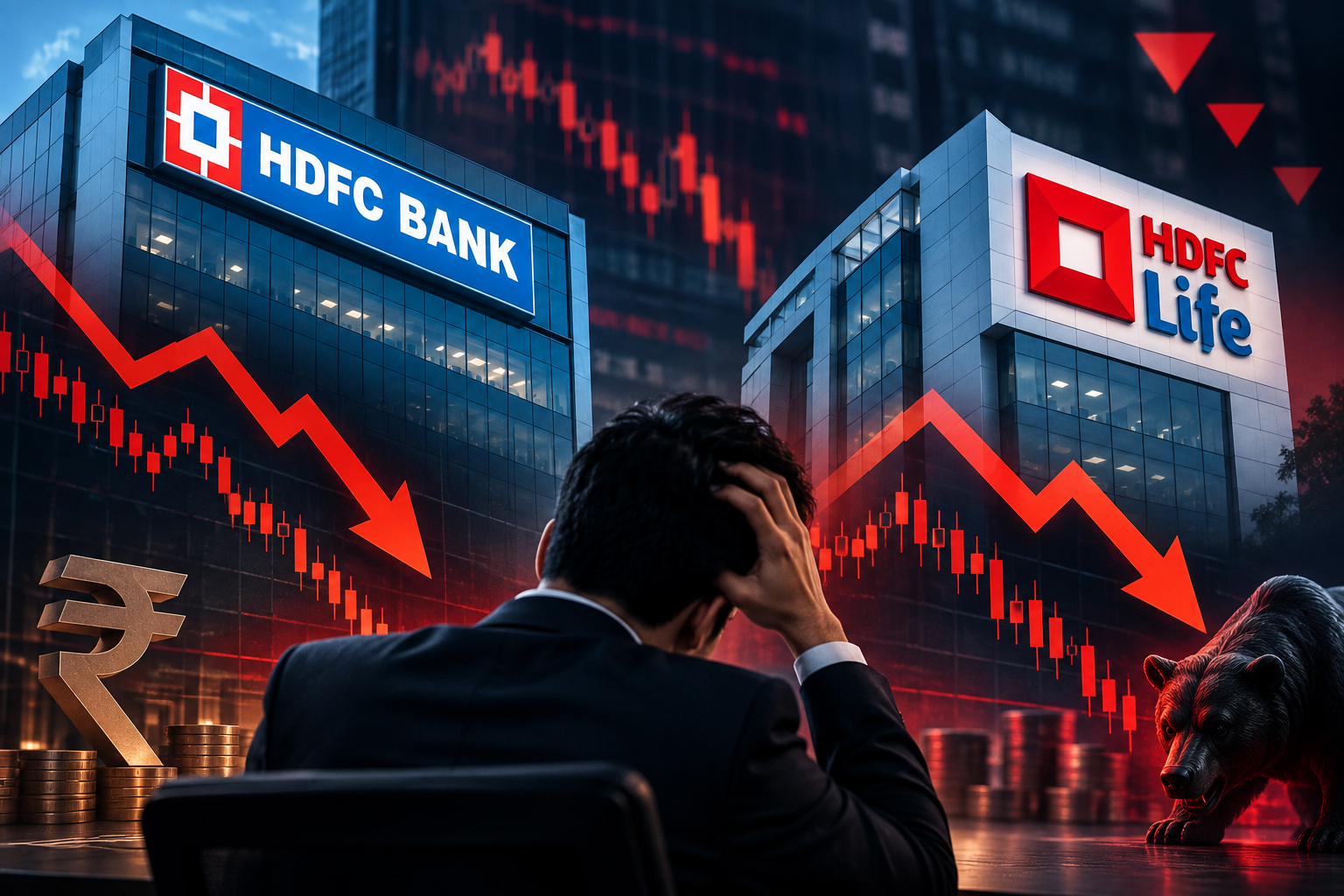
HDFC Bank has declined 28.5 per cent and HDFC Life 31.3 per cent in 2026, as concerns over business growth, interest rates and insurance distribution costs weigh on investor sentiment
Shares of HDFC Bank and HDFC Life Insurance came under renewed selling pressure on Wednesday, hitting fresh 52-week lows amid weakness in the broader market.
HDFC Bank fell nearly 2 per cent to an intraday low of ₹690.65 on the NSE, its lowest level since June 2024. HDFC Life declined 3.5 per cent to ₹515.10, marking a new 52-week low and bringing the stock close to a two-year low.
The sustained decline has raised concerns over the growth outlook for both companies. While HDFC Bank is facing pressure from slower business expansion and macroeconomic risks, HDFC Life is being affected by uncertainty over premium growth and possible regulatory changes related to commissions and distribution costs.
HDFC Bank, HDFC Life Underperform in 2026
HDFC Bank has lost approximately 28.5 per cent so far in 2026, while HDFC Life has declined around 31.3 per cent during the same period.
At around 10:55 AM on Wednesday, HDFC Bank was trading 1.2 per cent lower at ₹694, with approximately 14.12 million shares changing hands on the NSE. HDFC Life was down 2.7 per cent at ₹519, with trading volume of nearly 2.9 million shares.
The Nifty was trading around 0.4 per cent lower at 23,535 during the same period.
The sharp fall in the two stocks reflects broader investor concerns over financial-sector earnings, interest-rate expectations and the sustainability of future growth.
Why HDFC Bank Shares Are Under Pressure
G Chokkalingam, founder and head of research at Equinomics Research, believes HDFC Bank may remain under pressure in the short term compared with HDFC Life.
According to the analyst, the bank has been finding it difficult to outperform peers in terms of business growth. Slower loan growth, competitive pressure and concerns over future earnings expansion have affected investor sentiment.
Another risk is the possibility of higher interest rates. With crude oil prices trading close to the $100-per-barrel mark, inflationary pressures and rate-hike concerns have increased.
Higher interest rates can affect the banking sector in several ways:
-
Increase borrowing costs for customers
-
Reduce demand for loans
-
Put pressure on credit growth
-
Affect liquidity conditions
-
Increase funding costs for banks
-
Weigh on equity valuations
Chokkalingam, however, believes HDFC Bank remains attractive from a long-term perspective at current valuations. The near-term outlook may remain weak, but the bank’s scale, franchise strength and long-term business potential could support a recovery if growth momentum improves.
HDFC Life Faces Insurance-Sector Concerns
HDFC Life has also witnessed a sharp correction despite reporting strong quarterly numbers.
Chokkalingam noted that insurance stocks have declined in recent sessions even though August premium collections showed healthy growth. The analyst believes investors have not gained sufficient confidence from the latest monthly premium data because growth has remained volatile.
Insurance premium growth has fluctuated between strong double-digit expansion and single-digit growth. This variation has made it difficult for the market to establish a consistent growth outlook for the sector.
The analyst expects HDFC Life’s premium growth could remain in the single digits over the next three to four years. Such an outlook could limit the company’s valuation potential, particularly after a period when investors had expected stronger growth from the insurance industry.
Regulatory Risks Add to Insurance Sector Pressure
Apart from growth concerns, the insurance sector is also facing uncertainty over possible regulatory changes.
The government and insurance regulator have been examining the high commissions and distribution costs associated with insurance products. Any measures aimed at reducing these costs could affect the way insurance policies are sold and distributed.
While lower distribution costs could benefit the industry over the long term, a sharp reduction in commissions may create challenges for agents, distributors and insurers in the short term.
Potential changes could affect:
-
Agent and distributor incentives
-
New policy sales
-
Premium collection growth
-
Product pricing
-
Distribution strategies
-
Profitability across insurance companies
Investors are therefore assessing whether regulatory intervention could reduce premium growth or affect the economics of new business.
HDFC Bank Q1FY27 Earnings Snapshot
HDFC Bank reported a 5 per cent year-on-year increase in standalone net profit to ₹19,060 crore for the quarter ended June 2026.
The growth was supported by lower provisions and a nearly 7 per cent increase in net interest income.
However, the bank’s net interest margin narrowed to 3.26 per cent in Q1FY27 from 3.38 per cent in the March 2026 quarter. A decline in NIM can raise concerns about the bank’s ability to maintain profitability if funding costs remain elevated or lending yields come under pressure.
The bank’s earnings remain profitable and stable, but investors are looking for stronger business growth and improved margins to support a sustained recovery in the stock.
HDFC Life Reports Strong Profit and Premium Growth
HDFC Life Insurance reported a 12 per cent year-on-year increase in Q1FY27 net profit to ₹611 crore.
The performance was supported by growth in premium collections, particularly from policy renewals.
Net premium income increased approximately 14 per cent to ₹16,548 crore. First-year premiums from new policies rose nearly 6 per cent, while renewal premiums increased around 19 per cent.
The stronger renewal premium growth indicates continued contribution from the company’s existing policy base. However, the relatively moderate growth in first-year premiums remains an area that investors will monitor closely.
New business growth is important for insurance companies because it supports future premium income and long-term profitability.
Strong Quarterly Numbers Fail to Lift Sentiment
The contrasting market reaction to the companies’ earnings highlights the importance of future growth expectations.
HDFC Bank’s profit increased despite pressure on margins, while HDFC Life reported double-digit profit growth and strong premium income. However, investors appear more focused on the sustainability of earnings rather than the latest quarterly numbers.
For HDFC Bank, the key issue is whether loan growth can accelerate without putting additional pressure on margins. For HDFC Life, the focus is on whether new business growth can improve while regulatory uncertainty remains.
The continued selling pressure suggests that the market is assigning greater importance to long-term growth visibility and valuation comfort.
Key Factors to Track Ahead
Investors tracking HDFC Bank and HDFC Life should monitor the following factors:
For HDFC Bank
-
Loan and deposit growth
-
Net interest margin movement
-
Credit costs and asset quality
-
Interest-rate expectations
-
Competition from private-sector peers
-
Recovery in business growth
For HDFC Life
-
First-year premium growth
-
Renewal premium collections
-
New business margins
-
Persistency ratios
-
Regulatory developments
-
Distribution and commission costs
These factors will determine whether the recent correction creates a long-term investment opportunity or whether further weakness is likely.
Market Outlook
HDFC Bank and HDFC Life may remain volatile in the near term as investors assess growth prospects, interest-rate risks and sector-specific regulatory concerns.
HDFC Bank’s long-term investment case remains linked to a recovery in business growth and improvement in margins. However, the stock may need stronger earnings visibility before investor confidence returns.
For HDFC Life, sustained premium growth and clarity on commission-related regulations will be critical. Strong renewal collections provide support, but slower new business growth could limit the pace of recovery.
Investors should avoid making decisions solely on the basis of the stocks’ sharp decline. Further analysis of valuation, earnings growth, asset quality and regulatory developments will be important before taking a long-term position.