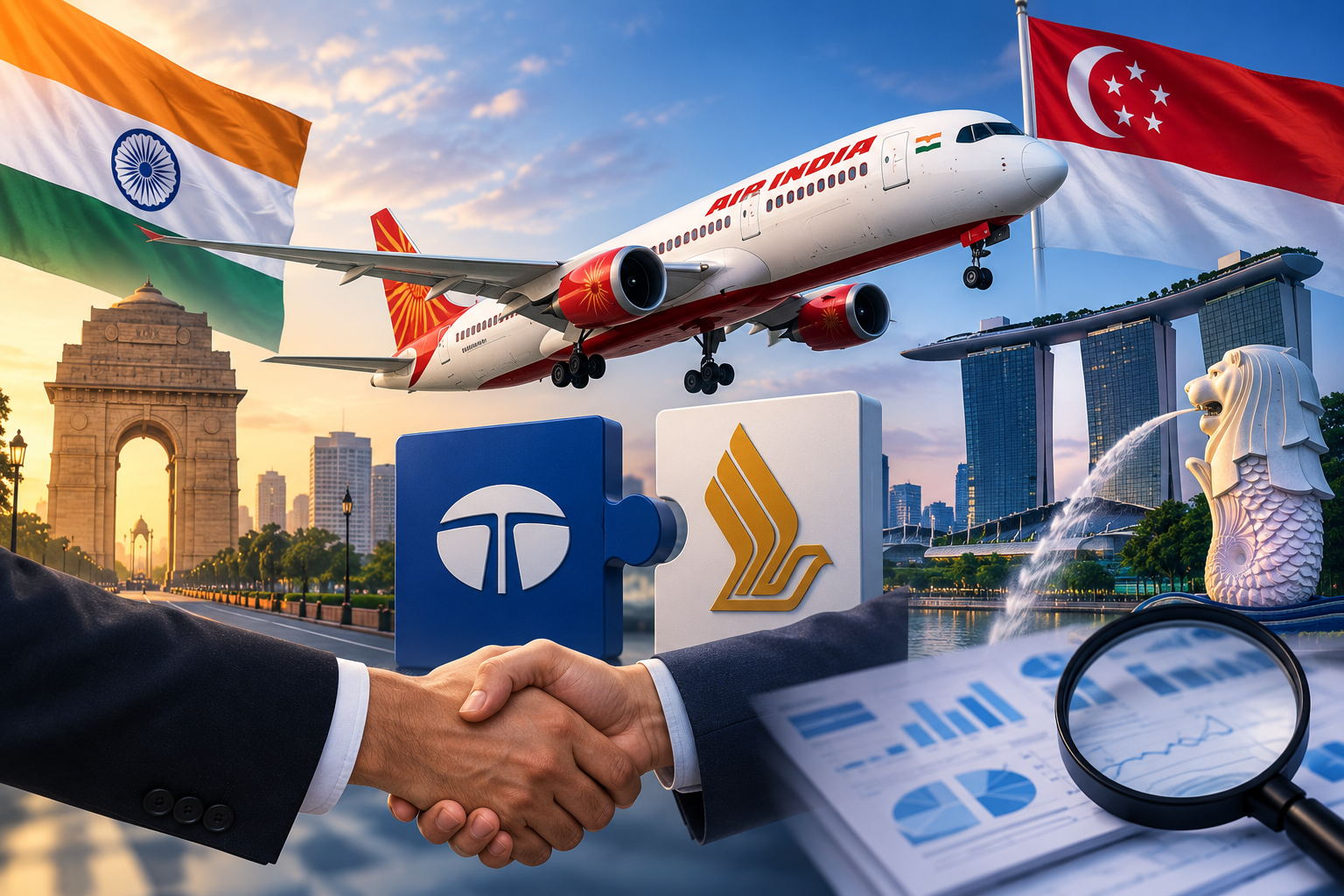
Air India’s reported $1.5 billion funding request from Tata Sons and Singapore Airlines has triggered a debate over Temasek’s indirect exposure to the Indian carrier, while Singapore’s government defends the investment and condemns anti-Indian abuse online
Air India’s reported request for approximately $1.5 billion in fresh funding from its owners, Tata Sons and Singapore Airlines, has sparked political scrutiny in Singapore over the state investor Temasek’s indirect exposure to the Indian airline.
The funding discussion comes months after Air India and its budget subsidiary reported a combined annual loss of around $2.33 billion. While Tata Group is the majority owner of Air India, Singapore Airlines holds a 25.1 per cent stake in the carrier and is itself majority-owned by Temasek.
The issue has raised questions in Singapore about whether public-linked funds could be used to support an overseas airline. Singapore’s government, however, has defended the investment and stressed that decisions regarding Singapore Airlines are made by its board.
Air India Seeks Fresh Capital
According to reports, Air India has approached Tata Sons and Singapore Airlines for additional equity funding.
The request follows a period of substantial financial pressure for the airline. Air India and its budget arm have reportedly recorded a combined annual loss of $2.33 billion, increasing the need for additional capital as the group works to strengthen its operations and expand its fleet.
Tata Group acquired control of Air India in 2022 and has been investing in the airline’s fleet, services, technology and operational capabilities. The airline is also pursuing a broader transformation strategy aimed at improving its competitiveness in the international aviation market.
Air India and Tata Group have not publicly commented on the reported funding request.
Singapore Airlines’ Indirect Exposure Through Temasek
Singapore Airlines owns 25.1 per cent of Air India. Since Singapore Airlines is majority-owned by Temasek, the Singapore state investor has indirect exposure to the Indian carrier through its investment in the airline.
Temasek manages its own investment portfolio, while its reserves form part of Singapore’s national reserves. This ownership structure has led some critics to argue that Singaporeans could be indirectly exposed to Air India’s financial performance.
Workers’ Party lawmaker Kenneth Tiong questioned whether Temasek-linked funds should be used to support Air India through Singapore Airlines. His comments triggered a wider debate over the relationship between Singapore’s state investment entities and overseas commercial investments.
The debate has focused not only on Air India’s losses but also on the broader question of how state-linked investors should evaluate long-term strategic investments.
Singapore Government Defends the Investment
Singapore Transport Minister Jeffrey Siow defended Singapore Airlines’ investment in Air India during parliamentary discussions.
Siow said investment decisions were the responsibility of Singapore Airlines’ board and emphasised that Singaporeans were not being asked to directly finance the Air India investment.
He also stated that Singapore Airlines had not sought additional capital from its shareholders.
The government’s position is that Singapore Airlines operates as a commercial company and makes investment decisions based on its own strategic and financial considerations. The state’s ownership of the airline does not mean that every investment is directly funded by taxpayers.
Singapore Airlines Highlights Long-Term Strategy
Singapore Airlines has said that its investments in India have been and will continue to be funded through internal resources, subject to board approval and a disciplined capital allocation framework.
The airline described its investment in Air India as a long-term strategic commitment aligned with its multi-hub strategy.
India is one of the world’s fastest-growing aviation markets, with rising passenger demand, expanding international connectivity and increasing demand for premium air travel. Singapore Airlines’ investment in Air India provides access to this growth opportunity while potentially strengthening connectivity between India, Southeast Asia and other international markets.
The partnership also offers Singapore Airlines a strategic presence in a large domestic market and a potential platform for future network expansion.
Why Air India Matters to Singapore Airlines
Air India’s importance to Singapore Airlines extends beyond its shareholding.
India has a large and growing aviation market, and Air India’s network includes several major domestic and international routes. A stronger Air India could create opportunities for improved connectivity, code-sharing, coordinated schedules and greater access to international passengers.
Singapore Airlines has historically followed a multi-hub strategy, using partnerships and investments to expand its reach beyond Singapore. Its investment in Air India is therefore being viewed by the company as a long-term strategic decision rather than a short-term financial transaction.
However, the airline’s ability to justify the investment will depend on Air India’s operational improvement, financial performance and progress in reducing losses.
Political Opposition Questions Use of State-Linked Funds
The political criticism has centred on Temasek’s ownership structure and the fact that its reserves form part of Singapore’s national reserves.
Critics argue that investments involving state-linked entities should face closer public scrutiny, particularly when the recipient company has reported substantial losses.
The government has responded that Temasek operates independently and that Singapore Airlines’ investment decisions are made by its own board. This distinction is central to Singapore’s defence of the transaction.
The debate reflects a broader issue faced by state-backed investment institutions: how to balance commercial returns, national interests and strategic objectives while maintaining financial discipline.
Anti-Indian Abuse Sparks Separate Controversy
The funding debate has also triggered a wave of anti-Indian abuse online, adding a sensitive social dimension to the issue.
Senior Minister K. Shanmugam said the funding report had prompted racist comments, including allegations that Temasek Chief Executive Officer Dilhan Pillay Sandrasegara favoured Air India because of his Indian ethnicity.
Shanmugam condemned the remarks as libellous and said Pillay was as Singaporean as any other citizen. He also said he had asked the police to examine the comments.
Singapore Prime Minister Lawrence Wong separately condemned the abuse, warning that legitimate debate over investment decisions should not be used as a cover for prejudice against any community or hostility towards foreigners.
The government’s response highlights the distinction between questioning an investment on financial or policy grounds and making allegations based on ethnicity or nationality.
Investment Debate Extends Beyond Air India
The controversy has raised wider questions about the role of Singapore’s state-linked investment institutions in overseas businesses.
Temasek has investments across multiple sectors and markets, including aviation, technology, financial services, healthcare and infrastructure. Such investments are generally evaluated on commercial and strategic grounds, but they can attract public attention when they involve companies facing financial difficulties.
In the case of Air India, the central question is whether the investment can deliver long-term strategic value for Singapore Airlines while maintaining financial discipline.
The reported funding request also highlights the challenges involved in transforming a large legacy airline. Air India’s recovery requires substantial investment in aircraft, maintenance, customer service, technology, staffing and network development.
Air India’s Financial Recovery Remains Critical
Air India’s ability to secure additional capital will depend on its owners’ assessment of its long-term prospects and the progress of its transformation plan.
The airline faces strong competition from domestic and international carriers, rising fuel costs, operational challenges and the need to modernise its fleet and customer experience.
Additional funding could support fleet expansion, operational improvements and the integration of Air India’s different airline businesses. However, sustained profitability will require stronger revenue generation, cost control and improved operational efficiency.
For Singapore Airlines, the investment’s success will depend on whether Air India can become a financially stronger and more competitive airline over time.
What Happens Next?
The reported funding request remains subject to discussions and approvals. Singapore Airlines has indicated that any investment will be funded through internal resources and assessed under its capital allocation framework.
The company’s board will ultimately determine whether additional funding is justified based on Air India’s financial position, strategic value and future prospects.
Meanwhile, the political debate in Singapore is likely to continue, particularly around the role of Temasek and the responsibilities of state-linked companies.
The controversy has also underlined the importance of keeping investment criticism focused on financial performance, governance and strategic rationale, rather than allowing legitimate policy disagreements to fuel racial or national hostility.