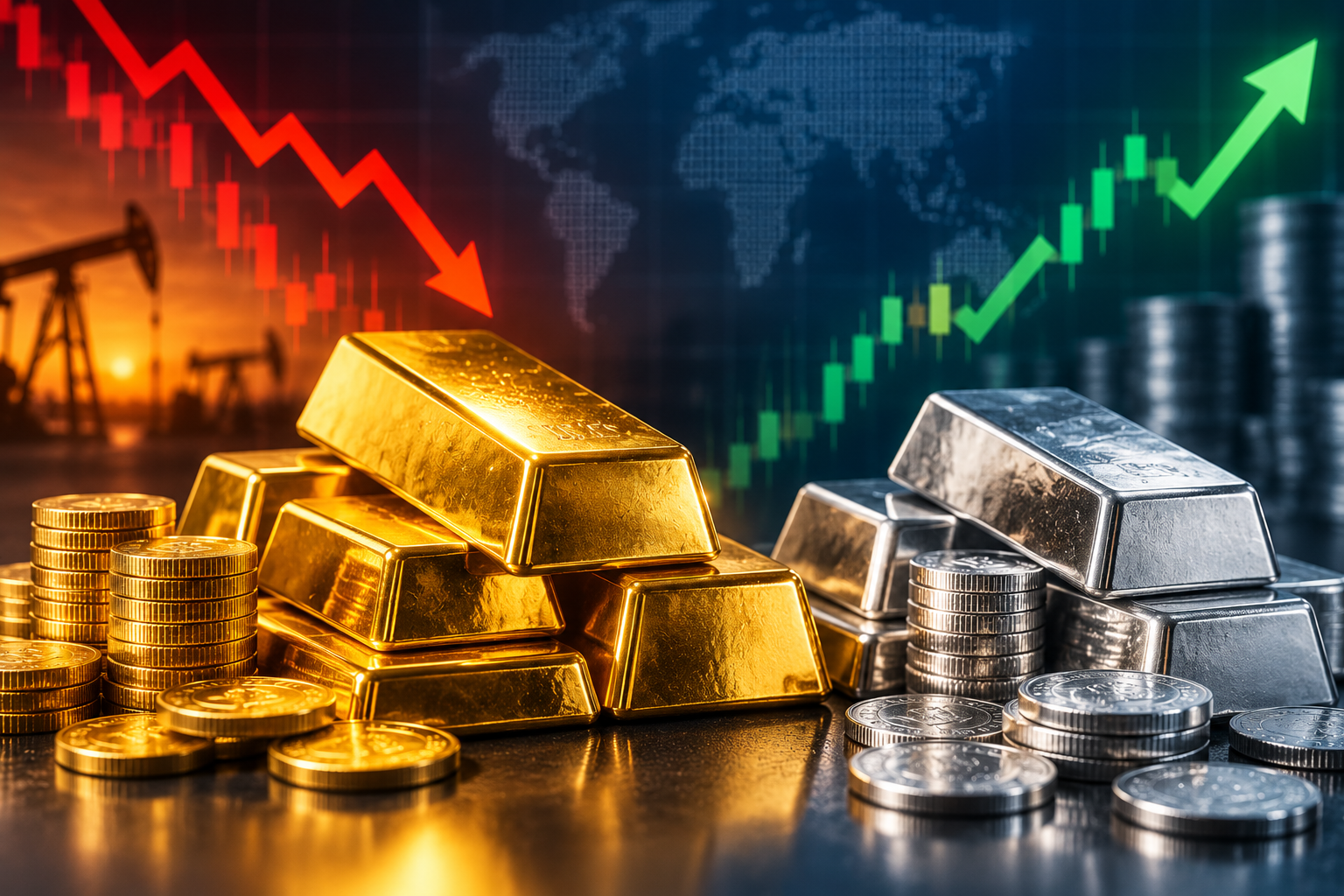
Rising crude oil prices and expectations of higher interest rates weigh on gold, while silver remains supported by industrial demand and investor interest
Gold futures opened lower on the Multi Commodity Exchange (MCX) on Wednesday, September 9, while silver prices moved higher. Rising crude oil prices have renewed inflation concerns and increased expectations of higher interest rates, putting pressure on non-yielding assets such as gold.
However, gold continues to attract demand as a hedge against inflation and market uncertainty. The precious metal had risen sharply in August, supported by stronger investment and hedging demand, along with continued purchases by central banks, including China’s central bank.
In the international market, both gold and silver futures were trading lower at the time of reporting, reflecting pressure from interest-rate expectations, currency movements and profit booking after the recent rally.
Gold Futures Open Lower on MCX
The benchmark October gold contract opened at ₹1,52,180 per 10 grams, down ₹399 from the previous close of ₹1,52,579.
At the time of writing, the contract was trading at approximately ₹1,52,369 per 10 grams, lower by ₹210. During the session, it touched an intraday high of ₹1,52,400 and a low of ₹1,52,101.
Gold futures had earlier touched their highest level of the year at ₹1,80,779 per 10 grams. The latest decline indicates some profit booking and caution among traders following the sharp rise in prices.
Despite the weakness, gold remains supported by demand from investors seeking protection against inflation, geopolitical uncertainty and financial-market volatility.
Silver Futures Gain ₹193 on MCX
Silver futures opened higher on the MCX. The benchmark December silver contract opened at ₹2,39,620 per kg, gaining ₹193 from the previous close of ₹2,39,427.
At the time of writing, the contract was trading at around ₹2,39,700 per kg, up ₹273. During the session, it touched a high of ₹2,39,765 and a low of ₹2,39,081.
Silver futures had previously touched a yearly high of ₹4,20,048 per kg.
Silver has a dual role as both a precious metal and an industrial commodity. Its use in electronics, solar panels, electric vehicles and other industrial applications can provide additional support to prices. However, the metal is also more volatile than gold and remains sensitive to global economic growth and manufacturing activity.
Gold and Silver Prices in the International Market
On the Comex, gold opened at approximately $4,399 per ounce, compared with the previous closing price of $4,439.
At the time of writing, gold was trading at around $4,416.10 per ounce, down $22.90. International gold prices had earlier touched a yearly high of $5,586.20 per ounce.
Comex silver futures opened at $66.44 per ounce, against the previous close of $67. At the time of writing, silver was trading at approximately $66.66 per ounce, down $0.34.
International silver prices had earlier reached a yearly high of $121.79 per ounce.
The decline in global prices, despite silver’s gains on the MCX, highlights the influence of currency movements and domestic market factors on Indian commodity prices.
Why Rising Crude Oil Prices Matter
Higher crude oil prices can increase transportation, manufacturing and energy costs across the global economy. This can lead to renewed inflationary pressure and influence central banks to maintain restrictive monetary policies.
Gold generally benefits from inflation concerns because investors use it as a store of value. However, when inflation expectations lead to higher interest rates and bond yields, gold can face short-term pressure.
Higher interest rates increase the opportunity cost of holding gold because the metal does not generate interest income. A stronger US dollar can also weigh on international gold prices by making the commodity more expensive for buyers using other currencies.
Central-Bank Buying Continues to Support Gold
Gold’s strong performance in recent months has been supported by continued purchases from central banks. China’s central bank has remained an important buyer, adding to long-term demand for the precious metal.
Central-bank purchases are generally driven by reserve diversification and long-term financial stability rather than short-term trading considerations. This provides a structural source of support to gold prices.
However, the pace of central-bank buying, changes in global interest rates and the direction of the US dollar will remain important factors in determining the next phase of the rally.
Gold Faces Competing Market Forces
Gold prices are currently being influenced by several opposing factors.
Factors supporting gold
-
Continued central-bank purchases
-
Inflation and geopolitical concerns
-
Strong investment and hedging demand
-
Expectations of safe-haven buying during market uncertainty
-
Demand for portfolio diversification
Factors weighing on gold
-
Rising crude oil prices
-
Expectations of higher interest rates
-
Stronger bond yields
-
A firm US dollar
-
Profit booking after the recent rally
The balance between these factors will determine whether gold consolidates or resumes its upward movement.
Silver Outlook Linked to Industrial Demand
Silver’s outlook remains closely connected to global industrial activity. Demand from solar energy, electronics, electric vehicles and other technology-related industries could provide long-term support.
However, the metal’s higher volatility means that it can experience sharp price movements in both directions. A slowdown in manufacturing activity or weaker global economic growth could reduce industrial demand and put pressure on prices.
Silver may continue to attract investors seeking exposure to both precious metals and the broader industrial recovery, but traders should remain cautious about sudden corrections.
What Investors Should Watch
Commodity investors will closely monitor the following factors:
-
International crude oil prices
-
US inflation data
-
Federal Reserve interest-rate expectations
-
US dollar movements
-
Global bond yields
-
Central-bank gold purchases
-
Geopolitical developments
-
Industrial demand for silver
-
MCX and Comex price movements
Domestic gold and silver prices may also be influenced by the movement of the Indian rupee against the US dollar. A weaker rupee can increase the landed cost of imported precious metals and support domestic prices, even when international prices remain subdued.
Market Outlook
Gold’s near-term outlook remains mixed. Inflation concerns and central-bank buying continue to provide support, while rising crude oil prices, higher interest-rate expectations and a stronger dollar are creating pressure.
Silver remains supported by its industrial-use potential and investment demand, although its higher volatility makes it more sensitive to changes in global economic conditions.
Investors should avoid making decisions solely on the basis of daily price movements. Gold and silver may be better suited to a diversified investment strategy, while short-term traders should closely track international prices, currency movements, interest-rate expectations and key technical levels.