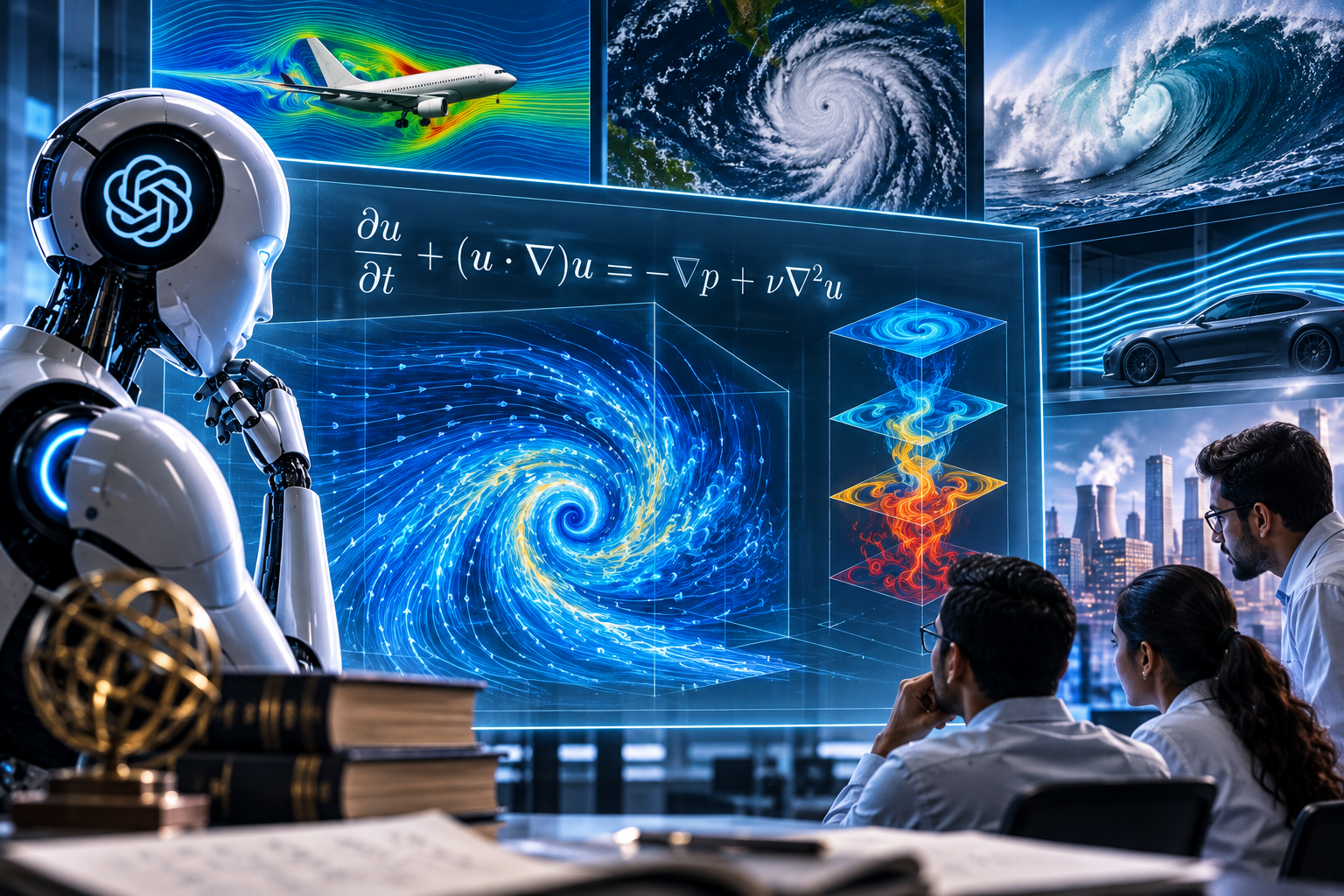
AI system reportedly demonstrates how smooth fluid flow can develop a singularity, challenging one of mathematics’ most important unanswered questions
OpenAI has announced that its internal artificial intelligence system has produced a mathematical proof addressing the Navier-Stokes existence and smoothness problem, a nearly 90-year-old challenge involving the behaviour of fluids.
The problem is one of the seven Millennium Prize Problems identified by the Clay Mathematics Institute in 2000. Each problem carries a prize of $1 million for a verified solution. Until now, only one of the seven problems had been solved.
OpenAI’s announcement could mark a significant development in mathematical research. However, the claimed result will need to undergo detailed examination and independent verification by mathematicians before it can be accepted as a definitive solution.
What Is the Navier-Stokes Problem?
The Navier-Stokes equations are mathematical formulas used to describe the movement of fluids, including water, air and other liquids and gases.
The equations are based on Newton’s second law of motion and treat fluids as continuous substances rather than tracking individual molecules. They help scientists and engineers understand a wide range of phenomena, including:
-
Weather systems and atmospheric movement
-
Ocean currents and waves
-
Airflow around aircraft
-
Water movement through pipes
-
Turbulence in engines and industrial systems
-
The behaviour of gases and liquids in machinery
Although the equations are widely used in practical applications, mathematicians have struggled to establish whether their solutions always remain mathematically well-behaved.
The Central Question: Can Fluid Flow Break Down?
The Navier-Stokes existence and smoothness problem asks whether smooth, physically reasonable fluid motion can develop a singularity in a finite amount of time.
A singularity is a point at which a mathematical quantity, such as fluid velocity, becomes infinitely large or otherwise ceases to remain well-defined.
In simple terms, the question is:
If a fluid begins moving smoothly, can its motion become so extreme that the equations can no longer describe it properly?
Mathematicians have not been able to prove conclusively whether such a breakdown can occur or whether the equations always produce smooth solutions under the relevant conditions.
Why Viscosity Matters
One of the most important elements of the Navier-Stokes equations is viscosity.
Viscosity refers to a fluid’s resistance to flow. Honey has greater viscosity than water, which means it flows more slowly and resists changes in motion more strongly.
Viscosity generally acts as a smoothing force. It helps prevent small disturbances in a fluid from becoming uncontrollably large.
The difficulty is determining whether this smoothing effect is always powerful enough to prevent a singularity.
If viscosity can always control the growth of fluid motion, smooth solutions may exist indefinitely. If other forces within the fluid can overpower that effect, a singularity could potentially form.
What OpenAI Says Its AI System Demonstrated
According to OpenAI, its internal AI system produced an analytical proof showing that an initially smooth fluid flow can develop a singularity within a finite period.
The company said the result involves a vortex, or spinning fluid structure, that spirals inward and becomes increasingly elongated. As the central region contracts, the fluid velocity rises sharply.
OpenAI said the fluid’s total energy remains finite even as the velocity grows without bound. This creates the mathematical conditions required for a singularity.
The company also stated that the result demonstrates a breakdown emerging from the fluid’s internal dynamics rather than from the application of an infinitely large external force.
How the Vortex Creates the Breakdown
The reported solution focuses on the interaction of several terms within the Navier-Stokes equations, including:
-
Fluid acceleration
-
Pressure
-
Momentum transfer
-
Viscosity
-
The movement and deformation of the vortex
OpenAI said these terms become increasingly large as the vortex contracts, but cancel one another in a precise manner.
This allows the external force driving the system to remain smooth even while the fluid velocity becomes unbounded.
The result, according to OpenAI, corresponds to statements “C” and “D” in the Clay Mathematics Institute’s formulation of the problem.
Formal Proof Written in Lean
OpenAI said it also produced a formalised version of the proof in Lean, a computer-based system used to verify mathematical arguments.
Formalisation involves translating mathematical reasoning into a precise language that a computer can check step by step. This can help identify gaps, hidden assumptions or logical inconsistencies that may not be obvious in a conventional proof.
However, formal verification does not automatically settle every question surrounding a major mathematical claim. Researchers must still examine whether the assumptions accurately match the original problem and whether the formalised argument addresses the exact conditions required by the Clay Institute.
Why the Claim Is Significant
A verified solution to the Navier-Stokes problem would have implications far beyond mathematics.
The equations are central to fluid dynamics, computational engineering and scientific modelling. A clearer understanding of when and how solutions break down could improve the study of turbulence and help researchers understand the limitations of fluid simulations.
Potential areas of impact include:
-
Aircraft and spacecraft design
-
Weather and climate modelling
-
Energy and power generation
-
Industrial fluid systems
-
Oceanography
-
Computational physics
-
Advanced engineering simulations
The result could also demonstrate how AI systems may assist researchers in solving complex mathematical problems that have remained unresolved for generations.
Independent Verification Remains Essential
Despite the significance of the announcement, OpenAI’s claim should not be treated as an officially accepted solution until independent experts have reviewed it.
The Navier-Stokes problem is particularly demanding because a valid solution must satisfy the precise mathematical conditions specified by the Clay Mathematics Institute. A proof showing that one type of singularity can occur must also be carefully assessed to determine whether it fully addresses the problem’s formal requirements.
Mathematicians will likely examine the assumptions, boundary conditions, treatment of viscosity and the exact relationship between the reported result and the Clay Institute’s formulation.
OpenAI has said it does not intend to claim the $1 million Millennium Prize for the result.
AI’s Growing Role in Mathematical Research
The announcement highlights the expanding role of artificial intelligence in advanced scientific research.
AI systems can search through large mathematical spaces, identify patterns, suggest possible approaches and help formalise complex arguments. They can also work with proof-assistance systems such as Lean to test whether a chain of reasoning is logically consistent.
However, AI-generated mathematical results still require scrutiny. The importance of the Navier-Stokes problem means that even a technically impressive result must be checked by specialists before it becomes part of the accepted mathematical record.
The episode could nevertheless encourage greater collaboration between mathematicians, computer scientists and AI researchers.
A 90-Year Search for Mathematical Certainty
The Navier-Stokes equations were developed in the 19th century by mathematicians Claude-Louis Navier and George Gabriel Stokes. Their practical usefulness has been established for decades, but the deeper question of whether smooth solutions always exist has remained unresolved.
The problem became one of the seven Millennium Prize Problems in 2000, placing it among the most important open questions in modern mathematics.
OpenAI’s reported breakthrough could represent a major step towards resolving that question. The ultimate significance of the claim, however, will depend on whether the proof survives independent mathematical review and is accepted by the wider research community.
Market Outlook
The development is not directly linked to financial markets, but it highlights the growing importance of artificial intelligence in advanced research, engineering and technology.
If independently verified, the result could strengthen confidence in AI’s ability to support high-level scientific discovery. It may also encourage further investment in AI systems designed for mathematics, simulation, engineering and scientific computing.
For investors, the broader opportunity lies in the continued development of AI infrastructure, specialised computing, software verification and research technologies. However, the commercial impact of this particular announcement remains uncertain until the mathematical claim is independently validated.