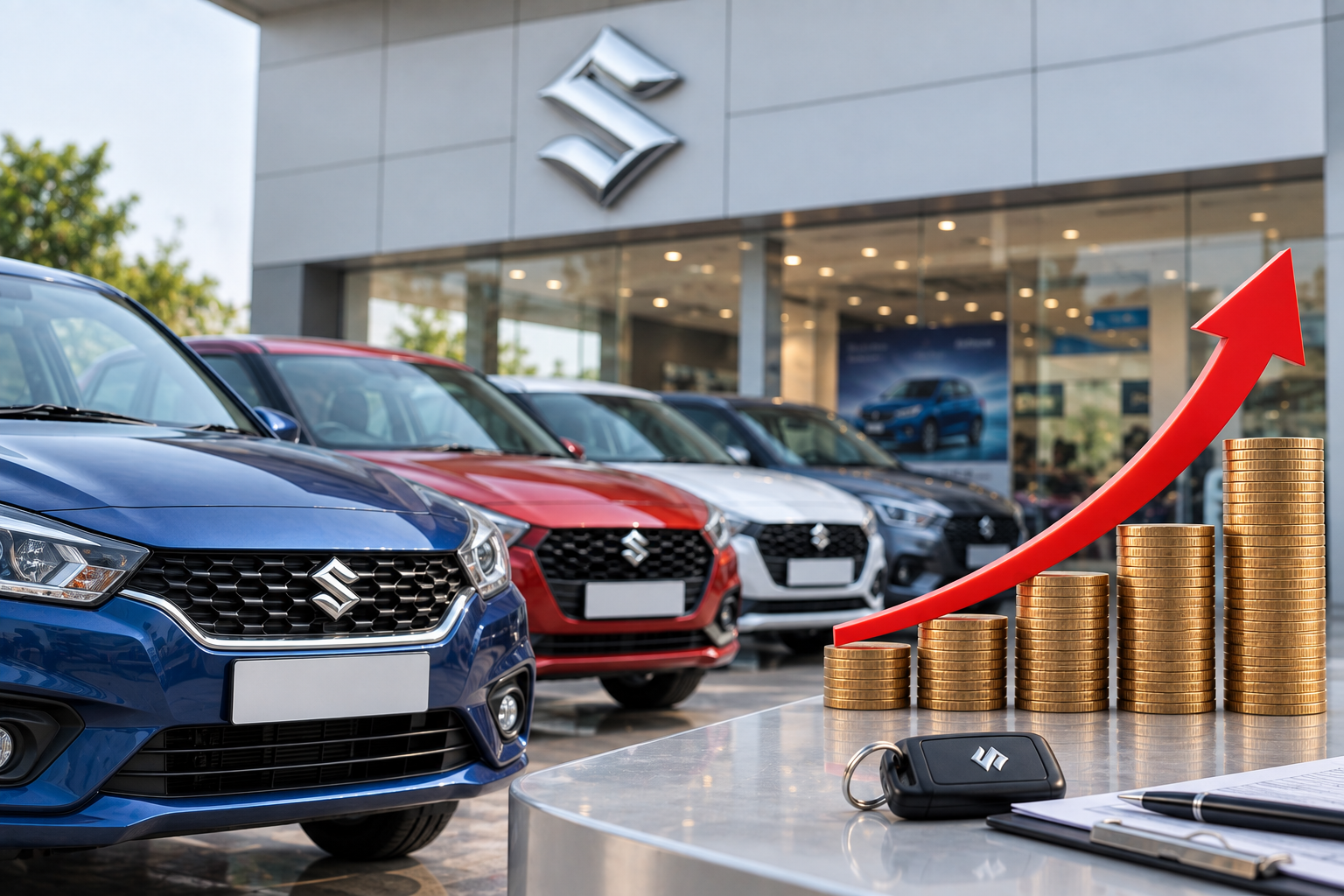
Third Price Increase Since May Comes as Automaker Faces Sustained Input-Cost and Inflationary Pressures
Maruti Suzuki India will increase the prices of select vehicle models by up to ₹20,000 from September 2026, the company said in a filing with the BSE on Monday.
The automaker attributed the latest revision to a sustained increase in input costs and elevated inflationary pressures. The company said it has been taking internal measures to absorb a portion of the additional burden but now has limited room to manage the entire increase without passing some of it on to customers.
The September revision will be Maruti Suzuki’s third price hike since May. However, unlike the earlier increases, which applied across the company’s entire vehicle portfolio, the latest hike will be limited to selected models.
Maruti Suzuki Shares Trade Higher
Maruti Suzuki shares were trading at ₹12,770 on Monday, up 0.60 per cent from the previous close.
The stock touched an intra-day high of ₹12,784 and a low of ₹12,618. Its 52-week trading range stands between ₹12,201 and ₹17,371.60.
The price announcement comes at a time when investors are closely monitoring the company’s sales momentum, product mix, operating margins and ability to manage cost inflation.
While a price increase can support revenue realisations, the market will also assess whether higher prices affect demand, particularly in the entry-level and price-sensitive segments.
Third Price Hike Since May
Maruti Suzuki had announced two earlier price increases since May, both of which applied across its vehicle range.
The latest increase will be more selective. The company has not yet disclosed the exact models or variants that will be affected, and the final increase may differ across products.
The maximum price increase will be ₹20,000 and will become effective during September 2026.
The selective approach could help the company limit the impact on overall demand while allowing it to recover part of the higher production costs.
Why Maruti Suzuki Is Raising Prices
The company said the latest decision was taken because of the “continuous sustained increase in input costs”.
Automobile manufacturers are exposed to fluctuations in the prices of several raw materials and components, including:
-
Steel
-
Aluminium
-
Copper
-
Rubber
-
Plastics
-
Precious metals
-
Electronic components
-
Energy and transportation services
In addition to raw-material prices, automakers face pressure from logistics costs, supplier expenses, labour costs and regulatory requirements.
Maruti Suzuki has been using internal cost-reduction measures to mitigate the impact. However, the company said the cost environment remains challenging and that it is now required to pass on a portion of the increase to the market.
Company Seeks to Limit Impact on Customers
Maruti Suzuki said it would continue its efforts to ensure that the impact of the price increase on customers remains as limited as possible.
The company’s cost-reduction measures may include manufacturing efficiencies, better procurement, supplier negotiations, productivity improvements and optimisation of operating expenses.
However, such measures may not be sufficient to fully offset prolonged cost inflation.
The latest price revision indicates that the company is attempting to maintain a balance between protecting profitability and keeping its vehicles competitive in a price-sensitive market.
Impact on Customers and Vehicle Financing
A price increase of up to ₹20,000 may have a limited impact on the overall cost of a vehicle, but it can still influence purchase decisions in the entry-level segment.
Customers buying vehicles through loans may also face a marginal increase in the total loan amount and monthly instalments.
The final impact will depend on the model, variant, financing structure and discounts offered by dealers.
Customers planning to purchase a Maruti Suzuki vehicle may therefore compare the revised prices, available dealer offers and financing costs before finalising a purchase.
Tata Motors Also Raises Passenger Vehicle Prices
Maruti Suzuki’s announcement follows a similar price increase by Tata Motors.
Tata Motors raised prices of its passenger vehicles by up to ₹25,000 with effect from September 1. The increase covered vehicles powered by internal combustion engines as well as electric vehicles.
The price revisions by two major automakers indicate that input-cost pressure remains a broader industry issue.
If commodity prices and other production expenses remain elevated, more automobile manufacturers may consider selective price increases to protect their margins.
Pricing Power Remains Important
The ability to pass on higher costs to customers is a key factor in determining an automaker’s profitability.
Maruti Suzuki benefits from its strong brand, extensive dealership network and broad product portfolio. These factors provide the company with a degree of pricing flexibility.
However, the Indian passenger vehicle market remains highly competitive. Manufacturers use discounts, exchange offers, financing schemes and promotional benefits to attract customers.
A significant increase in effective purchase costs could encourage some buyers to postpone purchases, select lower-priced variants or consider competing models.
The impact is likely to be more visible in the entry-level segment, where customers are generally more sensitive to price changes.
SUV Demand Could Support Realisations
Consumer preferences in the Indian automobile market have shifted increasingly towards SUVs and utility vehicles.
Maruti Suzuki has been expanding its SUV portfolio to capture this trend. A higher contribution from SUVs can support average selling prices and improve the company’s product mix.
Premium models may also be better positioned to absorb moderate price increases compared with entry-level vehicles.
However, Maruti Suzuki must continue balancing its SUV expansion with demand for affordable hatchbacks and compact cars, which remain important for its overall sales volumes and market reach.
Rural Demand Remains a Key Growth Factor
Rural demand is an important component of Maruti Suzuki’s sales performance, particularly in the entry-level and compact vehicle categories.
Vehicle purchases in rural markets are influenced by agricultural income, monsoon conditions, employment, financing availability and consumer confidence.
A favourable monsoon and improved rural income could support demand despite higher vehicle prices. However, elevated inflation, uneven rainfall or higher borrowing costs may affect purchase decisions.
The company’s ability to maintain demand in smaller cities and rural markets will be an important factor in assessing the impact of the September price hike.
Possible Impact on Margins
The price increase could support Maruti Suzuki’s revenue and operating margins if vehicle volumes remain stable.
The actual benefit, however, will depend on several factors:
-
The models covered by the hike
-
The average price increase
-
Raw-material cost movements
-
Dealer discounts
-
Customer demand
-
Product mix
-
Production efficiency
-
Competitive pricing
If the company successfully passes on a portion of the cost increase without significant volume pressure, the move could help protect profitability.
On the other hand, higher discounts or weaker sales could reduce the expected benefit from the price revision.
Investors Should Track Monthly Sales Data
Monthly vehicle sales will provide an early indication of how customers are responding to the price increase.
Investors should monitor:
Total Sales Volumes
A sustained decline in sales after the price hike could indicate pressure on demand.
Segment-Wise Performance
The performance of hatchbacks, compact cars, SUVs and premium vehicles will help determine which segments are most affected.
Average Selling Prices
An increase in realisations could support revenue even if overall volumes remain stable.
Dealer Inventory
Rising inventory levels may indicate weaker retail demand or increased discounting.
Discount Levels
Higher discounts could reduce the effective benefit of the announced price increase.
Operating Margins
The company’s quarterly margins will indicate whether price hikes are sufficient to offset higher input costs.
Key Risks for Maruti Suzuki
Demand Sensitivity
Higher prices may affect affordability, particularly among first-time buyers and customers in the entry-level segment.
Competitive Pressure
Aggressive pricing or discounts from rival automakers could limit Maruti Suzuki’s ability to pass on higher costs.
Commodity Inflation
Further increases in steel, aluminium, rubber and other raw-material prices could create additional margin pressure.
Rural Market Weakness
Weak rural income growth or an uneven monsoon could affect demand for affordable passenger vehicles.
Product-Mix Risk
A slower-than-expected shift towards SUVs and higher-value models could limit improvement in average realisations.
Financing Costs
Higher interest rates or tighter vehicle-loan conditions could discourage customers from making new purchases.
Market Outlook
Maruti Suzuki’s decision to raise prices of select models by up to ₹20,000 reflects the continuing pressure from higher input costs and elevated inflation.
The selective nature of the September increase suggests that the company is attempting to protect margins while limiting the impact on customer affordability. The move could support revenue realisations if demand remains stable and the company successfully passes on part of the cost increase.
However, the overall impact will depend on the models affected, customer response, dealer discounts and competitive pricing across the passenger vehicle market.
For investors, the key factors to monitor will be monthly sales volumes, SUV demand, rural recovery, commodity prices, average selling prices and operating margins. Maruti Suzuki’s strong brand and distribution network remain important advantages, but sustained cost inflation and competitive pressure could limit the benefits of the latest price hike.