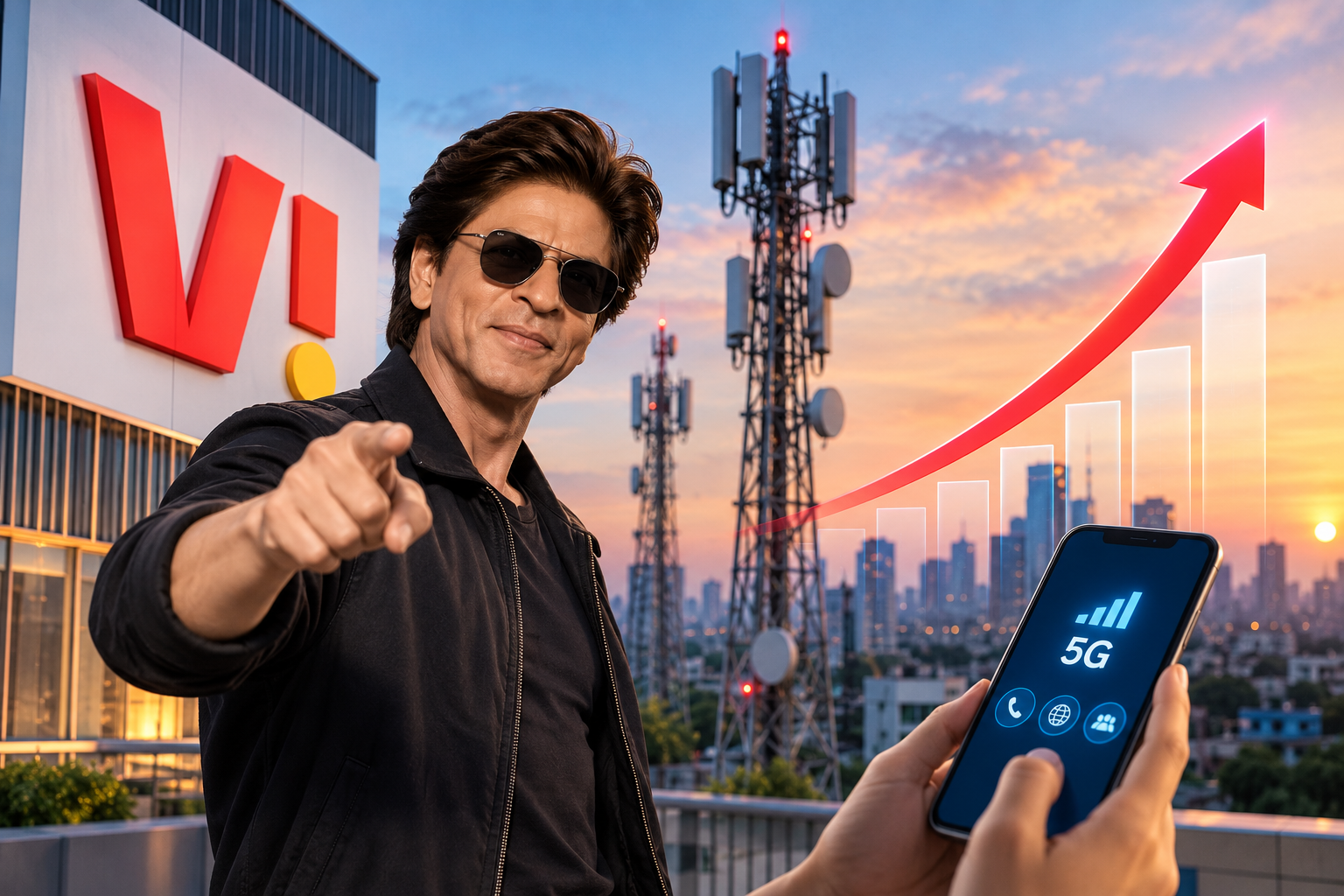
New Brand Identity, Shah Rukh Khan Association and Improving Business Trends Lift Investor Sentiment
Shares of Vodafone Idea surged nearly 4 per cent on Monday, hitting a 25-month high in an otherwise weak stock market. The rally was accompanied by heavy trading volumes, indicating renewed investor interest in the telecom operator.
The stock touched ₹15.65 on the BSE, its highest level since August 30, 2024. Vodafone Idea, which operates under the Vi brand, has extended its recent gains after unveiling a new brand identity and announcing Bollywood actor Shah Rukh Khan as its brand ambassador.
The company’s improving revenue performance, higher average revenue per user and expectations of gradual operational stabilisation have also supported the positive sentiment.
Vodafone Idea Shares Gain 11% in Four Trading Sessions
Vodafone Idea shares have gained approximately 11 per cent in the past four trading sessions. The stock rose nearly 8 per cent over the previous two trading days, extending Friday’s upward movement.
At around 11:00 AM on Monday, the stock was trading 3.2 per cent higher at ₹15.49, while the BSE Sensex was down 0.50 per cent.
Trading activity remained strong, with around 395.3 million equity shares changing hands on the NSE and BSE.
The stock’s latest rally has brought it to its 52-week high of ₹15.65. It has also recovered sharply from its 52-week low of ₹7.16.
New Vi Brand Identity Drives Fresh Interest
Vodafone Idea unveiled its new brand identity on September 1, replacing its earlier “V!” logo with “Vi”.
The company also launched a new campaign with the message “Vi badal raha hai... tayaar rahiye”, signalling a renewed focus on transformation, innovation and customer experience.
Shah Rukh Khan has been appointed as the company’s brand ambassador. The association is expected to strengthen Vi’s consumer visibility and support its effort to create a more aspirational and future-ready brand.
According to the company, Vi is working towards building a stronger brand through:
-
Rapid network expansion
-
Innovation-led products and services
-
Improved customer experience
-
Greater digital engagement
-
Stronger enterprise offerings
-
Better employee experience
-
Wider access to digital services
Vi Chief Executive Officer Abhijit Kishore said the company is building renewed confidence through improving business performance, growing consumer engagement and continued investment in its network.
Revenue Growth Improves Despite Subscriber Decline
Vodafone Idea’s operational performance has shown early signs of improvement, although subscriber-related challenges remain.
The company’s revenue increased 3 per cent year-on-year in the April-June 2026 quarter. This growth came despite a 3 per cent decline in active subscribers and was supported by a 6 per cent rise in average revenue per user.
The increase in ARPU indicates that the company is generating more revenue from each active customer. This could be supported by higher data consumption, customer upgrades and an improved tariff or plan mix.
However, the company’s revenue market share declined to approximately 13 per cent. A significant portion of the market-share loss was concentrated in Mumbai and Gujarat.
Analysts have observed that subscriber losses are moderating while revenue growth remains steady. This suggests that Vodafone Idea may be moving towards gradual operational stabilisation.
Market-Share Trends Remain Mixed
According to Jefferies’ telecom sector assessment, Vodafone Idea gained market share in B-Circles and C-Circles compared with FY26.
The company’s market share increased by approximately 40 basis points in B-Circles and 20 basis points in C-Circles. The gains were led by the eastern Uttar Pradesh circle.
However, Vi lost market share in 13 of its 22 circles and reported revenue declines in five circles.
The bulk of the market-share decline was concentrated in Mumbai and Gujarat. Analysts believe this indicates that competitive pressure may be becoming less broad-based, although the company continues to face challenges in several important markets.
The combination of stable revenue growth, improving subscriber trends and selective market-share gains points towards a gradual recovery in the company’s operating performance.
5G Expansion Remains Central to the Growth Strategy
Vodafone Idea holds a large spectrum portfolio, including mid-band 5G spectrum in 17 circles and millimetre-wave spectrum in 16 circles.
The company provides voice and data services across 2G, 4G and 5G platforms and is expanding its 5G services across 17 circles.
The next phase of growth will depend on Vi’s ability to expand network coverage, improve service quality and convert 5G investments into higher revenue.
The company is developing infrastructure to support newer and smarter technologies for both retail and enterprise customers. It is also strengthening its digital channels and on-ground distribution network to improve customer access and engagement.
Telecom Industry Moves Towards 5G Monetisation
The Indian telecom sector is gradually moving from a phase dominated by network investment towards one focused on 5G monetisation and digital services.
Premium tariff plans, rising data usage, subscriber upgrades, fixed wireless access and enterprise connectivity are expected to support ARPU growth.
At the same time, moderation in 5G capital expenditure could improve free cash flow generation and help telecom companies strengthen their balance sheets.
Major telecom operators are expanding beyond traditional voice and data services into:
-
Home broadband
-
Enterprise connectivity
-
Cloud services
-
Artificial intelligence
-
Data centres
-
Digital platforms
-
Fixed wireless access
-
Internet of Things solutions
These new business areas could create additional revenue opportunities and reduce dependence on conventional mobile services.
Industry Consolidation Supports Pricing Discipline
The Indian telecom industry has consolidated into three private operators and one state-owned player.
This consolidation has helped improve pricing discipline and strengthened the sector’s investment outlook. Earlier, intense competition and aggressive tariff pricing had placed significant pressure on telecom companies’ profitability and cash flows.
Government policy has also played an important role in supporting the industry’s recovery. Telecom infrastructure has enabled the expansion of digital public services, online education, healthcare, financial inclusion and e-governance.
The sector is no longer viewed merely as a commercial business. It has become essential national infrastructure and is expected to play a central role in India’s long-term digital transformation.
AGR Resolution Provides Greater Financial Clarity
Vodafone Idea stated in its FY26 annual report that the conclusion of the Adjusted Gross Revenue matter marked an important turning point for the company.
The company also highlighted continued promoter support, stronger credit ratings and a return to positive subscriber additions as important developments.
Together, these factors have provided a firmer foundation for the next phase of growth.
However, Vodafone Idea continues to face significant financial obligations and requires sustained investment to expand its network and compete effectively with larger rivals.
The company’s ability to improve cash flows, raise funds when required and maintain network investments will remain critical for its long-term sustainability.
Key Challenges Facing Vodafone Idea
Subscriber Retention
Although subscriber losses have moderated, Vi continues to lose customers in several circles. Sustained subscriber retention will be necessary to support long-term revenue growth.
Market-Share Pressure
The company has lost market share in several circles, particularly in important markets such as Mumbai and Gujarat.
Funding Requirements
The expansion of 5G services and network infrastructure requires significant capital expenditure. The company’s financial flexibility remains an important consideration for investors.
Strong Competition
Vodafone Idea faces intense competition from Bharti Airtel and Reliance Jio, both of which have stronger financial positions and extensive network capabilities.
5G Monetisation
The company must convert its 5G investments into higher revenue, improved customer retention and better cash flows. Delays in monetisation could affect profitability.
Tariff Uncertainty
Future tariff increases could support ARPU growth, but aggressive competition or delays in tariff revisions may limit the company’s revenue potential.
Market Outlook
Vodafone Idea’s recent rally reflects renewed investor optimism following its new brand identity, Shah Rukh Khan association and improving operating indicators.
The company’s higher ARPU, moderating subscriber losses and selective market-share gains suggest that the business may be moving towards gradual stabilisation. The expansion of 5G services and the development of enterprise and digital offerings could provide additional growth opportunities.
However, the stock’s sharp rise has also increased the importance of execution. Vodafone Idea will need to improve subscriber retention, expand network coverage, monetise 5G investments and manage its financial obligations effectively.
The stock may remain in focus if the company reports sustained revenue growth and provides evidence of improving cash flows. Nevertheless, investors should closely monitor subscriber trends, market share, funding requirements and competitive intensity before making fresh investment decisions.