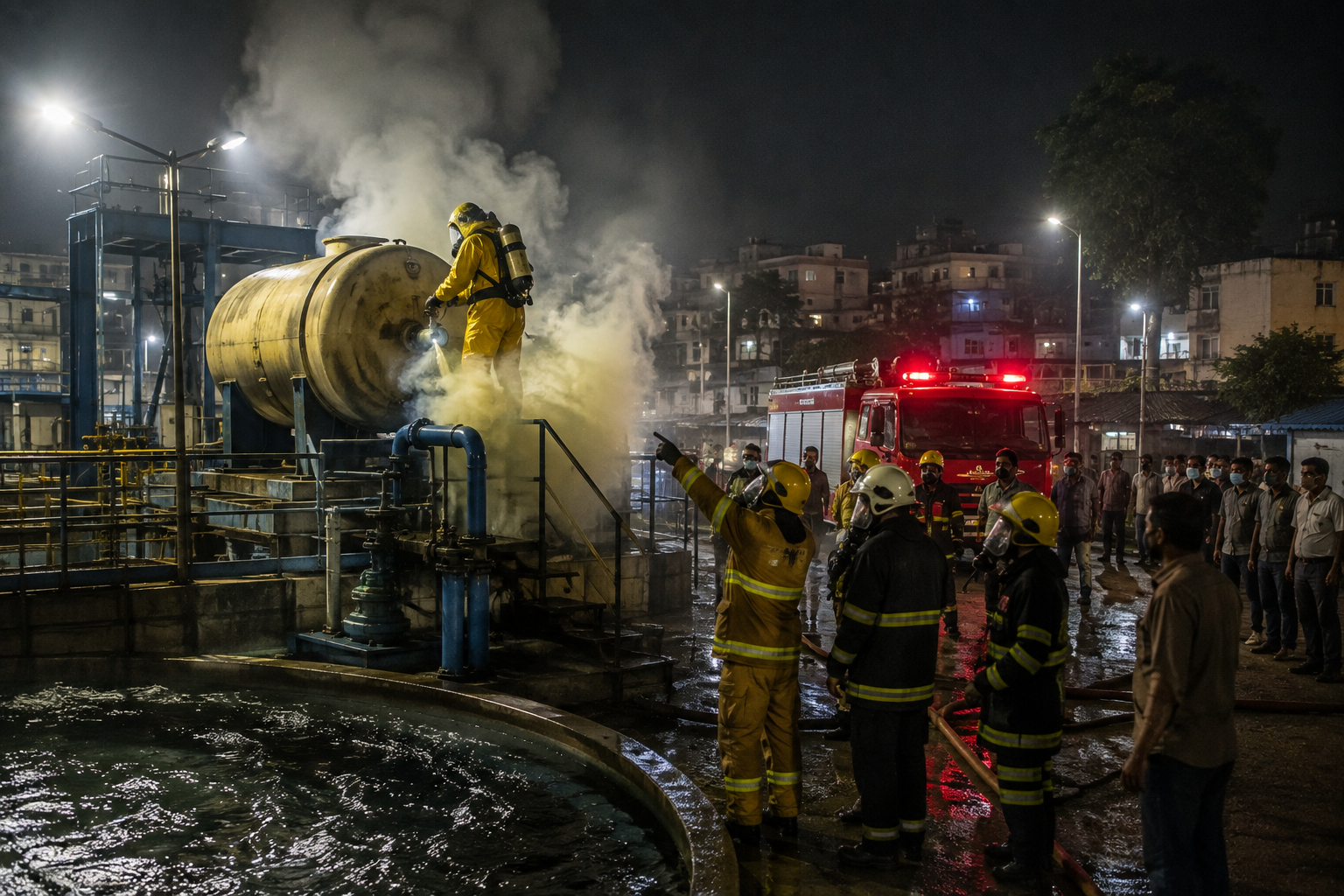
900-kg chlorine cylinder leaks at Godhani facility; residents within 200 metres evacuated as NDRF, firefighters and water utility teams work to contain the situation
A chlorine gas leak at a water treatment plant in Nagpur's Godhani village triggered panic in the early hours of Monday, August 24, after gas spread into nearby residential areas and several people complained of coughing and breathing difficulties.
The incident took place at around 1 am at a water treatment facility operated as part of Nagpur's drinking-water infrastructure. According to civic authorities, the leak originated from a 900-kg-capacity chlorine gas cylinder.
As the gas moved towards nearby settlements, residents rushed out of their homes seeking safer locations. Authorities subsequently launched an emergency response involving the police, fire brigade, Orange City Water Pvt Ltd (OCW) and the National Disaster Response Force (NDRF).
Chlorine leak spreads to residential areas
The incident occurred shortly after midnight, when most residents in the surrounding areas were asleep.
The leakage of chlorine gas created panic as residents began experiencing respiratory discomfort. Several people reportedly developed coughing and difficulty breathing, prompting them to seek medical attention.
Police and civic authorities moved quickly to restrict access to the affected area and prevent further exposure.
Residents living within a 200-metre radius of the water treatment plant were evacuated and shifted to safer locations while emergency personnel worked to control the leak.
Several residents taken to hospitals
A number of people were taken to hospitals following the incident.
According to police, some residents reached hospitals on their own after experiencing symptoms, while others were taken for medical treatment with police assistance.
The available information did not indicate any fatalities from the incident at the time of the report.
Medical evaluation is particularly important following exposure to chlorine because respiratory symptoms can require immediate attention, particularly among people who have had significant exposure.
Firefighters reach site with specialised equipment
After receiving information about the incident, civic fire personnel immediately reached the water treatment plant.
Two water tenders and breathing apparatus were deployed as part of the emergency response.
The use of breathing equipment was important because emergency personnel had to operate in an area potentially affected by chlorine gas.
Personnel from Orange City Water Pvt Ltd, which supplies drinking water in Nagpur, were also called to the site to assist with containment and technical operations.
NDRF joins emergency operation
Given the nature of the incident, a specialised team from the National Disaster Response Force (NDRF) was brought in to assist.
The NDRF worked alongside firefighters and OCW personnel to secure the affected cylinder and prevent further leakage.
The coordinated response involved multiple agencies, with police focusing on evacuation and security while emergency and technical teams concentrated on containment.
Leak brought under control around 5:30 am
Authorities said the chlorine leak was successfully plugged at approximately 5:30 am.
Following containment, emergency teams took additional measures to deal with the affected cylinder.
The NDRF, firefighters and OCW personnel placed the chlorine cylinder in a tank containing water mixed with caustic soda, according to the civic body's statement.
The operation was aimed at managing the remaining chlorine and reducing the possibility of further leakage.
Police cordon off affected zone
Security personnel from Mankapur police station cordoned off the affected area after the incident.
Residents within the 200-metre safety zone were evacuated, while people living in nearby settlements were advised to move away from the affected location.
The evacuation was intended to reduce the risk of further exposure while the emergency operation continued.
Authorities also appealed to residents to remain calm and follow instructions issued by officials.
Police urge residents to avoid rumours
The sudden gas leak led to panic among residents, prompting police to issue an appeal against misinformation.
Authorities urged people not to believe rumours and to rely on official information.
During an emergency involving a hazardous substance, inaccurate information can cause additional panic and complicate evacuation and rescue operations.
Officials therefore emphasised the importance of following instructions from the police, municipal authorities and emergency-response teams.
Why chlorine is used at water treatment plants
Chlorine is widely used in water-treatment processes because of its ability to disinfect water and control harmful microorganisms.
However, chlorine gas must be handled and stored under strict safety procedures because an accidental release can pose a serious risk to people in the immediate vicinity.
Water-treatment facilities therefore require appropriate storage systems, leak-detection mechanisms, protective equipment and emergency-response plans.
The Nagpur incident could lead authorities to examine whether existing safeguards at the facility require further strengthening.
Safety review likely to be important
Once the immediate emergency is over, determining the cause of the cylinder leak will be a key priority.
Authorities may examine the condition of the cylinder, associated equipment and handling procedures to determine what triggered the release.
A comprehensive safety review could also look at:
-
Condition and maintenance of chlorine cylinders
-
Leak-detection systems
-
Storage and handling procedures
-
Emergency evacuation protocols
-
Availability of protective equipment
-
Training of plant personnel
-
Communication systems for nearby communities
-
Coordination between the water utility and emergency agencies
Such measures can help reduce the risk of similar incidents in the future.
Importance of emergency preparedness
The incident highlights the importance of emergency preparedness at industrial and public-utility facilities that handle hazardous substances.
Water treatment plants are essential public infrastructure, but many are located relatively close to populated areas. Any chemical leak can therefore affect not only plant employees but also surrounding communities.
Regular emergency drills, clear evacuation routes and coordination between municipal authorities, police, firefighters and disaster-response agencies can significantly improve preparedness.
Early detection is also critical because it can allow authorities to isolate a leak before it spreads into densely populated areas.
Impact on nearby communities
For residents living close to the Godhani facility, the incident has raised concerns about safety around the water-treatment plant.
The evacuation of residents within 200 metres demonstrates the need for clearly defined emergency zones around facilities handling hazardous chemicals.
Authorities may need to assess whether residents in surrounding areas are sufficiently informed about emergency procedures and whether communication systems can quickly alert communities during a chemical incident.
Water supply operations under focus
The incident has also placed attention on the safety of Nagpur's water-treatment infrastructure.
Since OCW personnel were involved in the response, authorities may assess whether normal water-treatment operations were affected during the emergency.
The priority during such an incident remains the safety of workers and residents, followed by ensuring that water-treatment operations can resume safely once the affected equipment has been secured.
Any restart of the affected facility would be expected to follow appropriate safety checks.
Lessons for urban infrastructure
The Nagpur incident offers a wider lesson for rapidly expanding cities where critical infrastructure increasingly operates near residential communities.
As cities grow, water-treatment plants, industrial facilities and other utility installations can become surrounded by larger populations.
This increases the importance of:
Advanced monitoring: Continuous systems that can identify leaks at an early stage.
Regular maintenance: Periodic inspection of cylinders, valves, pipelines and related equipment.
Emergency planning: Clearly defined evacuation zones and response procedures.
Community awareness: Residents should know how to respond if an emergency occurs.
Multi-agency coordination: Police, fire services, municipal bodies, utilities and disaster-response agencies should have established coordination mechanisms.
Nagpur chlorine gas leak: Key facts
| Detail | Information |
|---|---|
| Location | Godhani village, Nagpur |
| Incident | Chlorine gas leak |
| Approximate time | 1 am, Monday |
| Equipment involved | 900-kg-capacity chlorine cylinder |
| Impact | Gas spread to nearby residential areas |
| Symptoms reported | Coughing and breathing difficulties |
| Evacuation zone | 200-metre radius |
| Emergency agencies | Fire brigade, police, NDRF and OCW |
| Leak contained | Around 5:30 am |
| Medical response | Several people taken to hospitals |
| Current focus | Safety, containment and investigation |
What happens next?
With the leak reportedly brought under control, authorities are likely to focus on determining the precise cause of the incident and assessing the safety of the affected facility.
A detailed technical examination of the chlorine cylinder and related equipment could help establish whether the incident resulted from equipment failure, maintenance issues, handling procedures or another factor.
Authorities may also review the emergency response and evacuation process to identify areas that can be improved.
Outlook
The Nagpur chlorine gas leak is a reminder of the risks associated with handling hazardous chemicals at essential public infrastructure facilities.
The rapid mobilisation of firefighters, police, OCW personnel and the NDRF helped authorities contain the leak and move residents away from the affected area. However, the long-term significance of the incident will depend on the findings of the safety assessment and the preventive measures implemented afterwards.
For communities living near water-treatment facilities, robust safety systems, reliable warning mechanisms and clearly communicated emergency procedures are essential.
The immediate priority is now to ensure that all affected residents receive appropriate medical attention, the facility is thoroughly inspected and the root cause of the leak is established. Strengthening preventive systems could help ensure that a similar incident does not pose a wider risk to Nagpur's residential communities in the future.