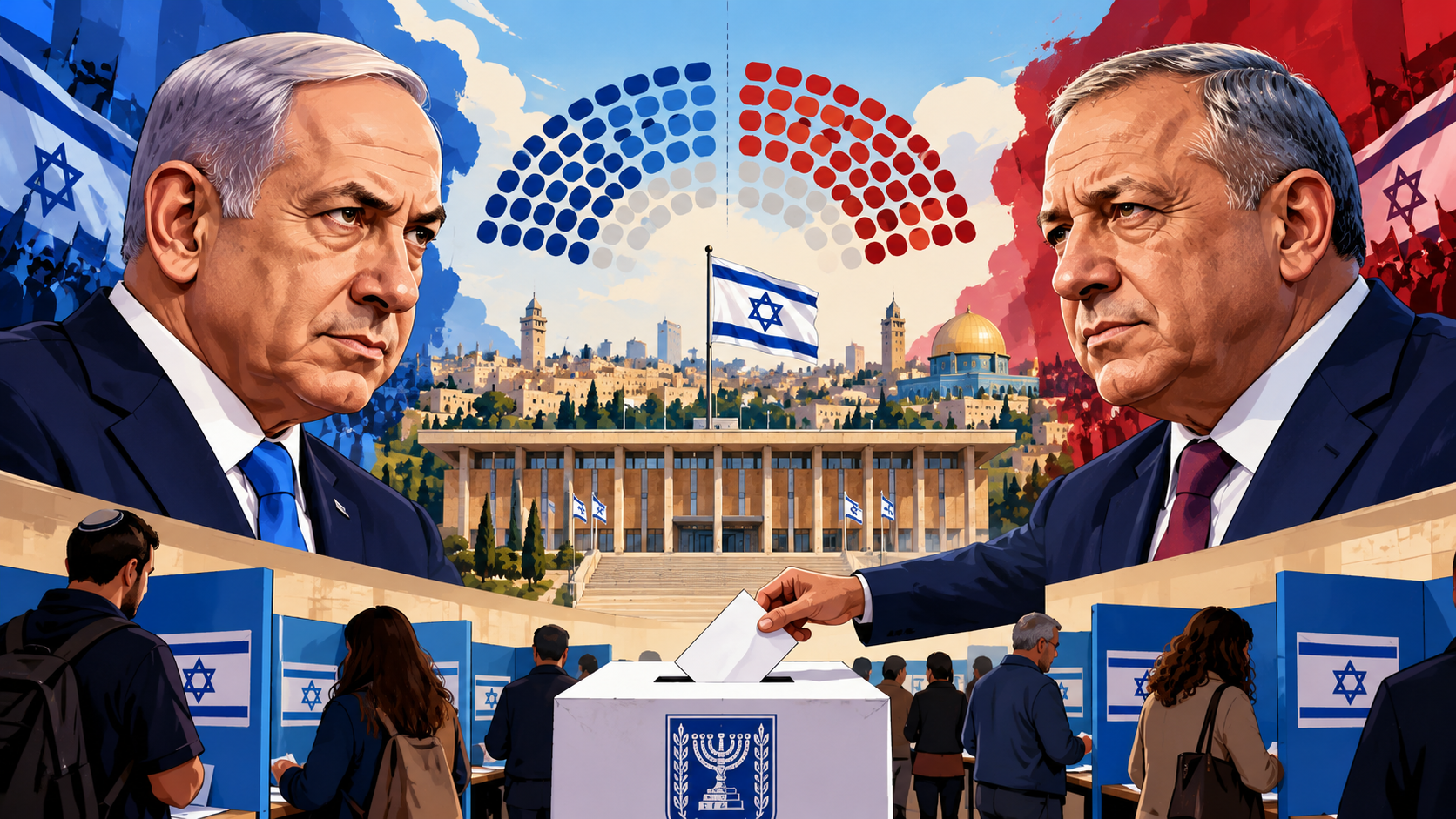
Exit polls indicate a closely fought election, with Prime Minister Benjamin Netanyahu’s right-wing alliance and opposition leader Gadi Eisenkot’s centrist bloc each projected to win 51 seats in the 120-member parliament. Arab parties could emerge as kingmakers as coalition negotiations threaten to prolong political uncertainty.
Israel faces a potentially prolonged period of political uncertainty after exit polls from its latest parliamentary election showed Prime Minister Benjamin Netanyahu and opposition leader Gadi Eisenkot locked in a tight contest, with neither bloc projected to secure the majority required to form a government independently.
Two exit polls released after voting concluded late Tuesday indicated that Netanyahu’s religious right-wing alliance and Eisenkot’s more centrist bloc were each on course to win 51 seats in the 120-member Knesset. A third exit poll showed Netanyahu marginally ahead after earlier projections had suggested an advantage for Eisenkot.
The projections suggest that coalition negotiations will determine who becomes Israel’s next prime minister. With votes still being counted, the final seat distribution could change, and the outcome remains uncertain.
The election is particularly significant because it is the first national vote since the Hamas-led attacks of October 7, 2023, which triggered a prolonged period of regional conflict and reshaped Israel’s domestic political debate.
Netanyahu and Eisenkot Claim Momentum After Voting
Both political camps expressed confidence that they could assemble a governing coalition despite the closely divided projections.
Netanyahu, 77, appeared before supporters in Jerusalem in the early hours of Wednesday and declared that his right-wing bloc had secured a decisive majority. He highlighted his relationship with US President Donald Trump and reiterated his commitment to confronting Iran, indicating that security policy would remain central to his political agenda.
Eisenkot, 66, a former military chief of staff, presented himself as an alternative to Netanyahu’s leadership. He criticised the outgoing government’s record and argued that voters had called for political change.
Eisenkot also urged political parties to avoid another election, saying the country needed a new government capable of addressing its security and domestic challenges.
Despite the competing claims, exit polls do not establish the final result. The distribution of seats and the willingness of smaller parties to join either camp will ultimately determine which leader has the strongest path to forming a government.
Arab Parties Could Become Kingmakers
Israel’s two Arab parties are emerging as potentially decisive players in the coalition negotiations. The exit polls projected that they could collectively secure 18 seats, giving them significant influence in a parliament where neither major bloc appears close to an outright majority.
Both parties have indicated support for Eisenkot’s effort to replace Netanyahu, having encouraged voters to participate in the election and oppose another term for the incumbent.
Their projected strength could provide Eisenkot with an important parliamentary advantage. However, the arithmetic of forming a government is only one part of the challenge. Political differences over security, governance and other policy priorities could complicate negotiations.
The positions adopted by smaller parties will also matter. Even if one candidate secures more seats than the other, the ability to assemble a coalition with sufficient parliamentary backing will be essential.
Israel has a long history of coalition governments, as no single party has ever won an outright majority in a national election. Negotiations can take days or weeks, and the final arrangement may involve compromises over ministerial appointments and policy commitments.
Likud Expected to Remain the Largest Single Party
Although the broader contest appears close, Netanyahu’s Likud party is projected to remain the largest individual party in the Knesset. However, it is expected to win substantially fewer seats than it secured in the previous election in 2022.
Eisenkot’s Yashar party is projected to finish second, according to the reported exit-poll estimates.
The distinction between the largest individual party and the largest potential governing coalition is important. A party can lead the election in terms of seats but still struggle to form a government if rival parties can assemble a larger parliamentary bloc.
Israel’s president, Isaac Herzog, is expected to nominate the candidate considered best placed to form a government after reviewing the final results and consulting political parties.
Until a successor is selected and a government is formed, Netanyahu will remain prime minister, retaining the authority of the office during the transition period.
Election Follows Years of War and Domestic Political Turmoil
The election took place against the backdrop of extensive military operations and continuing debate over the government's handling of national security.
Netanyahu has faced criticism from Israelis who blame his administration for failing to prevent the October 7, 2023, Hamas attacks. The assault was the deadliest day in Israel’s history, and the subsequent military campaigns in Gaza and elsewhere have kept security at the centre of national politics.
Netanyahu has defended his military strategy, arguing that the operations have strengthened Israel’s security and addressed threats from regional adversaries, including Iran.
Eisenkot has also emphasised national security but has attempted to distinguish his approach from that of the incumbent. On Iran, he has advocated curbing the country's nuclear programme, including through military action if necessary, while arguing that regime change in Tehran is not an achievable objective.
The competing positions suggest that a change in leadership would not necessarily produce a fundamental shift in Israel’s security priorities. However, differences in decision-making, diplomatic engagement and the management of military operations could influence the country's future approach.
The possibility of renewed confrontation with Iran remains a particularly important concern. Netanyahu has indicated that he would continue coordinating closely with Trump, while the timing and direction of any future military action could depend on developments during the coalition-formation period.
High Voter Turnout Highlights Political Stakes
Voter participation approached record levels during the election, reaching approximately 78% shortly before polling closed at 10 p.m., according to the reported figures from the Central Elections Committee.
Polling stations in parts of Tel Aviv experienced heavy crowds, with queues extending through schools and into surrounding streets. Political parties organised public outreach activities as voters turned out to influence the country's direction.
The high participation rate underlines the significance of the contest, particularly after years of conflict, domestic political divisions and public debate over the government's performance.
Beyond national security, voters were concerned about several domestic issues, including military service requirements for ultra-Orthodox men, the role of the Supreme Court, judicial independence, government transparency and corruption allegations.
These issues could become central to coalition negotiations. Smaller parties may seek policy concessions in exchange for supporting a candidate, potentially making the formation of a stable government more complicated.
Palestinian Issues and Regional Policy Remain Uncertain
The election is unlikely to produce an immediate change in conditions for Palestinians in Gaza and the occupied West Bank.
Both Netanyahu and Eisenkot have rejected a two-state solution on security grounds, although Eisenkot has criticised aspects of the government's approach towards Palestinians, including its support for Israelis accused of attacking Palestinian communities.
Consequently, a change in leadership would not necessarily translate into an immediate shift in policy towards the Palestinian territories.
The broader regional outlook will also depend on developments involving Iran, Lebanon and other areas affected by the conflict. Israel's next government will need to balance military priorities, diplomatic relationships and domestic pressure over the costs and consequences of prolonged hostilities.
The close election result could influence how quickly a new administration establishes its priorities and how much political room it has to make significant policy changes.
Economic Challenges Await the Next Government
Although security dominated the election campaign, economic pressures will remain a major challenge for whoever takes office.
Israel's economy has demonstrated resilience despite repeated military conflicts, with the shekel and domestic stock market reportedly outperforming many developed-market peers during the year. However, this resilience does not eliminate the financial burden of prolonged hostilities.
The next government will face pressure from rising defence expenditure, elevated sovereign debt and a high cost of living. Spending requirements associated with military operations can place additional pressure on public finances and complicate efforts to manage the budget.
Higher defence spending may also require difficult choices involving taxation, public services and other government expenditure. Meanwhile, households and businesses will be watching inflation, borrowing costs and consumer demand for signs of economic stability.
Political uncertainty could further complicate economic policymaking if coalition negotiations become prolonged or produce a fragile government. Investors will be monitoring whether the new administration can establish a credible fiscal strategy while addressing security requirements.
The shekel and Israeli equities may also respond to developments in coalition formation, regional tensions and expectations for government spending. However, market movements will depend on a combination of domestic and global factors rather than the election outcome alone.
Market Outlook: Investors Watch Coalition Talks and Regional Risks
The closely contested election introduces another source of uncertainty for Israeli financial markets. With exit polls projecting 51 seats each for Netanyahu’s alliance and Eisenkot’s bloc, the ability of either candidate to secure support from smaller parties will be a key determinant of the political outlook.
In the near term, investors are likely to focus on the final seat count, coalition negotiations and the prospects of a stable government. A relatively quick agreement could reduce political uncertainty, while prolonged negotiations or the possibility of another election could weigh on sentiment.
Regional security developments will remain equally important. Any escalation involving Iran or other regional actors could affect defence expenditure, investor confidence, currency movements and the broader economic outlook.
Israel's economy and financial markets have shown resilience during periods of conflict, but continued military spending, sovereign debt pressures and domestic political divisions remain risks.
For investors, the key indicators to monitor include the final election results, the composition of the next government, fiscal policy announcements, the shekel's performance and developments in regional security. Until the coalition picture becomes clearer, a cautious assessment of political and economic risks is warranted.