Investment partnership targets Japanese businesses, skilled workforce, technology, tourism and GCCs as Uttar Pradesh strengthens its position as a major destination for Japanese investment
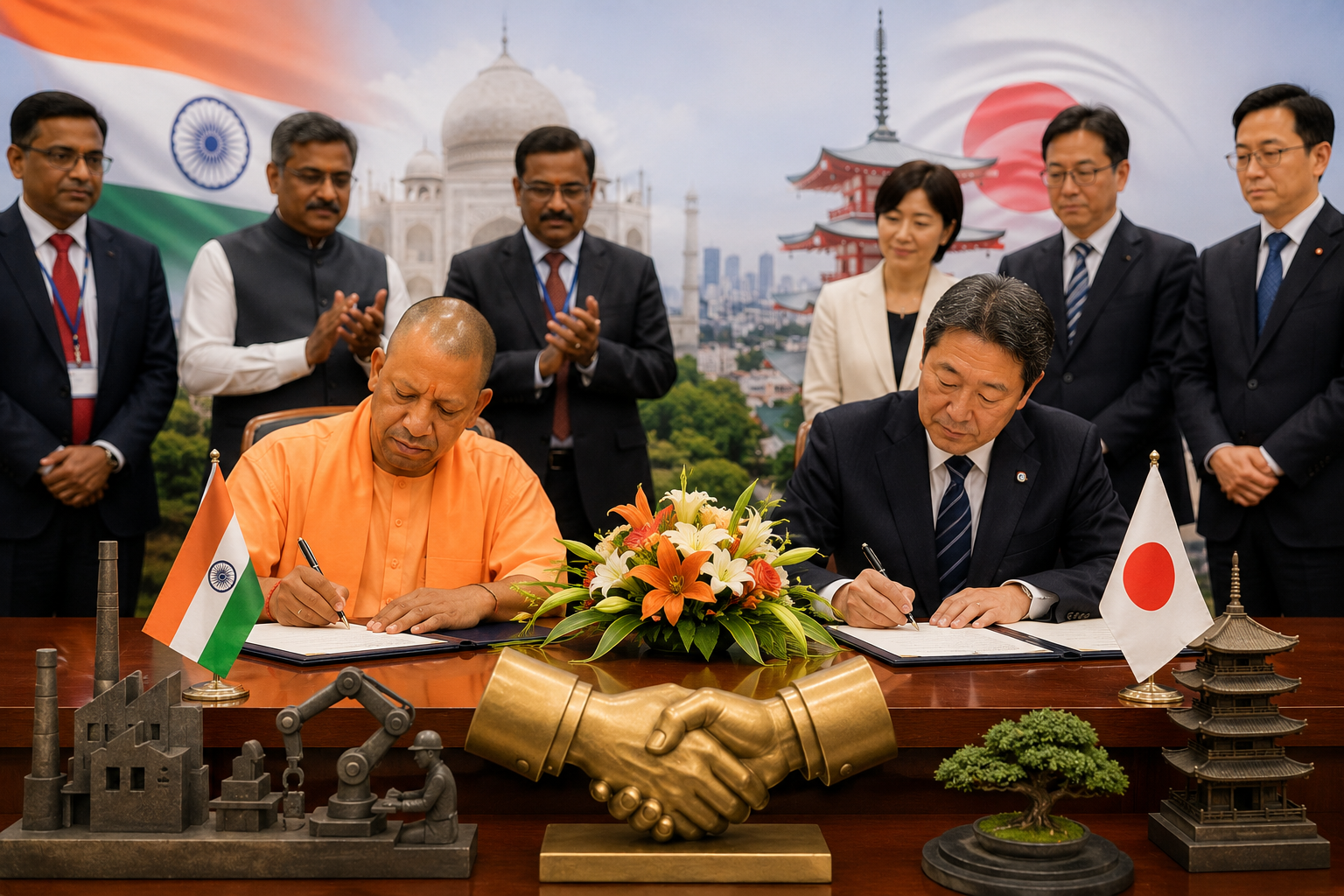
Uttar Pradesh has taken another significant step towards deepening its economic engagement with Japan after the state government and Yamanashi Prefecture signed four Memoranda of Understanding (MoUs) covering investment, technical skills, tourism and technology.
The partnership also includes a major ₹600-crore fund to support micro, small and medium enterprises (MSMEs) from Yamanashi that are looking to invest and establish operations in Uttar Pradesh.
The agreements were announced at the Japan–India Business Networking Event in Lucknow on August 21, bringing together government representatives and business stakeholders from both sides.
The latest initiative reflects Uttar Pradesh's broader strategy of attracting international investment while simultaneously developing skilled manpower, strengthening industrial capabilities and creating a more investor-friendly ecosystem.
Four MoUs create a broader India-Japan cooperation framework
The agreements between Uttar Pradesh and Yamanashi go beyond conventional investment promotion.
The four MoUs cover technical training and workforce development, tourism, Japanese Global Capability Centres (GCCs), and skilled manpower development.
This multi-sector approach could help create stronger long-term economic links between businesses and institutions in the two regions.
The objective is not only to attract Japanese capital but also to create the ecosystem required for Japanese companies to operate successfully in Uttar Pradesh.
For the state, this could translate into new investment, technology transfer and employment opportunities. For Japanese companies, it could provide access to India's large consumer market, industrial infrastructure and expanding talent pool.
Technical training to support Japanese businesses
One of the most important agreements focuses on technical education and workforce development.
Invest UP and the Technical Training & Research Centre in Kanpur will work together on technical training, workforce development and placement opportunities.
The initiative is designed to create a workforce whose technical capabilities are aligned with the requirements of Japanese businesses.
Access to appropriately trained workers is often a critical consideration for companies entering a new market. By building specialised training programmes, Uttar Pradesh can potentially reduce recruitment and training challenges for Japanese companies.
The partnership could also improve employment opportunities for local workers by providing training linked to actual industry requirements.
Japanese-language workforce gets special attention
Language skills form another important component of the cooperation.
The Uttar Pradesh Labour Department and Yamanashi will work towards developing a pool of Japanese-language-proficient workers who can meet employment requirements in Japan and support Japanese companies operating in India.
Japanese-language capabilities could become an important competitive advantage for Uttar Pradesh as more Japanese companies establish manufacturing and service operations in the state.
A workforce capable of communicating effectively with Japanese management teams could improve operational coordination and reduce cultural and communication barriers.
The initiative could also create opportunities for skilled Indian workers to seek employment in Japan.
Tourism partnership to promote Buddhist and cultural links
The cooperation is not limited to business.
The Uttar Pradesh Tourism Department and Yamanashi Prefecture will work together to promote Buddhist and cultural tourism.
Uttar Pradesh has several destinations of importance to Buddhist pilgrims and international visitors, while Japan has a strong cultural and historical connection with Buddhism.
Greater cooperation could help increase the number of Japanese tourists visiting Uttar Pradesh and encourage the development of tourism-related services.
Improved promotion, travel facilitation and cultural exchanges could benefit hotels, transportation providers, tour operators, handicraft businesses and other tourism-linked industries.
Japanese GCCs targeted in Noida and Greater Noida
Another major area of focus is attracting Japanese Global Capability Centres to Uttar Pradesh, particularly in Noida and Greater Noida.
GCCs have increasingly become important contributors to India's technology and business-services ecosystem.
Japanese companies establishing GCCs in the state could create opportunities in areas including information technology, engineering, finance, research and development, analytics and business services.
Noida and Greater Noida already have a growing corporate and technology ecosystem, making them natural locations for Japanese companies seeking access to skilled professionals and modern commercial infrastructure.
The government's focus on Japanese GCCs could therefore help diversify investment beyond traditional manufacturing.
₹600-crore fund gives MSMEs a dedicated investment channel
The announcement of the ₹600-crore fund for Yamanashi-based MSMEs is arguably one of the most significant elements of the partnership.
Small and medium-sized companies often face greater challenges when entering overseas markets compared with large multinational corporations.
Financing, land, regulatory approvals, market research, local partnerships and workforce recruitment can all become barriers to expansion.
The proposed fund is intended to make it easier for Yamanashi-based MSMEs to explore and invest in Uttar Pradesh.
By providing a dedicated financial mechanism, the initiative could encourage smaller Japanese businesses to consider investments that might otherwise be difficult to undertake.
MSMEs could become a major source of technology transfer
Japanese MSMEs are known for specialised capabilities across several industrial and technology segments.
If companies supported through the new fund establish manufacturing or technology operations in Uttar Pradesh, the partnership could generate benefits beyond direct investment.
Potential benefits include:
-
Technology transfer
-
Local employment generation
-
Technical training
-
Development of supplier networks
-
Manufacturing capability enhancement
-
Export opportunities
-
Integration into Japanese supply chains
For Uttar Pradesh, the arrival of specialised Japanese MSMEs could therefore contribute to the development of a deeper industrial ecosystem.
Potential boost for manufacturing and supply chains
Japanese investment could be particularly relevant to Uttar Pradesh's manufacturing ambitions.
The state's large workforce, extensive industrial base and access to major domestic markets create opportunities for companies looking to establish production facilities.
Japanese companies could potentially participate in sectors such as engineering, electronics, automotive components, machinery, precision manufacturing and other industrial activities.
The development of local supplier networks around these businesses could create a multiplier effect, allowing Indian MSMEs to become part of larger Japanese-linked value chains.
Dedicated Yamanashi Desk to support investors
To facilitate greater business engagement, Uttar Pradesh Chief Minister Yogi Adityanath announced a dedicated Yamanashi Desk at Invest UP.
The desk is expected to act as a specialised interface for Japanese businesses and investors from Yamanashi.
A dedicated support mechanism can be particularly useful for smaller companies that may not have extensive experience navigating India's investment procedures.
The desk could help coordinate information related to approvals, land, infrastructure, government schemes and other investment requirements.
Coordination with JETRO and JICA
The state also plans regular coordination with the Japan External Trade Organization (JETRO) and the Japan International Cooperation Agency (JICA).
Greater coordination with Japanese institutions could help improve communication between prospective investors and Uttar Pradesh authorities.
It may also help identify potential investment projects, technical cooperation opportunities and workforce-development programmes.
The involvement of established Japan-linked institutions could strengthen the credibility and institutional foundation of the partnership.
90-day review mechanism aims to improve execution
Investment announcements frequently face a gap between commitments and actual project implementation.
To address this challenge, Uttar Pradesh plans a 90-day review mechanism to track the progress of projects.
The mechanism is expected to monitor areas such as investment progress, land allotment and project-related issues.
Regular reviews could help identify administrative bottlenecks at an early stage and allow the government to intervene before projects face prolonged delays.
For investors, predictable project execution and faster resolution of issues can be an important factor when deciding where to allocate capital.
Legislative ties add another dimension
Economic cooperation between Uttar Pradesh and Yamanashi is also being supported through institutional engagement.
A separate agreement was signed between the Uttar Pradesh Legislative Assembly and the Yamanashi Prefectural Assembly.
The agreement provides for mutual visits, information sharing and exchanges of experience.
Such exchanges can help build stronger institutional relationships and provide opportunities to share approaches to governance, economic development and public policy.
Although these activities may not immediately translate into investment, they can contribute to the long-term foundation of bilateral cooperation.
Why Japan is important for Uttar Pradesh
Japan has long been an important source of investment, technology and industrial expertise for India.
Japanese companies have established operations across several sectors, while Japanese manufacturing practices and workforce-training models have influenced industrial development in the country.
For Uttar Pradesh, deeper engagement with Japanese investors could support its ambition to become a major manufacturing and investment hub.
The state can potentially leverage Japanese expertise in areas where precision, quality, process efficiency and advanced technology are particularly important.
Opportunity for employment generation
One of the biggest potential benefits of the partnership is employment creation.
New manufacturing units, GCCs and MSME operations could generate direct employment, while supplier networks and service providers could create additional indirect jobs.
The emphasis on technical and Japanese-language training could make the workforce more employable in both Japanese-owned businesses in Uttar Pradesh and employment opportunities in Japan.
This creates the possibility of a two-way talent pipeline, connecting Uttar Pradesh's workforce with Japanese industry.
Technology and skills could be as important as capital
The economic significance of the partnership should not be measured only by the amount of investment attracted.
Technology transfer and skills development could have a longer-term impact on the state's industrial competitiveness.
Japanese companies could introduce new manufacturing techniques, quality-control systems, engineering practices and workforce-management processes.
Local businesses that become suppliers to Japanese companies could also gain exposure to higher production and quality standards.
Over time, this could improve the competitiveness of the wider MSME ecosystem.
Challenges remain despite the positive outlook
While the partnership presents significant opportunities, its success will depend on execution.
Signing MoUs does not automatically translate into investment or job creation. The state will need to ensure that announced projects move efficiently from agreement to implementation.
Land availability, infrastructure, regulatory approvals, skilled manpower and project timelines will remain important factors.
The proposed 90-day review mechanism and Yamanashi Desk could help address some of these challenges, but their effectiveness will depend on how quickly issues are resolved.
What investors and businesses should watch
The next stage of the partnership will be measured by tangible outcomes.
Key indicators to watch include:
-
Number of Yamanashi MSMEs entering Uttar Pradesh
-
Actual investment committed and deployed
-
Number of Japanese GCCs established
-
Jobs created through new projects
-
Progress of technical training programmes
-
Number of Japanese-language-trained workers
-
Growth in Japanese tourist arrivals
-
Land allotment and project implementation timelines
-
Technology-transfer agreements
-
Development of local supplier networks
-
Progress under the ₹600-crore MSME fund
Outlook: A potential new chapter in Japan-UP economic ties
The Uttar Pradesh–Yamanashi partnership represents a broader model of international economic cooperation that combines investment, skills, tourism, technology and institutional engagement.
The ₹600-crore MSME fund could be particularly important because it targets smaller Japanese businesses that may have significant technical expertise but require additional support to enter a new market.
Meanwhile, the focus on Japanese GCCs, technical training and language skills could help create a more integrated ecosystem for Japanese companies operating in Uttar Pradesh.
For the state, the immediate challenge is to convert the MoUs into actual factories, offices, jobs, technology partnerships and business activity.
Investor and business takeaway
Uttar Pradesh's latest agreements with Japan's Yamanashi Prefecture strengthen the state's efforts to attract global investment and develop an internationally connected industrial ecosystem.
The ₹600-crore MSME fund, dedicated Yamanashi Desk, technical-training partnership and push for Japanese GCCs could collectively create a stronger platform for Japanese businesses seeking to expand into India.
The partnership also has the potential to benefit local MSMEs through technology transfer, supplier opportunities and integration into Japanese value chains.
However, the real economic impact will depend on implementation rather than announcements alone. Faster approvals, reliable infrastructure, skilled manpower and effective monitoring will determine how quickly Japanese investment commitments translate into operational projects.
If successfully executed, the Uttar Pradesh–Yamanashi partnership could evolve from a series of MoUs into a long-term investment and technology corridor, strengthening Japanese business participation in Uttar Pradesh while creating new opportunities for MSMEs, workers and local industries.