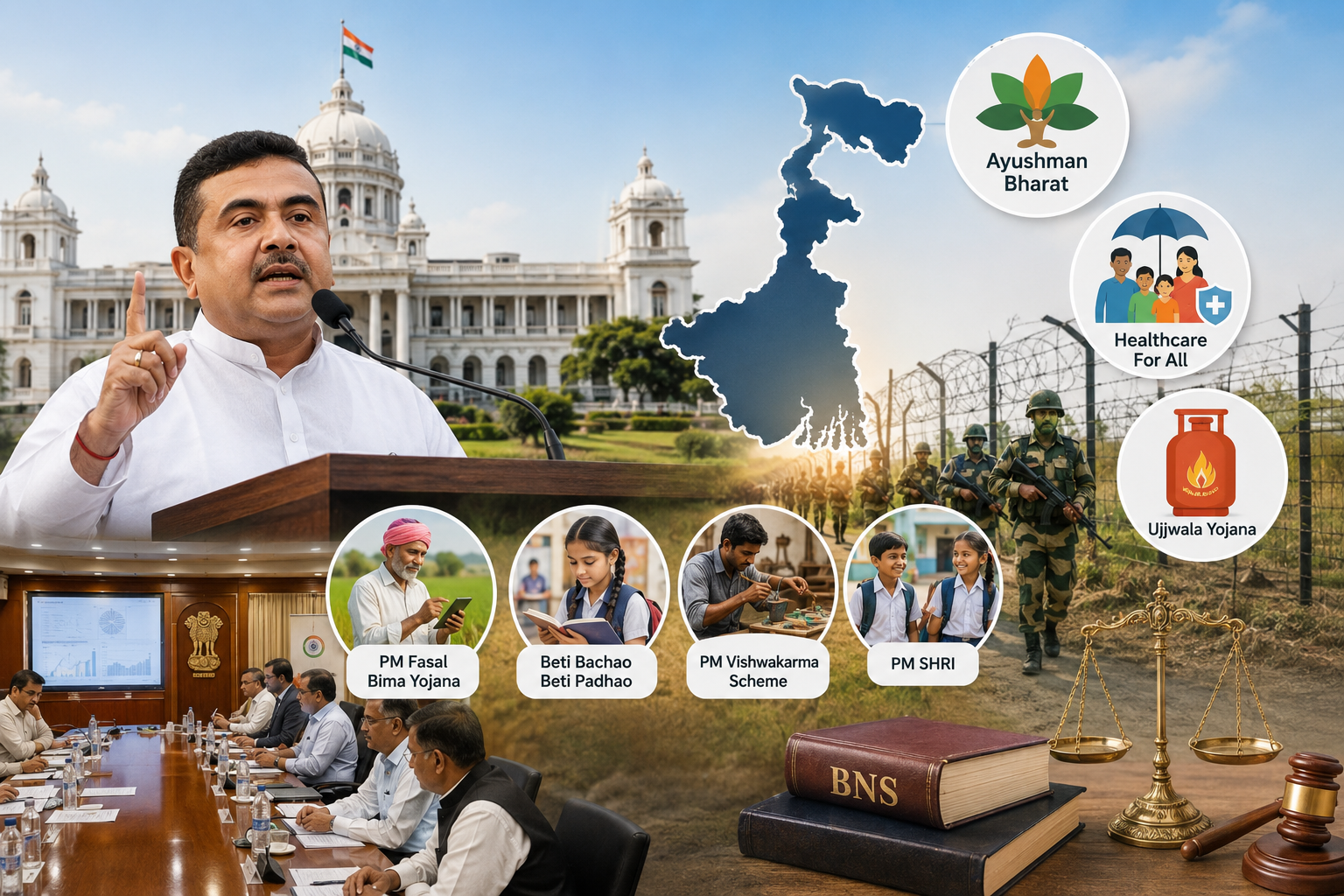
Ayushman Bharat Rollout, Administrative Reforms and Double-Engine Governance Mark Major Policy Shift in State
The newly formed BJP government in West Bengal has announced a sweeping policy overhaul by deciding to implement Ayushman Bharat and several flagship Central Government welfare programmes across the state.
Chief Minister Suvendu Adhikari made the announcements after the first cabinet meeting held at Nabanna, describing the move as the beginning of a new era of “good governance, security and development” under a double-engine government framework.
The decisions signal one of the biggest administrative and political shifts in West Bengal in recent decades, with the new government seeking closer policy alignment with the Centre and faster implementation of welfare programmes.
Ayushman Bharat to Strengthen Healthcare Coverage
Among the most significant announcements was the state’s formal decision to join the Ayushman Bharat scheme, India’s largest public healthcare insurance initiative.
The West Bengal government has directed senior health officials to complete the agreement process with the Union Health Ministry at the earliest. Once implemented, the programme is expected to provide cashless healthcare benefits to lakhs of economically weaker families across the state.
The scheme offers financial protection for secondary and tertiary healthcare treatments at empanelled hospitals nationwide, potentially reducing out-of-pocket healthcare expenses for rural and low-income households.
Analysts believe the move could significantly improve healthcare accessibility in West Bengal while increasing the flow of healthcare investments into hospitals, diagnostics and medical infrastructure.
Central Welfare Schemes to See Faster Implementation
The state government also announced plans to actively implement several major Central welfare and development programmes that had previously seen limited expansion in the state.
These include:
- Pradhan Mantri Jan Arogya Yojana
- Pradhan Mantri Fasal Bima Yojana
- PM SHRI
- PM Vishwakarma Scheme
- Beti Bachao Beti Padhao
- Pradhan Mantri Ujjwala Yojana
District Magistrates have reportedly been instructed to expedite applications and coordinate directly with Union Ministries for faster approvals and implementation.
The government said these schemes would support sectors including healthcare, agriculture, women empowerment, education, traditional artisans and rural development.
Administrative Reforms Aim to Align State With Centre
The new administration has also launched a series of bureaucratic and governance reforms aimed at improving coordination with the Central Government.
As part of the reforms, IAS officers posted in West Bengal will now participate in Central Government training programmes similar to officers in other states. The government believes this will improve administrative efficiency and policy implementation standards.
The cabinet also approved steps to fully align the state with the provisions of the Bharatiya Nyaya Sanhita (BNS), which replaced colonial-era criminal laws at the national level.
In another major decision aimed at boosting employment opportunities, the government increased the upper age limit for state government job applications by five years.
Border Security and Census Process Prioritised
The government has placed strong emphasis on border security and administrative compliance.
The cabinet approved the process of handing over land required by the Border Security Force (BSF), directing officials to complete the transfer within 45 days.
Chief Minister Suvendu Adhikari stated that the state government would fully cooperate with national security agencies and ensure that pending Central directives related to border management and census operations are implemented without delay.
The administration also claimed that previous directives issued by the Union Home Ministry regarding census procedures had not been fully implemented earlier and that corrective administrative action has now been initiated.
Welfare Delivery to Continue With Greater Transparency
The government assured citizens that no ongoing welfare scheme would be discontinued under the new administration. However, officials stated that all welfare programmes would now operate through stricter transparency and verification mechanisms.
The government said welfare benefits would be restricted only to eligible Indian citizens and warned against misuse of public schemes by ineligible beneficiaries.
The administration has framed these reforms as part of a broader governance strategy focused on accountability, security and efficient delivery of public services.
Economic Impact Could Be Significant
Policy experts believe the implementation of Central welfare schemes and closer Centre-state coordination could bring substantial economic benefits to West Bengal over the coming years.
Sectors such as healthcare, rural infrastructure, agriculture, education and consumer welfare could witness increased government spending and investment activity. Improved welfare delivery may also support rural consumption and financial inclusion in the state.
The rollout of Ayushman Bharat alone could create opportunities for hospitals, insurance-linked healthcare providers, pharmaceutical companies and diagnostics businesses operating in eastern India.
Political Landscape Enters a New Phase
The policy announcements also carry major political significance. The BJP government’s emphasis on “double-engine governance” reflects an effort to closely integrate state development priorities with Central Government programmes and funding mechanisms.
Chief Minister Suvendu Adhikari reiterated the government’s commitment to governance based on transparency, security and development while invoking Prime Minister Narendra Modi’s message of “Fear Out, Trust In.”
With major welfare schemes, administrative restructuring and Centre-state integration now underway, West Bengal appears to be entering a new political and economic phase that could reshape governance and development priorities in the state over the coming years.