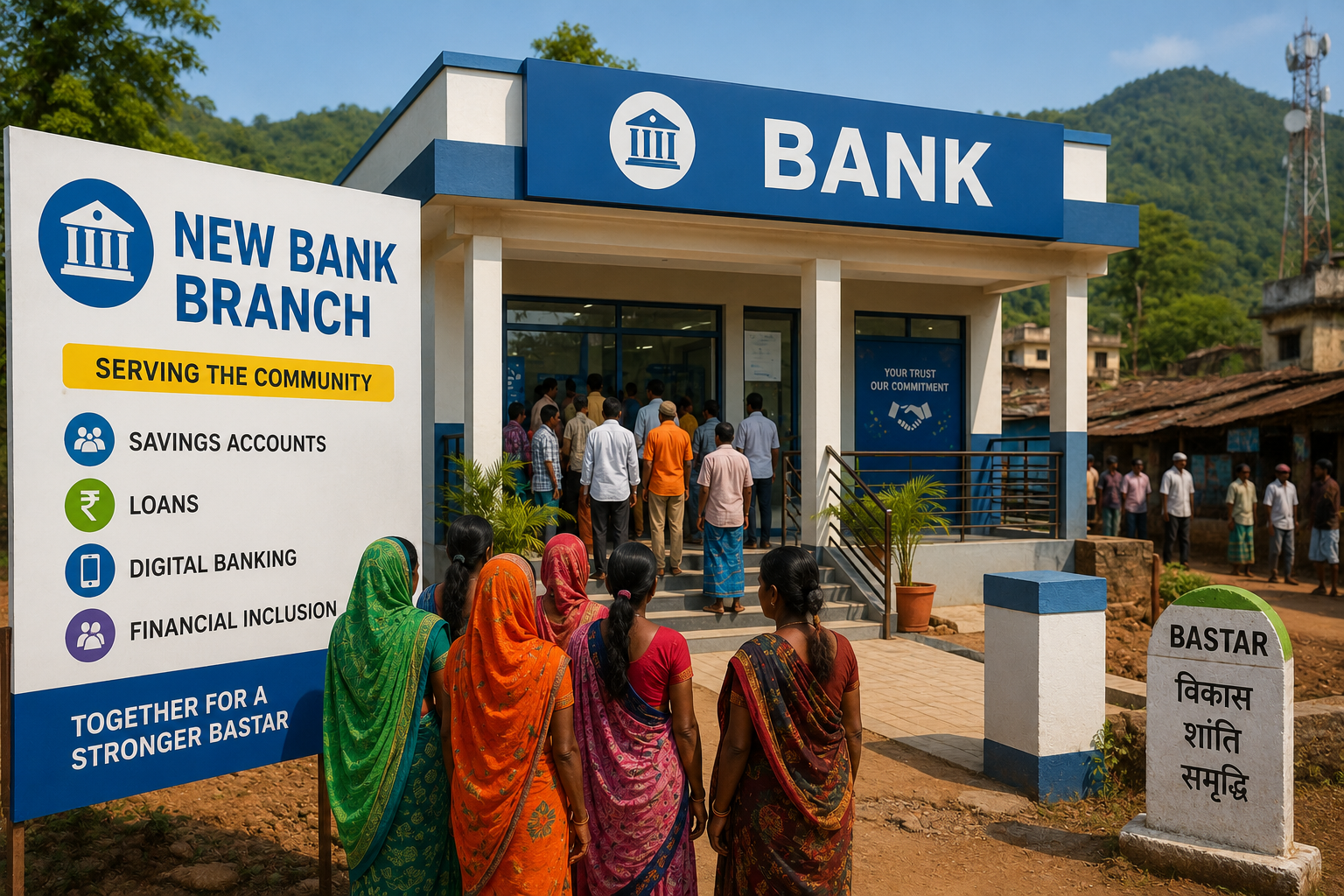
Expansion of banking infrastructure highlights improving security, connectivity, and financial inclusion across tribal regions of Chhattisgarh
A remarkable transformation is gradually reshaping Bastar division, a region once widely associated with Maoist violence, underdevelopment, and poor connectivity. In a major sign of changing ground realities, officials announced that 31 new bank branches have been opened across Bastar over the last two-and-a-half years.
The expansion of banking infrastructure into remote tribal regions that were once inaccessible due to insurgency is being viewed as a strong indicator of improving peace, rising public confidence, and accelerating development in the region.
Authorities say Bastar is witnessing a new phase of economic and social integration as government institutions, infrastructure projects, and financial services steadily expand deeper into previously isolated areas.
Banking Services Reach Remote Tribal Villages
According to officials, the newly opened bank branches are spread across various districts of the Bastar division, helping improve access to formal financial services for thousands of residents.
For decades, many villages in Bastar lacked nearby banking facilities because of security concerns, difficult terrain, and limited infrastructure. Residents often had to travel long distances to withdraw money, access welfare benefits, or complete basic banking transactions.
The new branches are expected to significantly improve access to savings accounts, direct benefit transfers, pensions, loans, digital payments, and financial assistance schemes for tribal and rural populations.
Experts believe better banking access can play a transformative role in strengthening local economic participation and reducing financial exclusion in underserved communities.
Bastar Slowly Moves Beyond Its Maoist Legacy
The Bastar region in Chhattisgarh has historically been one of the areas most affected by Left-Wing Extremism in India.
Frequent Maoist attacks, weak infrastructure, poor road connectivity, and security challenges had long restricted economic growth and institutional presence in several parts of the region.
However, officials say recent years have witnessed gradual improvement in the overall security environment due to intensified security operations, infrastructure expansion, and stronger administrative outreach.
The opening of bank branches in areas once considered high-risk zones is now being seen as evidence of increasing stability and confidence among both citizens and institutions.
Financial Inclusion Becomes Key Development Focus
The expansion of banking infrastructure is expected to strengthen financial inclusion initiatives in tribal areas where large sections of the population previously remained outside the formal banking system.
Officials say easier access to banking services will help improve the implementation of welfare schemes, rural development programs, and direct subsidy transfers.
The move could also encourage more residents to adopt digital transactions and formal financial systems, reducing dependence on cash-based informal networks.
Experts note that financial inclusion often plays a critical role in empowering rural communities by improving savings habits, credit access, and economic security.
Infrastructure Growth Supporting Regional Change
Authorities say the banking expansion has been made possible due to broader improvements in roads, telecom connectivity, electricity supply, and administrative access across Bastar.
Over the past few years, the government has intensified efforts to improve physical infrastructure in remote tribal areas through road construction, mobile tower installations, educational institutions, and healthcare facilities.
Improved connectivity has enabled banks and other institutions to operate in areas that were previously difficult to access because of security concerns and poor transportation networks.
Officials believe infrastructure development and institutional expansion together are helping reduce isolation and integrate Bastar more closely with mainstream economic activity.
Economic Opportunities Expected to Increase
The growing presence of banks in Bastar could open new economic opportunities for local residents, farmers, self-help groups, and small entrepreneurs.
Better access to credit and formal financial services may help support agricultural activity, small businesses, tribal enterprises, handicrafts, and rural entrepreneurship in the region.
Development experts say financial infrastructure is often a crucial foundation for long-term economic growth, poverty reduction, and social stability in previously conflict-affected areas.
The increased banking network may also help encourage private investment and commercial activity over time.
Public Trust and Governance Presence Strengthen
Officials believe the spread of banking services also reflects growing public trust in government institutions and improving confidence among residents.
The presence of formal institutions such as banks, schools, hospitals, and administrative centres is increasingly being viewed as a symbol of state outreach and governance penetration in remote tribal regions.
Analysts say institutional presence often plays an important role in reducing alienation and strengthening long-term stability in insurgency-affected regions.
Bastar Emerging as Symbol of Change
The latest developments are being presented as part of a broader narrative of transformation unfolding across Bastar.
Once known primarily for violence and underdevelopment, the region is gradually emerging as a symbol of infrastructure expansion, administrative outreach, and socio-economic change.
While challenges related to poverty, education, healthcare, and security still remain in some pockets, officials say the opening of 31 bank branches in just two-and-a-half years demonstrates how rapidly the region is evolving.
As Bastar continues its transition, policymakers and development experts are expected to closely monitor how financial inclusion, infrastructure growth, and governance expansion contribute to lasting peace and sustainable development in the region.