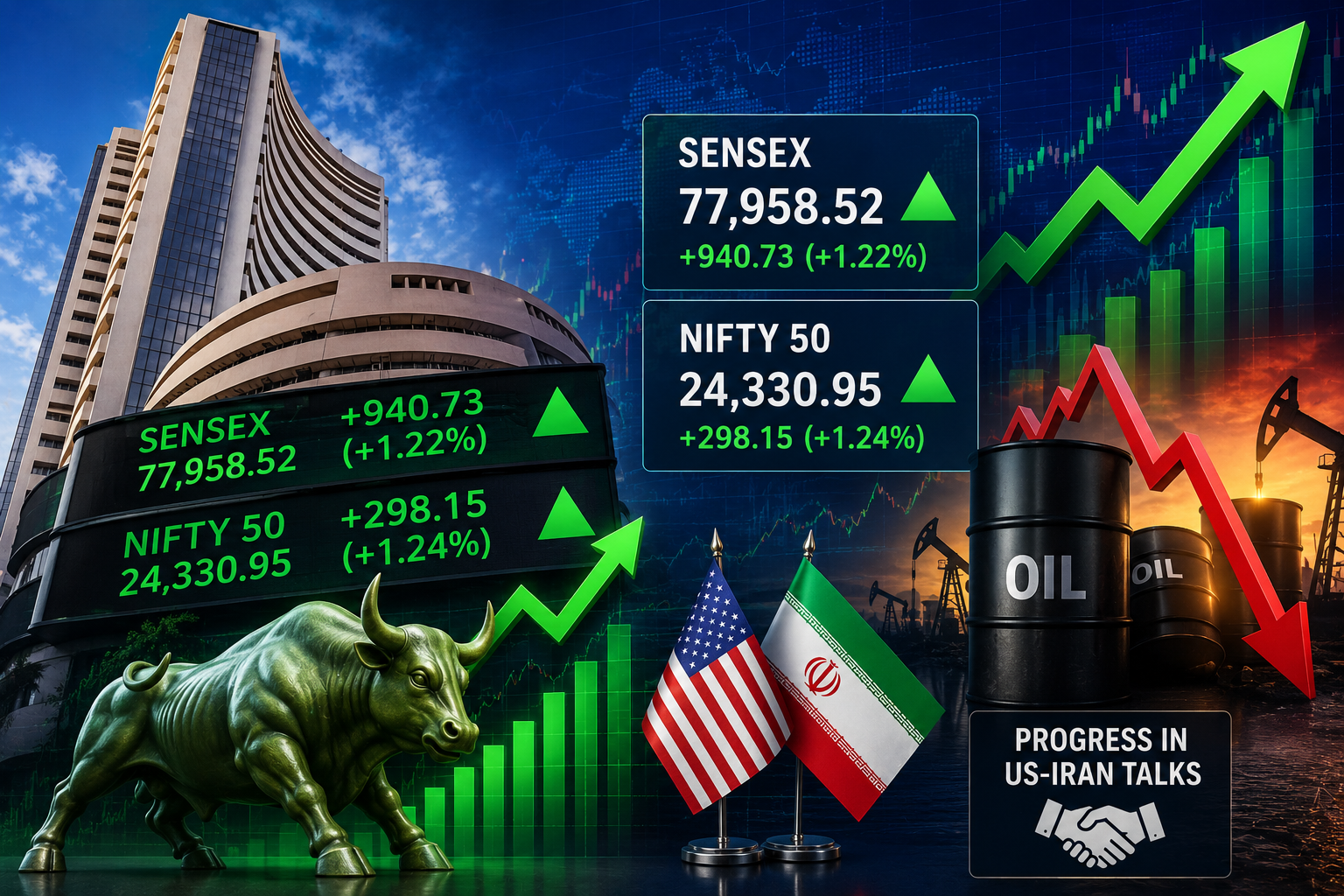
Sensex Soars 940 Points, Nifty Reclaims 24,300 Mark Amid Global Risk-On Sentiment
Indian equity markets staged a powerful rebound on Wednesday as benchmark indices surged sharply following a steep decline in global crude oil prices triggered by optimism surrounding potential peace negotiations between the United States and Iran.
The rally gained momentum in the final trading hours after reports suggested progress toward a possible agreement aimed at ending the ongoing conflict in West Asia, boosting investor confidence globally and easing concerns over energy supply disruptions.
The sharp fall in oil prices significantly improved sentiment across domestic equities, particularly in sectors sensitive to energy costs and inflation.
Sensex Climbs Nearly 1,000 Points
The 30-share BSE Sensex surged 940.73 points, or 1.22 per cent, to settle at 77,958.52.
During intraday trade, the index touched a high of 78,022.78, rising over 1,000 points before closing slightly below the day’s peak.
Meanwhile, the Nifty 50 advanced 298.15 points, or 1.24 per cent, to close at 24,330.95, reclaiming the psychologically important 24,300 level.
The strong close reflected aggressive late-session buying across banking, financial and heavyweight stocks.
Oil Prices Decline as Diplomatic Hopes Rise
The biggest trigger behind the market rally was the sharp decline in crude oil prices after US President Donald Trump claimed progress in negotiations with Iran.
Global energy markets reacted positively to signs that both countries may be moving closer to a framework aimed at reducing hostilities and stabilising the region.
The easing tensions also reduced concerns regarding disruptions around the strategically critical Strait of Hormuz, through which a significant portion of global oil shipments passes daily.
Analysts noted that lower crude oil prices are highly favourable for India, one of the world’s largest energy importers.
Why Falling Oil Prices Matter for India
India’s economy is particularly sensitive to crude oil prices due to its heavy dependence on imported energy.
A decline in oil prices generally helps:
- Reduce inflationary pressure
- Improve fiscal balance
- Lower import costs
- Support the Indian rupee
- Improve corporate profit margins
- Ease pressure on interest rates
Market experts believe easing energy prices could improve macroeconomic stability and strengthen investor confidence over the coming months.
Banking and Financial Stocks Lead Gains
The market rally was led by strong buying in banking and financial shares, which benefited from improving global sentiment and expectations of lower inflationary risks.
Large-cap private and public sector banking stocks witnessed sharp gains as investors rotated back into rate-sensitive sectors.
Analysts believe lower oil prices could help moderate inflation expectations, potentially creating a more favourable environment for financial markets and lending activity.
Broader Markets Outperform Benchmarks
The rally extended beyond frontline indices into the broader market, with midcap and smallcap shares witnessing even stronger momentum.
The Nifty Midcap 100 and Nifty Smallcap 100 indices closed significantly higher, reflecting improved risk appetite among retail and institutional investors.
Market breadth remained strongly positive, indicating widespread participation across sectors.
Strong gains were witnessed in:
- Banking and finance
- Auto stocks
- Infrastructure companies
- Capital goods shares
- IT and technology stocks
- Pharmaceuticals
Global Markets Cheer Possibility of De-Escalation
International markets also reacted positively to signs of diplomatic progress between the United States and Iran.
Investors worldwide have been closely monitoring developments in West Asia due to concerns over:
- Energy supply disruptions
- Rising crude oil prices
- Shipping restrictions
- Inflation risks
- Geopolitical instability
The possibility of reduced tensions improved sentiment across global equities, commodities and currency markets.
Foreign Investor Sentiment May Improve
Analysts believe stabilisation in oil prices and easing geopolitical concerns could improve foreign institutional investor (FII) sentiment toward emerging markets, including India.
Higher oil prices typically create pressure on emerging economies with large import bills, often leading to currency weakness and capital outflows.
The latest development may therefore support:
- Improved foreign inflows
- Better rupee stability
- Stronger equity sentiment
- Reduced inflation concerns
Volatility Likely to Continue
Despite Wednesday’s sharp rally, market experts caution that volatility could remain elevated as geopolitical developments continue to evolve rapidly.
Investors are expected to closely monitor:
- Further progress in US-Iran negotiations
- Global crude oil prices
- Developments around the Strait of Hormuz
- Foreign investor activity
- Upcoming macroeconomic data
Analysts noted that while the market reaction has been positive, geopolitical uncertainty remains a major risk factor for global financial markets.
Domestic Fundamentals Continue Supporting Markets
Apart from global triggers, India’s domestic macroeconomic environment continues to remain relatively stable compared to many global economies.
Supportive factors include:
- Strong domestic demand
- Stable banking system
- Government infrastructure spending
- Healthy GST collections
- Improving manufacturing activity
Analysts believe these domestic strengths continue to provide medium-term support to Indian equities despite global uncertainty.
Smart Investment Market Take
Wednesday’s sharp market rally highlights how quickly global geopolitical developments can influence investor sentiment, crude oil prices and emerging market equities.
For India, easing oil prices remain one of the biggest positive triggers due to the country’s heavy dependence on imported energy.
While near-term volatility may continue, improving diplomatic signals and stable domestic fundamentals are helping restore confidence across equity markets.
What Investors Should Watch Next
Market participants will closely track:
- Progress in US-Iran peace negotiations
- Crude oil price movement
- Global inflation trends
- FII buying activity
- RBI policy expectations
- Corporate earnings momentum
Analysts believe energy prices and geopolitical developments will remain among the most important market drivers in the near term.