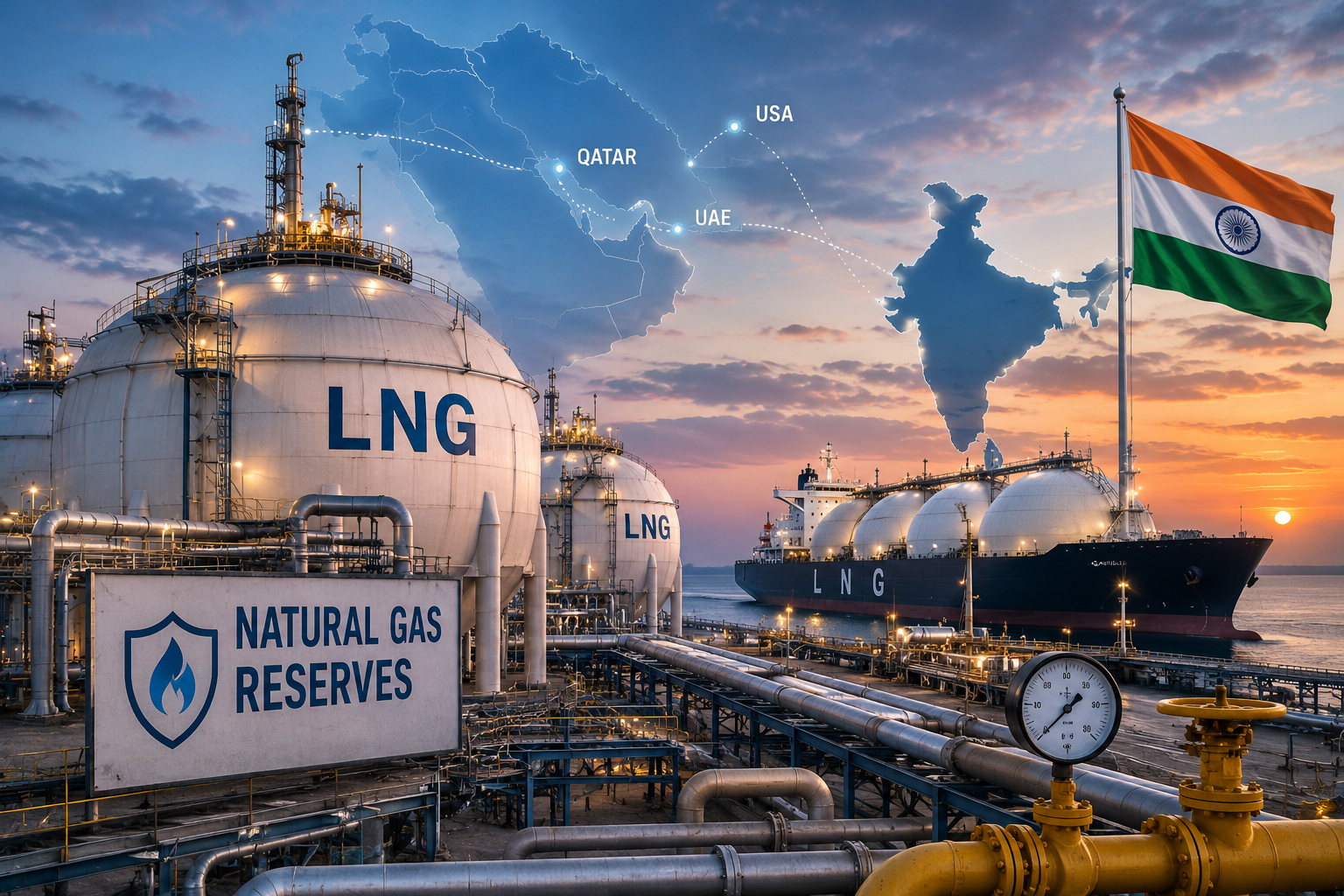
LNG Supply Risks, Rising Import Dependence and Geopolitical Tensions Expose Energy Security Challenges
The ongoing geopolitical conflict in West Asia has intensified concerns over India’s energy security, with industry experts and policymakers increasingly stressing the urgent need for the country to develop strategic natural gas reserves and strengthen LNG storage infrastructure.
While India has steadily expanded its strategic crude oil reserves over the past decade, experts argue that the country remains significantly vulnerable in the natural gas segment despite rapidly increasing dependence on imported liquefied natural gas (LNG).
The latest disruptions in global energy supply chains have highlighted the risks associated with India’s growing reliance on overseas gas supplies from politically sensitive regions.
India’s LNG Dependence Continues to Rise
India currently imports more than half of its natural gas requirements, with a large portion sourced through long-term LNG contracts from countries including Qatar, United Arab Emirates and the United States.
Natural gas has become increasingly important for India’s energy transition strategy as the government seeks to raise the share of gas in the country’s energy mix to reduce dependence on coal and liquid fuels.
Demand for natural gas has expanded rapidly across key sectors such as:
- Fertiliser production
- Power generation
- City gas distribution (CGD)
- Industrial manufacturing
- Transportation and mobility
However, rising import dependence has also increased India’s exposure to geopolitical disruptions and global LNG market volatility.
Supply Disruptions Trigger Fresh Concerns
Industry concerns intensified after Petronet LNG Ltd, one of India’s largest LNG importers, indicated that the country is evaluating expansion of LNG storage tank capacity across multiple import terminals.
The urgency became more visible after QatarEnergy reportedly declared force majeure on certain LNG contracts earlier this year, temporarily affecting shipments under Petronet’s long-term 7.5 million tonnes per annum (mtpa) agreement with Qatar.
Although the disruption has not yet triggered a nationwide supply crisis, analysts warn that prolonged instability in West Asia could create serious challenges for India’s industrial and energy sectors.
Energy experts note that unlike crude oil, natural gas supply chains are more infrastructure-dependent and less flexible during emergencies.
Strategic Gas Reserves Gain Importance
Energy analysts believe India now needs to seriously consider establishing strategic natural gas reserves similar to its strategic petroleum reserve programme.
Currently, India has limited dedicated gas storage capacity compared to major energy-importing economies.
Experts argue that strategic LNG reserves could help India:
- Manage temporary supply disruptions
- Stabilise domestic gas availability
- Reduce price volatility
- Improve bargaining power in global LNG markets
- Enhance long-term energy security
Several countries maintain large underground gas storage systems or LNG reserve facilities to protect against geopolitical shocks and seasonal demand fluctuations.
India’s current LNG storage capacity remains relatively small considering the scale of future demand growth expected over the next decade.
LNG Infrastructure Expansion Under Focus
The government and industry are increasingly focusing on expanding LNG infrastructure across the country.
India has already been investing heavily in:
- LNG import terminals
- Regasification facilities
- Gas pipeline networks
- City gas distribution infrastructure
Industry experts believe additional LNG storage tanks at import terminals could provide short-term flexibility during supply disruptions.
Companies are also evaluating floating storage solutions and integrated gas storage projects to improve supply resilience.
The expansion of infrastructure is expected to play a key role in supporting India’s long-term goal of increasing the share of natural gas in the national energy mix from around 6 per cent currently toward double-digit levels.
Fertiliser and Power Sectors Most Vulnerable
Natural gas remains a critical raw material for several core sectors of the Indian economy.
The fertiliser industry depends heavily on gas supplies for urea production, while gas-based power plants require stable fuel availability to manage peak electricity demand.
City gas distribution companies supplying piped cooking gas and compressed natural gas (CNG) also remain vulnerable to supply disruptions and price spikes.
Any prolonged interruption in LNG imports could therefore have broader economic implications, including:
- Higher fertiliser subsidy burden
- Increased electricity costs
- Rising transportation fuel prices
- Inflationary pressure on industries and consumers
Analysts believe ensuring uninterrupted gas supply has become increasingly important for maintaining economic stability.
Global LNG Market Becoming More Competitive
The West Asia conflict is also occurring at a time when global LNG competition is intensifying.
Asian economies including China, Japan and South Korea continue to aggressively secure long-term LNG contracts to strengthen energy security.
Europe’s increased LNG imports following the Russia-Ukraine conflict have also tightened global supply conditions.
Energy experts warn that India could face greater competition for spot LNG cargoes during future geopolitical crises if sufficient strategic reserves are not created.
Government Likely to Accelerate Energy Security Planning
The recent disruptions are expected to accelerate policy discussions around comprehensive energy security planning for natural gas.
Experts believe policymakers may increasingly focus on:
- Strategic LNG reserve creation
- Diversification of import sources
- Expansion of domestic gas production
- Long-term LNG contracting strategies
- Faster infrastructure development
Industry participants say India’s energy transition ambitions will require a far more resilient gas supply ecosystem in the coming years.
Long-Term Energy Transition Depends on Reliable Gas Supply
Natural gas is expected to remain a key bridge fuel in India’s transition toward cleaner energy systems.
The government’s industrial decarbonisation, urban mobility and clean fuel expansion plans rely heavily on stable and affordable gas availability.
Analysts believe the current geopolitical environment has become a wake-up call for India to strengthen its gas security architecture before import dependence rises further.
The West Asia crisis has once again demonstrated that energy security is no longer limited to crude oil alone, and that strategic preparedness for natural gas may become equally critical for India’s long-term economic and industrial growth.