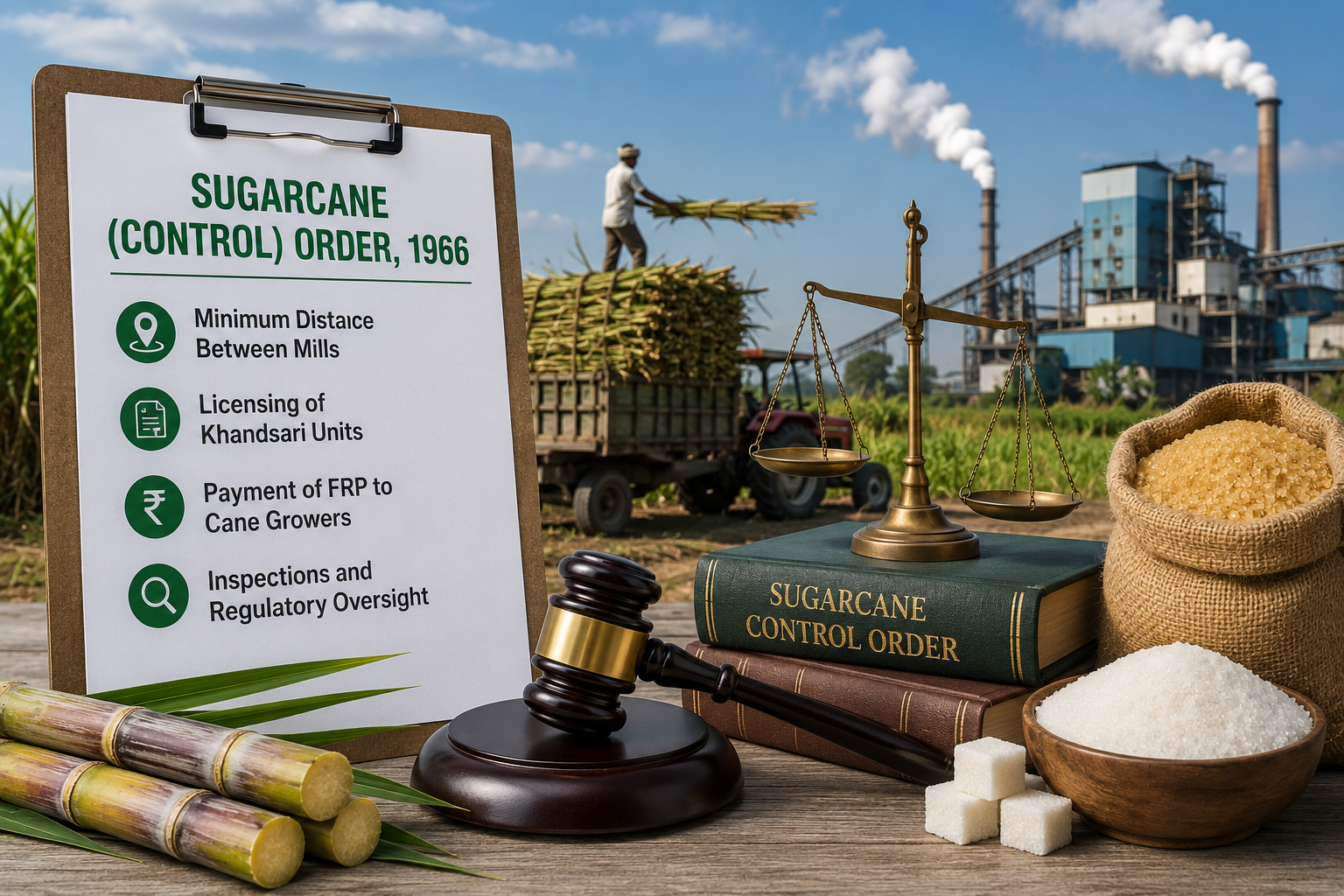
New Rules on Mill Distance, Licensing and Khandsari Oversight Trigger Debate Across Sector
India’s sugar industry is closely evaluating the Centre’s proposed amendments to the decades-old Sugarcane (Control) Order, with several industry stakeholders expressing concerns that the new rules could increase regulatory intervention and operational complexity across the sector.
The Central government recently floated draft amendments to the Sugarcane (Control) Order, 1966 — a key regulatory framework governing sugar production, cane procurement and pricing mechanisms in the country. The proposed reforms aim to modernise the sector, improve transparency and strengthen farmer protections, but industry players fear some provisions could lead to increased compliance burdens and tighter government oversight.
The draft amendments have been opened for stakeholder comments until May 20, after which the government is expected to review industry feedback before finalising the reforms.
25-Kilometre Distance Rule Becomes Major Talking Point
One of the most debated proposals is the introduction of a mandatory minimum distance of 25 kilometres between sugar mills.
The government believes the move could reduce excessive competition for sugarcane procurement and improve the long-term financial stability of mills by ensuring balanced cane availability across regions.
Officials argue that uncontrolled expansion of mills in close proximity often leads to disputes over cane sourcing areas, aggressive procurement practices and financial stress within the industry.
However, sugar companies and industry associations warn that the rule could limit future expansion opportunities and reduce investment flexibility in key sugar-producing states.
Several market participants believe the proposal may particularly impact regions witnessing rapid growth in ethanol production and integrated sugar processing investments.
Khandsari Units Come Under Regulatory Focus
The proposed reforms also seek to bring khandsari units under tighter regulatory supervision.
Khandsari is a traditional form of unrefined sugar derived from sugarcane and widely used in several parts of India. Unlike large sugar mills, many khandsari units currently operate with relatively lighter regulatory oversight.
Under the proposed amendments:
- Licences could become mandatory for khandsari units
- Units may face periodic inspections and compliance checks
- Operators may be required to maintain detailed procurement records
- Regulatory authorities could receive expanded monitoring powers
Industry experts say the government’s objective is to improve transparency, ensure fair competition and formalise the unorganised segment of the sugar economy.
FRP Payment Requirement May Raise Costs
Another key proposal is the requirement for khandsari units to pay farmers the officially declared Fair and Remunerative Price (FRP) for sugarcane procurement.
Currently, FRP regulations apply more directly to organised sugar mills. Extending the same framework to smaller khandsari operators could significantly increase procurement costs for many traditional producers.
The government believes the move would strengthen farmer protections and ensure equitable cane pricing across the industry.
However, some khandsari operators argue that uniform pricing obligations may create financial stress for smaller businesses with lower operating margins.
Industry representatives have urged policymakers to consider differentiated compliance norms for small-scale traditional units.
Industry Warns Against Return of ‘Inspector Raj’
Several industry participants have raised concerns that expanded inspection powers and licensing requirements could increase bureaucratic intervention in the sector.
Some stakeholders fear that excessive compliance procedures may create operational inefficiencies and discourage investment in smaller sugar processing businesses.
Industry bodies are particularly concerned about:
- Increased paperwork and licensing procedures
- Frequent inspections by authorities
- Delays in approvals and renewals
- Greater administrative costs for smaller operators
Executives argue that while regulation and transparency are important, the reforms should avoid creating unnecessary operational hurdles.
Many industry experts are calling for digitised compliance systems and simplified approval mechanisms to reduce administrative friction.
Government Aims to Formalise Sector
Policy analysts believe the proposed reforms reflect the government’s broader efforts to formalise India’s agricultural processing industries and improve traceability in commodity supply chains.
Authorities are increasingly focused on ensuring that all participants in the sugar ecosystem — including traditional processors — operate within a more structured regulatory framework.
The proposed changes are also expected to support better data collection, improve farmer payment monitoring and reduce disputes related to sugarcane procurement.
Experts note that the sugar industry plays a major role in India’s rural economy, supporting millions of farmers across major producing states such as Uttar Pradesh, Maharashtra and Karnataka.
Ethanol Push Adds New Complexity
The timing of the reforms is significant as India’s sugar industry undergoes major transformation driven by the government’s ethanol blending programme.
Many sugar mills have invested heavily in ethanol production capacity as part of India’s clean energy and fuel diversification strategy.
Industry participants fear that stricter operational rules could affect future expansion plans and investment decisions at a time when the sector is transitioning toward integrated sugar-energy models.
Analysts believe balancing farmer interests, industrial growth and regulatory oversight will be critical for ensuring long-term sector stability.
Investors and Industry Await Final Framework
The sugar sector is now closely watching how the government incorporates industry feedback before finalising the amendments.
Market experts believe the final policy framework will have important implications for sugar companies, ethanol producers, khandsari operators and rural supply chains.
While the reforms are intended to strengthen transparency and farmer protection, industry leaders argue that implementation should remain business-friendly and operationally practical.
The coming weeks are expected to witness intense consultations between policymakers, sugar mills, farmer groups and traditional processors as the sector prepares for one of its most significant regulatory updates in decades.