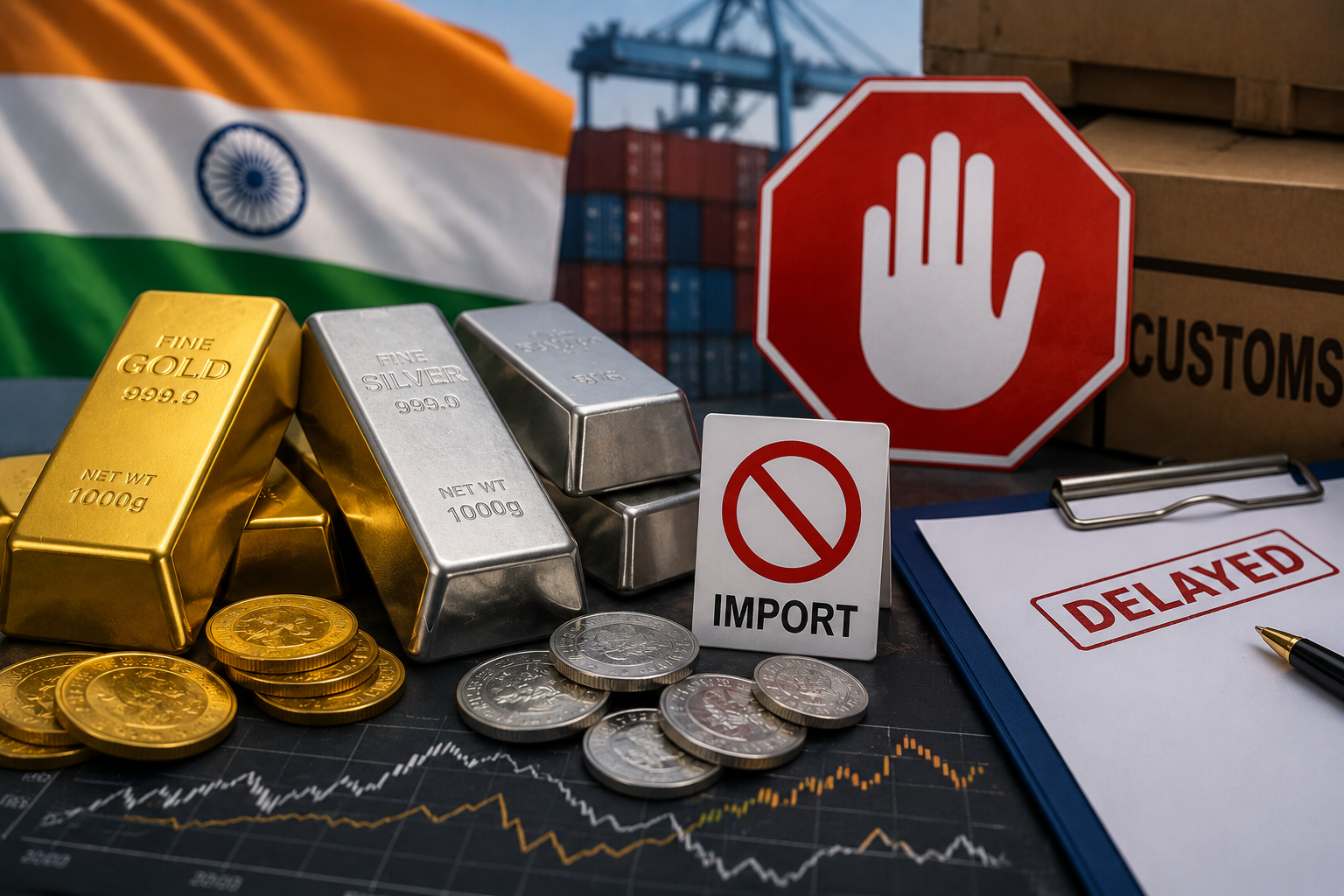
Customs Delays, Tax Confusion and Import Bottlenecks Push Domestic Premiums Higher
India’s bullion industry is facing mounting pressure after imports of gold and silver remained heavily disrupted for more than five weeks, creating fears of supply shortages in one of the world’s largest precious metals markets.
The prolonged standstill has impacted banks, traders, jewellers and refiners, with shipments reportedly stuck at customs since the start of the new financial year on April 1. Industry participants say administrative delays and uncertainty over tax treatment have slowed the release of bullion consignments, tightening domestic supply and pushing local premiums sharply higher.
As India remains the world’s second-largest consumer of gold, the disruption is being closely monitored by global bullion markets and jewellery manufacturers.
Banks Unable to Import Bullion
According to market participants, Indian banks — which play a major role in precious metals imports — have been unable to bring fresh gold and silver shipments into the country for weeks.
Industry experts noted that while temporary disruptions in bullion imports are not uncommon, the current halt is unusually long and is beginning to affect market liquidity.
The issue reportedly began after delays in the publication of the annual list of authorised bullion-importing banks by the government’s trade department. Although the list was eventually released in mid-April, customs clearances are still pending, preventing consignments from being released at ports and airports.
Traders say customs authorities are yet to provide complete operational clarity required for smooth processing of shipments.
Tax Uncertainty Adds to Market Confusion
Another major concern for bullion importers is uncertainty surrounding the applicability of integrated goods and services tax (IGST) exemptions on precious metals.
Market participants indicate that gold and silver had previously enjoyed certain tax exemptions, but banks and importers are still awaiting confirmation on whether the same treatment will continue under the new financial year framework.
The lack of clarity has made several importers cautious about initiating fresh transactions, further slowing bullion inflows into the domestic market.
Industry observers believe that quicker policy communication and administrative coordination could help ease the bottleneck.
Domestic Gold Premiums Rise Sharply
The supply disruption has already started influencing domestic bullion pricing. With imports slowing significantly, the premium of local gold prices over international benchmarks has widened considerably.
According to industry estimates, domestic gold premiums recently crossed $20 per ounce for the first time in several months, reflecting tightening physical supply conditions in the local market.
Jewellers are particularly concerned as they seek to replenish inventory following the strong festive buying demand witnessed during Akshaya Tritiya, one of India’s most important gold-purchasing occasions.
Retail demand for jewellery and investment products traditionally remains elevated after the festival season, increasing the urgency for fresh supplies.
Falling Global Prices Boost Buying Interest
International gold prices have corrected significantly in recent months after earlier geopolitical tensions and inflation fears pushed prices to record highs.
Analysts note that softer global prices are encouraging Indian buyers to return to the market, especially for wedding-related purchases and long-term investments.
However, the ongoing import disruption is limiting the availability of fresh bullion supplies just as buying interest begins to recover.
Silver demand has also remained firm due to strong industrial consumption and investment interest.
IIBX Emerges as Alternative Route
With traditional import channels facing delays, many traders have shifted purchases to the India International Bullion Exchange located in Gujarat International Finance Tec-City (GIFT City).
Trading activity through the exchange has reportedly surged in recent weeks, with volumes rising sharply as market participants look for alternative sourcing mechanisms.
However, traders say importing bullion through the exchange involves longer processing times and higher working capital requirements compared to conventional banking channels.
Despite the operational challenges, the exchange is emerging as an increasingly important component of India’s bullion ecosystem.
Jewellery Industry Faces Inventory Pressure
The import disruption is creating inventory concerns for jewellers across major markets including Mumbai, Ahmedabad, Chennai, Kolkata and Delhi.
Many retailers are attempting to rebuild stock levels after strong seasonal demand, but limited fresh supply is making procurement more expensive and difficult.
Industry analysts warn that if delays continue for an extended period, jewellery manufacturers may face tighter margins due to higher domestic bullion costs.
Smaller jewellers and regional traders are expected to feel the pressure more acutely because of limited inventory buffers and financing capacity.
Impact on India’s Trade Balance
While the disruption is creating challenges for the bullion industry, economists say it may temporarily improve India’s trade balance.
Gold remains one of India’s largest import categories after crude oil. A slowdown in bullion imports could therefore help reduce pressure on the country’s current account deficit in the short term.
Economists believe lower precious metals imports during April and May could support external balance indicators, particularly at a time when global energy prices remain volatile.
However, analysts caution that the positive trade impact may only be temporary if pent-up demand later triggers a sharp rebound in imports.
Market Awaits Policy Clarity
Bullion traders, banks and jewellery industry participants are now closely watching for regulatory clarity from customs authorities and financial regulators.
Industry experts believe faster administrative coordination and clearer tax guidance are necessary to restore normal import flows and stabilise domestic supply conditions.
With India’s festive and wedding demand cycles remaining strong, market participants warn that prolonged disruption could create further pricing volatility in both gold and silver markets over the coming months.