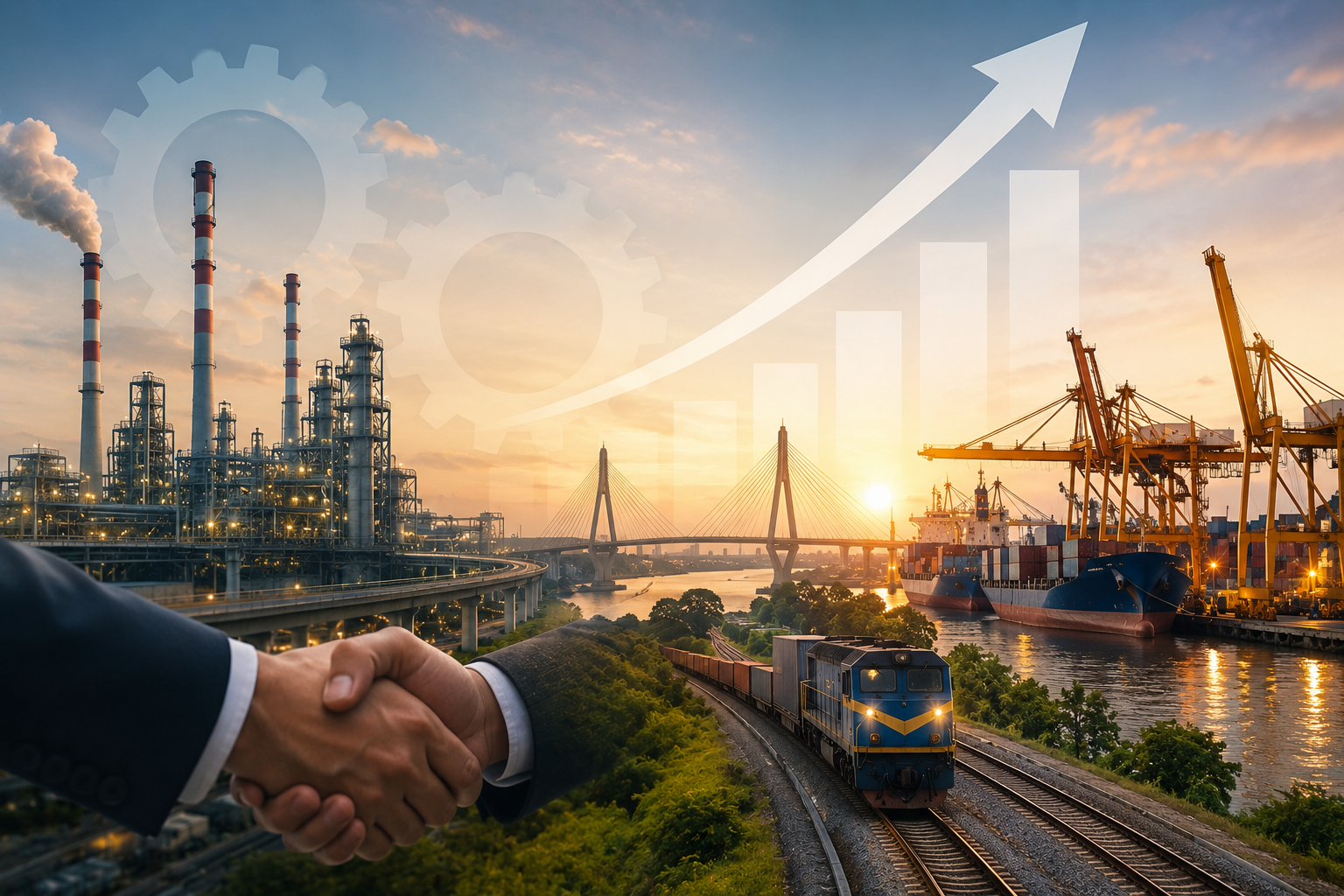
Industry Leaders and Investors Watch Closely as Political Alignment Between Centre and State Opens New Possibilities
The decisive electoral victory of Bharatiya Janata Party in West Bengal has triggered renewed discussions around the state’s long-term industrial future, with businesses, investors and policy experts debating whether the political shift could become a major turning point for economic growth and manufacturing expansion.
For the first time in more than five decades, the same political party now controls both the state administration and the central government led by Prime Minister Narendra Modi. Market participants believe this political alignment could reduce policy friction, accelerate infrastructure approvals and improve investor confidence across multiple sectors.
Political Stability Could Improve Investment Sentiment
Over the past decade, relations between the Centre and the previous All India Trinamool Congress government often remained tense, leading to concerns among large corporations regarding project clearances, industrial policy continuity and land acquisition processes.
Business analysts say the new political environment may create a more coordinated approach toward industrial development, logistics expansion and manufacturing investments. Experts believe smoother coordination between New Delhi and Kolkata could help fast-track central infrastructure projects, industrial corridors and port modernisation plans.
Several industry bodies have already indicated that policy stability and faster decision-making could improve the ease of doing business in the state.
Bengal Looks to Reclaim Its Industrial Legacy
Once considered one of India’s leading industrial and commercial hubs, West Bengal gradually lost momentum over several decades as industries shifted toward western and southern states offering more aggressive industrial policies and stronger infrastructure ecosystems.
Economists note that the state still possesses several structural advantages, including a strategic geographic location, strong rail and port connectivity, access to eastern and northeastern markets and a large skilled workforce.
Industrial experts believe sectors such as steel, logistics, chemicals, textiles, renewable energy, food processing and electronics manufacturing could emerge as key growth drivers if the new administration successfully improves the investment climate.
Infrastructure and Logistics Expected to Gain Attention
The state’s industrial revival plans are likely to focus heavily on infrastructure development. Analysts expect increased spending on highways, freight corridors, industrial parks and port-linked projects, particularly around the Kolkata Port and emerging logistics hubs in eastern India.
Improved connectivity with neighboring states and Bangladesh could also strengthen West Bengal’s position as a major trade gateway for eastern South Asia.
Industry observers say central government support for railway upgrades, smart city projects and industrial clusters may accelerate under the new political arrangement.
Corporate India Waiting for Policy Signals
While optimism has increased following the election outcome, companies are expected to wait for concrete policy announcements before committing large-scale investments.
Corporate executives and investors are likely to closely monitor the new government’s approach toward land reforms, labour regulations, industrial incentives and law-and-order conditions.
Several experts caution that investor confidence cannot be restored through political change alone. They argue that long-term industrial growth will depend on consistent policy implementation, administrative efficiency and transparent governance.
MSMEs and Manufacturing Could Benefit
Apart from large corporations, micro, small and medium enterprises (MSMEs) are also expected to play an important role in the state’s economic revival. Bengal already has a strong base in traditional industries such as leather, handicrafts, tea, engineering goods and textiles.
Economists believe improved industrial infrastructure and easier credit access could help local manufacturing businesses scale operations and integrate more effectively into national supply chains.
The startup ecosystem in Kolkata and surrounding urban centres may also benefit from increased digital infrastructure and investment-friendly policies.
Markets Eye Long-Term Economic Impact
Financial markets and industry analysts are expected to closely evaluate how quickly the new administration moves on reforms and project execution. A successful industrial turnaround in West Bengal could significantly strengthen eastern India’s contribution to the national economy over the next decade.
Investors believe the state has the potential to emerge as a major manufacturing and logistics destination if political stability is supported by sustained economic reforms and infrastructure expansion.
For now, the BJP’s historic victory has created optimism among industry stakeholders, but the real test will lie in translating political momentum into measurable economic growth and private sector investment.