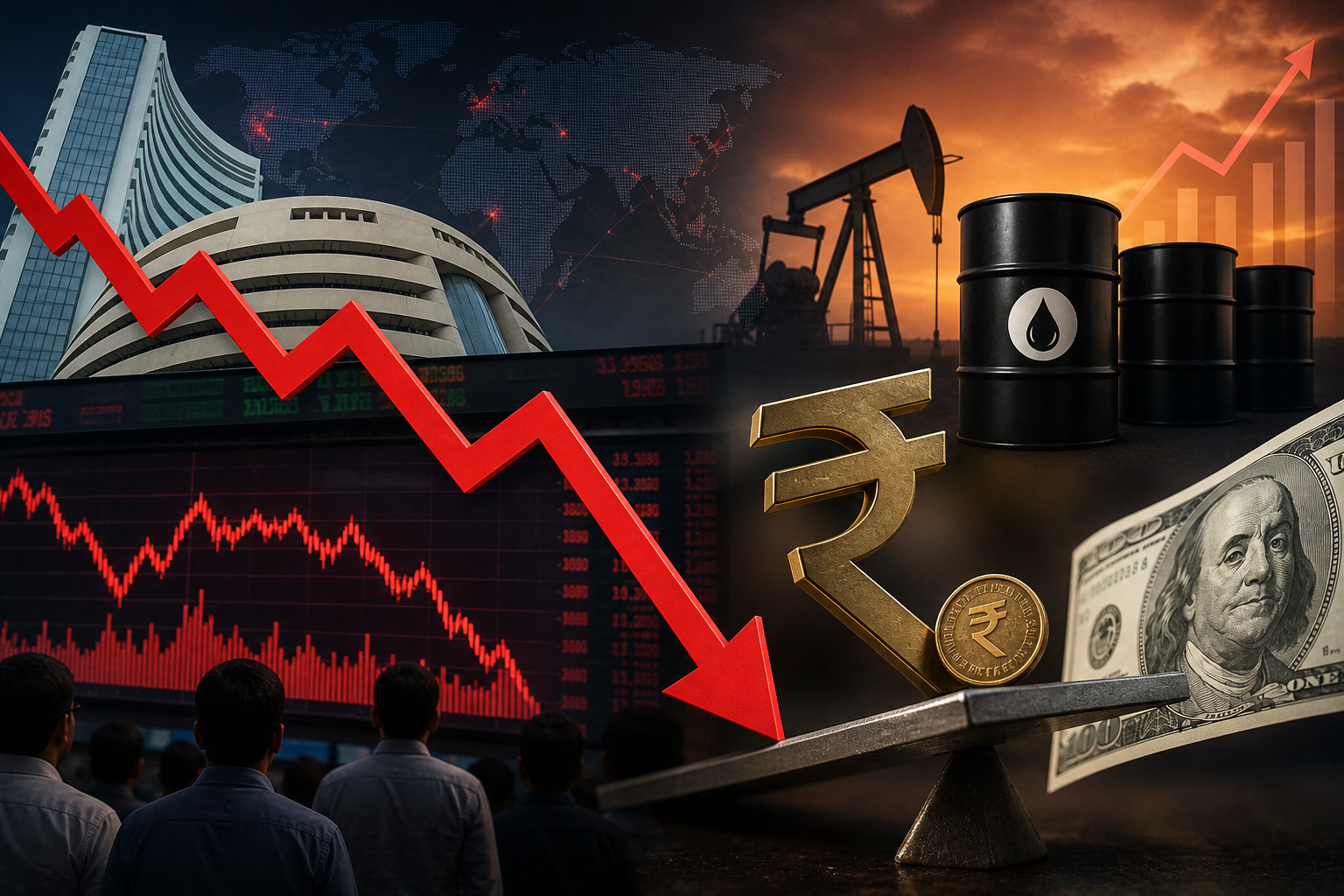
Oil Spike, Weak Rupee and FII Selling Drag Indian Markets Lower
Despite the weakness in frontline indices, broader markets showed resilience, with midcap and smallcap indices managing marginal gains.
1. Rising US-Iran Tensions Trigger Risk-Off Sentiment
Renewed fears of escalation in the Middle East weighed heavily on investor sentiment. Concerns over a breakdown in ceasefire between the US and Iran, along with reported attacks and military responses near the Strait of Hormuz, have heightened uncertainty.
Such geopolitical instability often leads to global risk aversion, prompting investors to reduce exposure to equities and shift towards safer assets.
2. Crude Oil Prices Surge Above $110
Global oil prices remained elevated, with Brent crude trading above $110 per barrel. For an oil-import-dependent economy like India, higher crude prices pose multiple challenges:
- Increase in inflationary pressures
- Widening current account deficit
- Rising input costs for companies
Sustained high oil prices can significantly impact economic stability and corporate profitability.
3. Rupee Hits Record Low Against Dollar
The Indian rupee weakened sharply, crossing the ₹95 per US dollar mark, hitting a fresh all-time low. Currency depreciation raises concerns for markets as it:
- Increases import costs
- Impacts foreign investor returns
- Signals capital outflows
A weak rupee, combined with high oil prices, creates a double pressure on the economy.
4. Heavy FII Selling Weighs on Markets
Foreign Institutional Investors (FIIs) have been लगातार selling Indian equities, with outflows crossing ₹2.28 trillion in 2026 so far.
This sustained selling pressure has:
- Reduced liquidity in the market
- Increased volatility
- Pulled down benchmark indices
FII ownership in Indian equities has also dropped to multi-year lows, reflecting cautious global sentiment.
5. Derivatives Expiry Adds Volatility
The weekly expiry of **Nifty 50 derivatives contracts added to market volatility. Traders adjusted positions around key levels:
- Resistance: 24,300 – 24,500
- Support: 23,800 – 24,000
Options data suggests markets may remain range-bound in the near term, with a slightly bearish bias.
Sectoral Performance: Mixed Trends
While several heavyweight stocks declined, some sectors showed resilience:
- Top losers: Banking, IT, metals
- Top gainers: Select auto and FMCG stocks
Notably, Mahindra & Mahindra Ltd emerged as a top gainer following strong quarterly results, highlighting stock-specific momentum even in weak markets.
Technical Outlook: Cautious Near-Term View
Market experts maintain a cautious stance, suggesting that:
- 24,000 on Nifty remains a