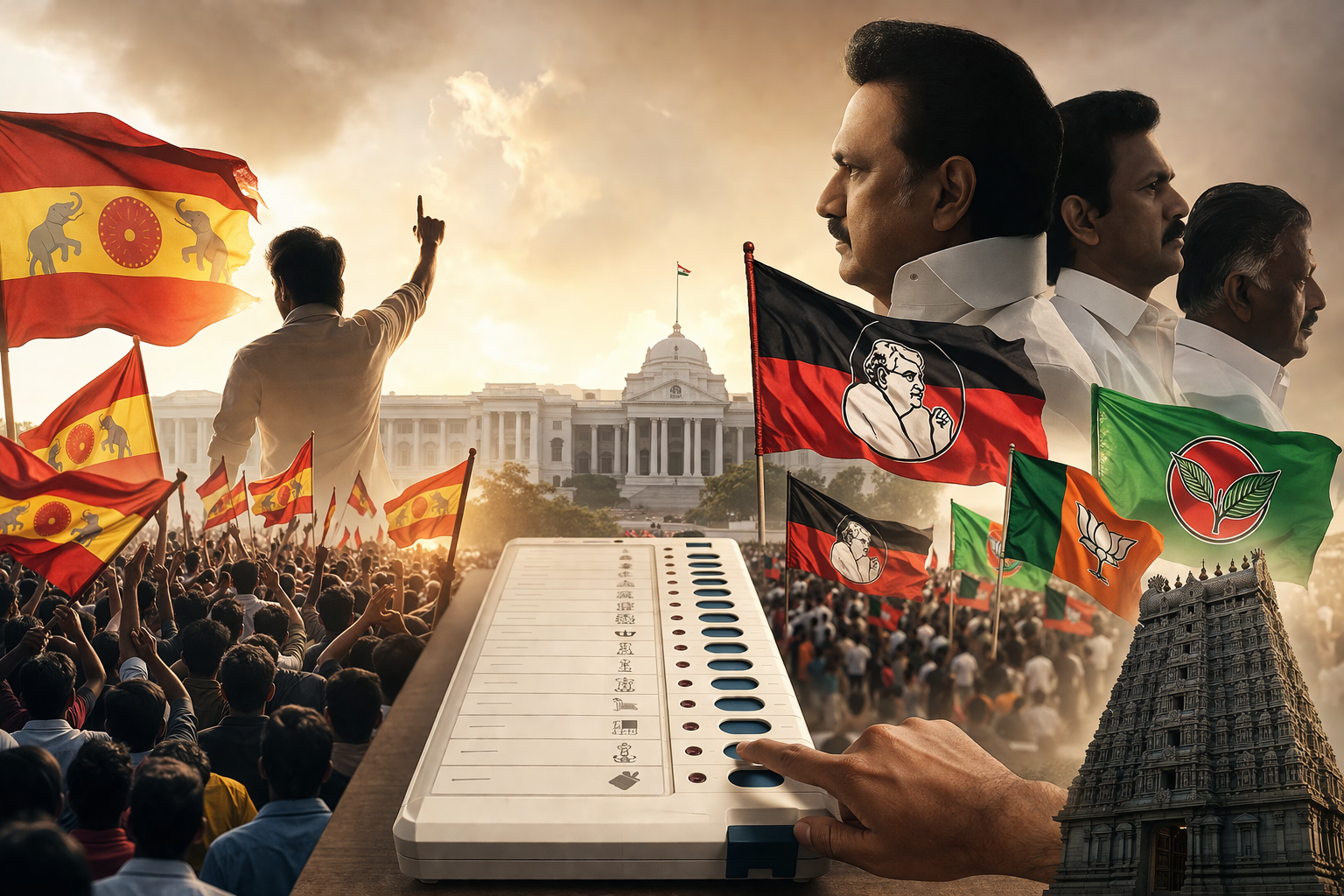
Vijay Emerges as Kingmaker as Three-Way Contest Disrupts Traditional Power Structure
A Three-Cornered Contest Breaks the Mold
Tamil Nadu’s politics has traditionally revolved around a bipolar contest between the Dravida Munnetra Kazhagam and the All India Anna Dravida Munnetra Kazhagam. However, the 2026 election has disrupted this pattern.
The ruling DMK alliance, led by Chief Minister M. K. Stalin, entered the contest with confidence backed by governance continuity and welfare-driven policies. On the other side, the AIADMK, supported by the Bharatiya Janata Party, aimed to consolidate anti-incumbency sentiment.
Yet, it is TVK’s aggressive entry that has transformed the contest into a three-way battle, fragmenting traditional vote banks and introducing a new narrative centered on governance reform and regional identity.
Key Constituencies Signal Voter Shift
Early leads suggest that Vijay is ahead in both Perambur and Tiruchirappalli (East), highlighting strong traction among urban voters and youth demographics. Meanwhile, M. K. Stalin trailing in Kolathur—his long-held bastion—points to a possible erosion of the DMK’s core support base.
In Chepauk-Thiruvallikeni, Udhayanidhi Stalin is facing a tough contest, reflecting a broader challenge for the next generation of DMK leadership. Simultaneously, O. Panneerselvam maintaining a lead in Bodinayakanur indicates that AIADMK retains pockets of strong regional influence.
The Rise of the ‘Vijay Model’
Vijay’s political messaging has carefully balanced emotional appeal with policy-driven positioning. By projecting himself as both anti-DMK and anti-BJP, he has tapped into a segment of voters seeking an alternative to established power centers.
His campaign emphasized Tamil pride, federal rights, and governance accountability. Unlike conventional campaigns, TVK leveraged cinematic storytelling, digital outreach, and high-energy rallies to build a strong connect with first-time voters.
This strategy appears to be paying off, as TVK’s performance suggests that celebrity influence, when combined with a clear political narrative, can translate into electoral success.
Exit Polls vs Ground Reality
Pre-election exit polls largely predicted a comfortable win for the DMK, estimating between 122 and 145 seats. However, projections that gave TVK between 98 and 120 seats now seem closer to reality, underscoring the limitations of traditional polling in capturing new political waves.
If current trends hold, Tamil Nadu may be headed toward a hung assembly, where TVK could play a decisive role in government formation.
Market and Economic Implications
For investors and businesses, the evolving political scenario carries significant implications. Political stability in Tamil Nadu—a key industrial and manufacturing hub—has historically supported investor confidence.
A fragmented mandate may initially create uncertainty in sectors such as infrastructure, manufacturing, and state-led welfare programs. However, it could also accelerate competitive governance, policy innovation, and investment-friendly reforms as parties seek to strengthen their positions.
A Turning Point in Tamil Politics
The 2026 election is not merely a contest for power—it is a referendum on Tamil Nadu