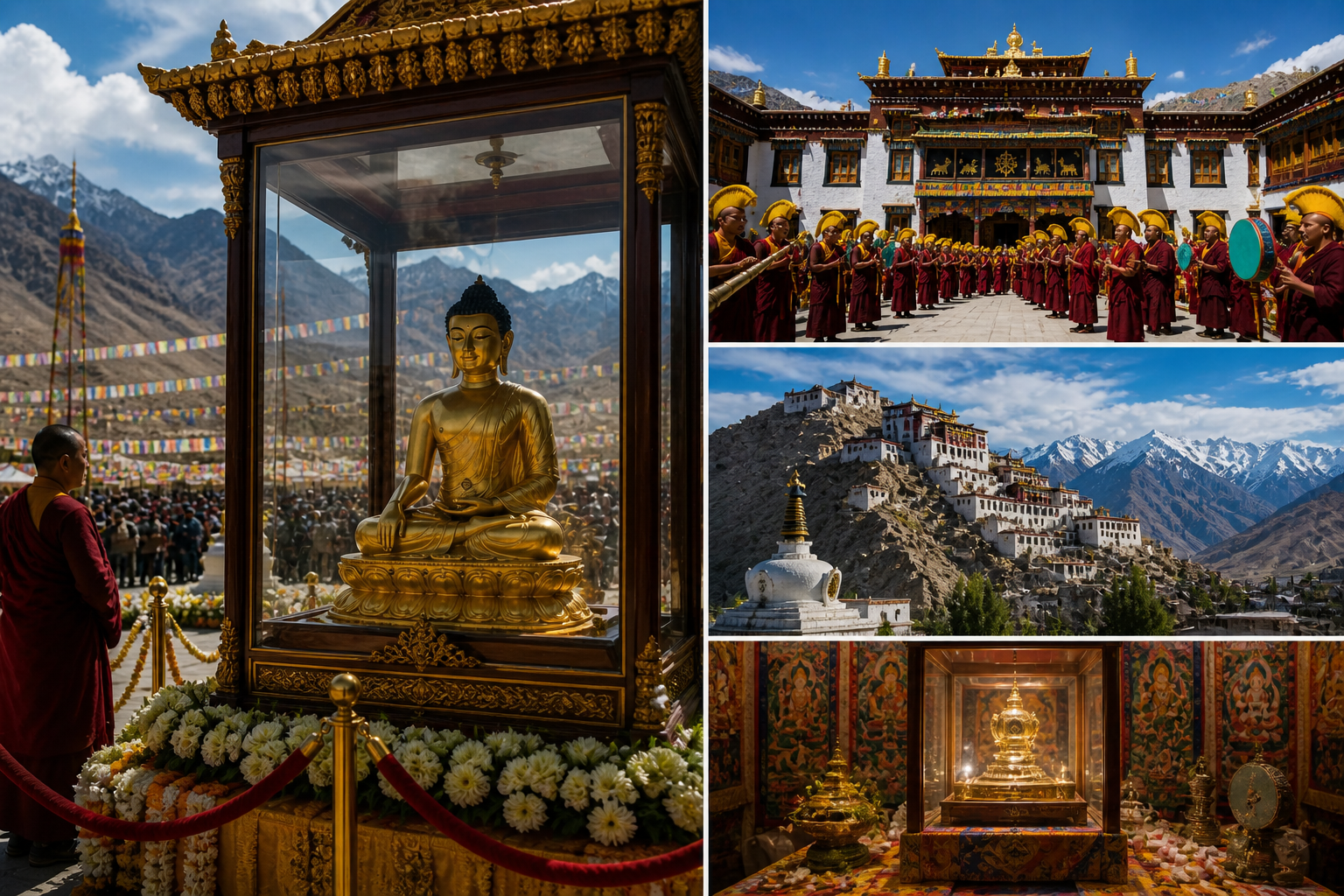
Union Home Minister Amit Shah described the return of sacred relics of Lord Buddha to Ladakh as a “historic reunion,” marking a significant cultural and spiritual moment for the region. The relics, returning after nearly 75 years, were unveiled during a special exposition at Jivetsal in Leh, coinciding with the 2569th celebrations of Buddha Purnima. Highlighting the region’s deep-rooted spiritual legacy, Shah described Ladakh as a “living land of dharma,” emphasising its role in preserving and nurturing Buddhist traditions for centuries. He noted that the region has long served as a centre of learning, compassion, and cultural continuity, with its monasteries and communities safeguarding ancient teachings. Referring to the teachings of Gautama Buddha, Shah stressed that the principles of peace, compassion, and the middle path are increasingly relevant in today’s complex and conflict-prone world. He underlined that these timeless values offer guidance not only for individuals but also for global harmony and sustainable coexistence. Ladakh’s significance extends beyond spirituality. The region is also strategically and economically important, attracting tourism, infrastructure investment, and cultural engagement. Events like the relic exposition are expected to boost spiritual tourism, drawing visitors from across India and abroad, thereby supporting local businesses and economic activity. The growing focus on cultural and spiritual tourism in Ladakh presents multiple opportunities: The event also reflects the government’s broader push to preserve India’s cultural and spiritual heritage while integrating it with economic development. Investments in infrastructure, tourism, and heritage conservation are expected to further position Ladakh as a global destination for spiritual and cultural exploration. The return of Buddha’s sacred relics to Ladakh is not just a religious event—it is a powerful symbol of cultural continuity and national heritage. As highlighted by Amit Shah, Ladakh continues to stand as a beacon of dharma, offering timeless lessons of peace and compassion. For investors and policymakers, the region represents a unique intersection of spirituality, tourism, and development potential—making it an increasingly important part of India’s growth narrative.Historic Return of Sacred Relics After 75 Years
Ladakh as a Living Centre of Buddhist Heritage
Relevance of Buddha’s Teachings in Modern Times
Cultural and Strategic Importance of Ladakh
Tourism and Investment Potential
Government’s Vision for Cultural Preservation
Conclusion
Union Home Minister Amit Shah described the return of sacred relics of Lord Buddha to Ladakh as a “historic reunion,” marking a significant cultural and spiritual moment for the region.