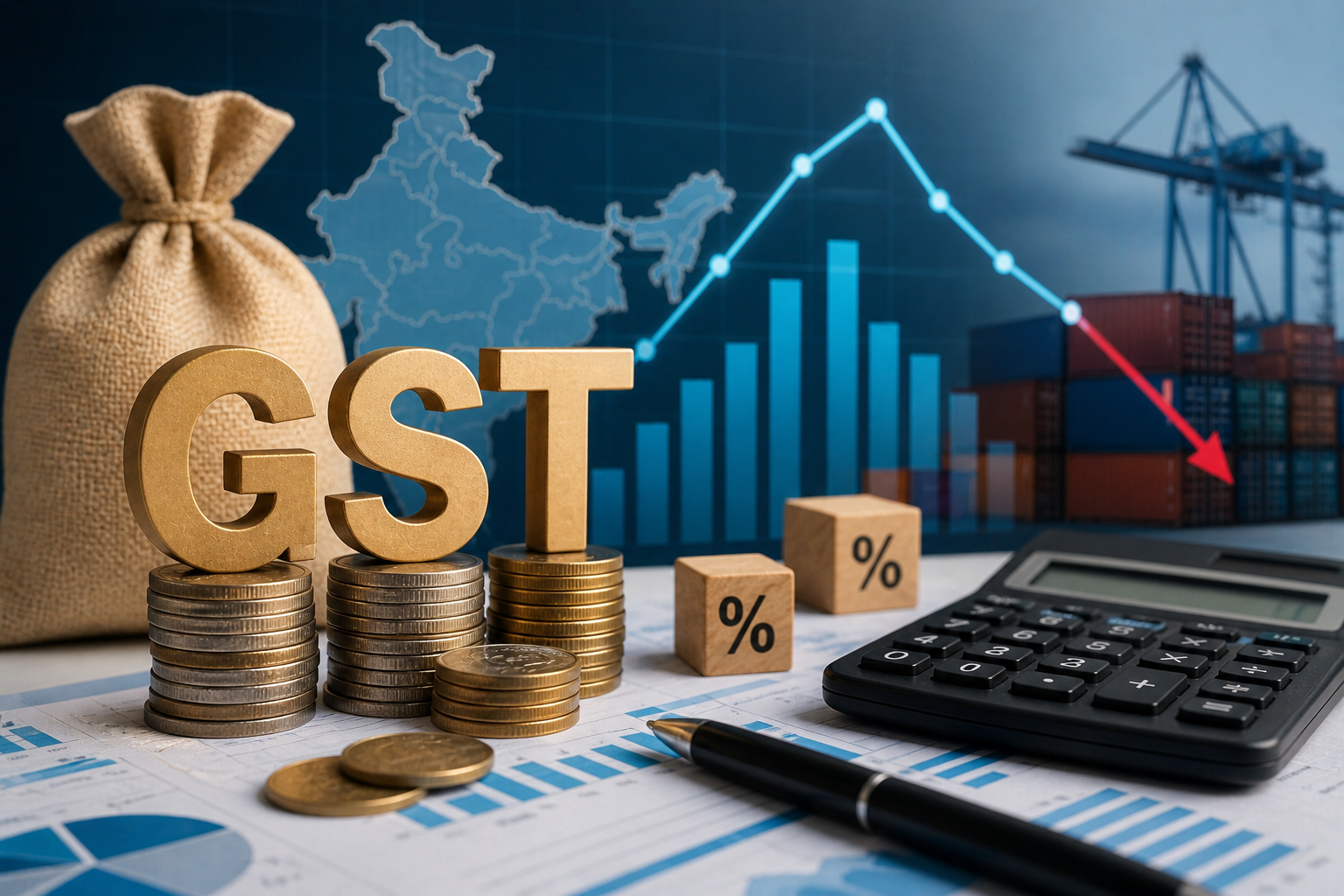
India’s Goods and Services Tax (GST) collections growth slowed to a five-year low of 5.57% in FY26, reflecting a cooling in economic momentum after years of strong expansion. Adjusted gross GST revenues (including cess for comparability) rose to ₹23.32 trillion from ₹22.09 trillion in FY25, marking the weakest growth since the pandemic period.
Data released by the Ministry of Finance suggests that while tax collections remain robust in absolute terms, the underlying growth trajectory is losing pace—raising concerns about domestic economic strength.
Import-Led Revenue Growth Raises Structural Concerns
A key highlight of FY26 GST data is the widening gap between import-driven and domestic tax collections:
- Import-linked GST revenues surged 12.8%
- Domestic GST collections grew only 3.3%
- IGST from imports rose 14.1% to ₹5.95 trillion
This imbalance indicates that external trade activity is contributing disproportionately to tax revenues, while domestic consumption and production remain relatively subdued.
Such divergence often signals uneven economic recovery, where global trade supports growth but internal demand lags behind.
Refund Surge Compresses Net Collections
The sharp increase in GST refunds has further dampened net revenue growth:
- Total refunds rose nearly 18% year-on-year
- Domestic refunds jumped 23.8%
- Import refunds increased 10.9%
After adjusting for refunds, net GST growth stood at around 4%, significantly lower than gross figures. While higher refunds reflect improved compliance and efficiency, they also reduce the net inflow of tax revenue.
End of Compensation Cess Alters Revenue Dynamics
The discontinuation of the GST compensation cess from February 2026 has also impacted overall growth figures. Cess collections dropped sharply by over 33%, contributing to the lower adjusted growth rate.
This structural shift marks a transition phase in GST accounting and fiscal planning, as the government moves away from temporary compensation mechanisms.
Uneven State-Level Performance Highlights Economic Gaps
State-wise GST performance reveals considerable disparities:
- Strong growth: Haryana (22%), Maharashtra (13%)
- Moderate gains: Gujarat, Karnataka, Tamil Nadu
- Declines: Jharkhand (-12%), Chhattisgarh (-14%), Odisha (-9%), Jammu & Kashmir (-8%)
In total, 12 states recorded negative growth, while many others reported only single-digit increases, highlighting uneven economic activity across regions.
Policy Outlook: Need for Targeted Reforms
Experts from Deloitte India emphasize the need for the next phase of GST reforms to address these structural imbalances.
Key focus areas may include:
- Sector-wise analysis to identify weak demand segments
- Further tax rationalisation to simplify the GST structure
- Measures to boost compliance and widen the tax base
- Enhanced coordination between producing and consuming states
Such reforms could help stabilise collections and improve revenue buoyancy in FY27.
Market Implications: What Investors Should Watch
The GST slowdown offers important signals for financial markets:
- Consumption Sector: Slower domestic GST growth may indicate weak consumer demand
- Corporate Earnings: Demand-sensitive sectors could face pressure on revenue growth
- Fiscal Health: Lower tax growth may impact government spending and deficit targets
- Trade Dynamics: Strong import growth could affect currency and trade balances
Outlook for FY27: Stability with Reform-Driven Growth
While GST collections remain at elevated levels, sustaining growth will depend on policy action and revival in domestic demand. If reforms are implemented early in FY27, they could support a rebound in tax collections and economic activity.
Conclusion
The decline in GST growth to a five-year low is not just a statistical shift—it reflects deeper structural changes in India’s economy. Strong import activity contrasts with subdued domestic demand, while rising refunds and uneven state performance add to the complexity.
For investors and policymakers, the message is clear: strengthening domestic demand and addressing structural inefficiencies will be key to sustaining India’s growth momentum in the coming years.