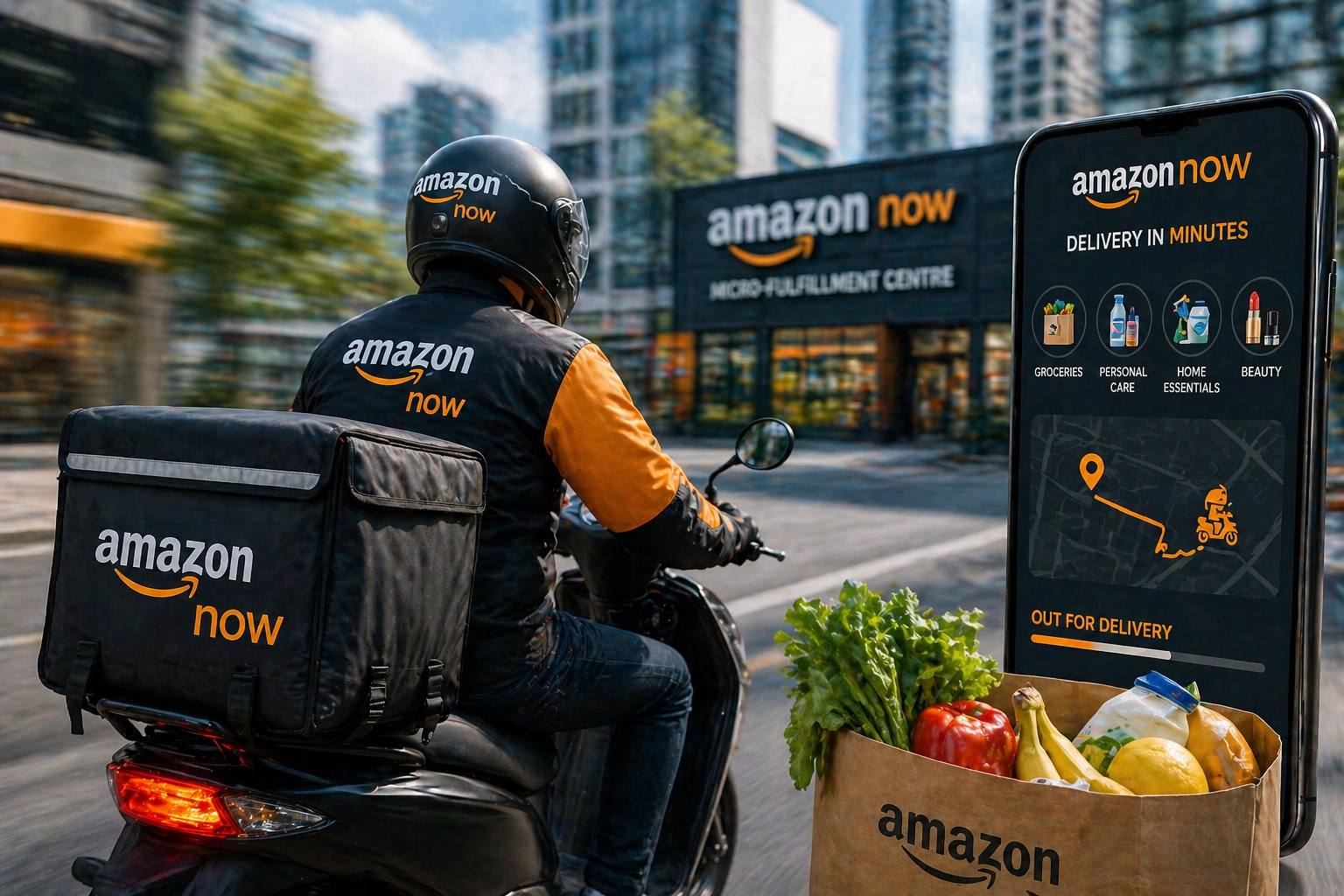
Massive micro-fulfilment push, Tier-II focus and rising competition reshape India’s rapid delivery landscape
Amazon is significantly scaling up its ultra-fast delivery service, Amazon Now, with plans to expand to 100 cities across India. The move highlights the company’s aggressive push into the fast-evolving quick-commerce segment, where speed, convenience, and logistics efficiency are becoming key differentiators.
Strategic expansion beyond metros
Having established a strong presence in metros like Mumbai, Delhi-NCR, and Bengaluru, Amazon is now targeting cities such as Pune, Hyderabad, Chennai, Kolkata, Jaipur, Lucknow, and Ahmedabad. This expansion reflects a broader industry shift toward unlocking growth in Tier-I and Tier-II markets.
The company aims to build a network of over 1,000 micro-fulfilment centres, enabling deliveries within minutes while ensuring consistent service quality across regions.
Strengthening last-mile and supply chain capabilities
Amazon Now offers a wide selection of daily essentials, including groceries, fresh produce, personal care, beauty items, and household goods. The company is leveraging advanced logistics systems, data analytics, and warehouse automation to optimise delivery times and inventory management.
A notable aspect of this expansion is Amazon’s integration of farmers into its supply chain. Over 16,000 farmers are expected to benefit by directly supplying produce through the platform, improving both efficiency and income opportunities.
₹2,800 crore investment to fuel growth
The expansion is backed by Amazon’s investment of more than ₹2,800 crore, aimed at enhancing operational infrastructure, associate safety, and delivery capabilities. This includes scaling dark stores, improving fulfilment speed, and deploying technology to streamline last-mile logistics.
Competitive intensity reaches new highs
India’s quick-commerce market is witnessing fierce competition, with players such as Blinkit, Zepto, Swiggy (Instamart), Flipkart, and JioMart aggressively expanding their networks.
The country already has over 6,000 dark stores, with heavy concentration in urban areas. This overlap has intensified competition, leading to pressure on margins and forcing companies to rethink growth strategies.
Profitability challenges and evolving strategies
As the sector matures, companies are focusing on improving unit economics. One key strategy is increasing average order value by expanding into higher-margin categories such as electronics, fashion, and general merchandise.
Additionally, players are experimenting with standalone apps to improve customer engagement and brand recall. Flipkart, for instance, is planning to spin off its quick-commerce service into a separate platform, following similar moves by competitors.
Tier-II cities: next growth frontier with risks
While smaller cities offer significant untapped potential, they come with structural challenges such as lower population density, limited awareness, and lower spending power. These factors may impact order frequency and profitability in the short term.
However, with rising digital adoption and improving logistics infrastructure, these markets are expected to play a crucial role in the next phase of growth.
Market outlook remains strong
Despite near-term challenges, India’s e-commerce market continues to show strong long-term potential. Industry estimates suggest the market could nearly double to $280–300 billion by 2030, driven by a growing user base and increasing online consumption.
Investment perspective
Amazon’s aggressive push into quick commerce signals a long-term bet on speed-driven retail. For investors, the sector presents both opportunity and risk—high growth potential supported by rising demand, but coupled with intense competition and pressure on profitability.
The coming years will likely determine which players can achieve the right balance between scale, speed, and sustainable margins in India’s rapidly evolving digital commerce ecosystem.