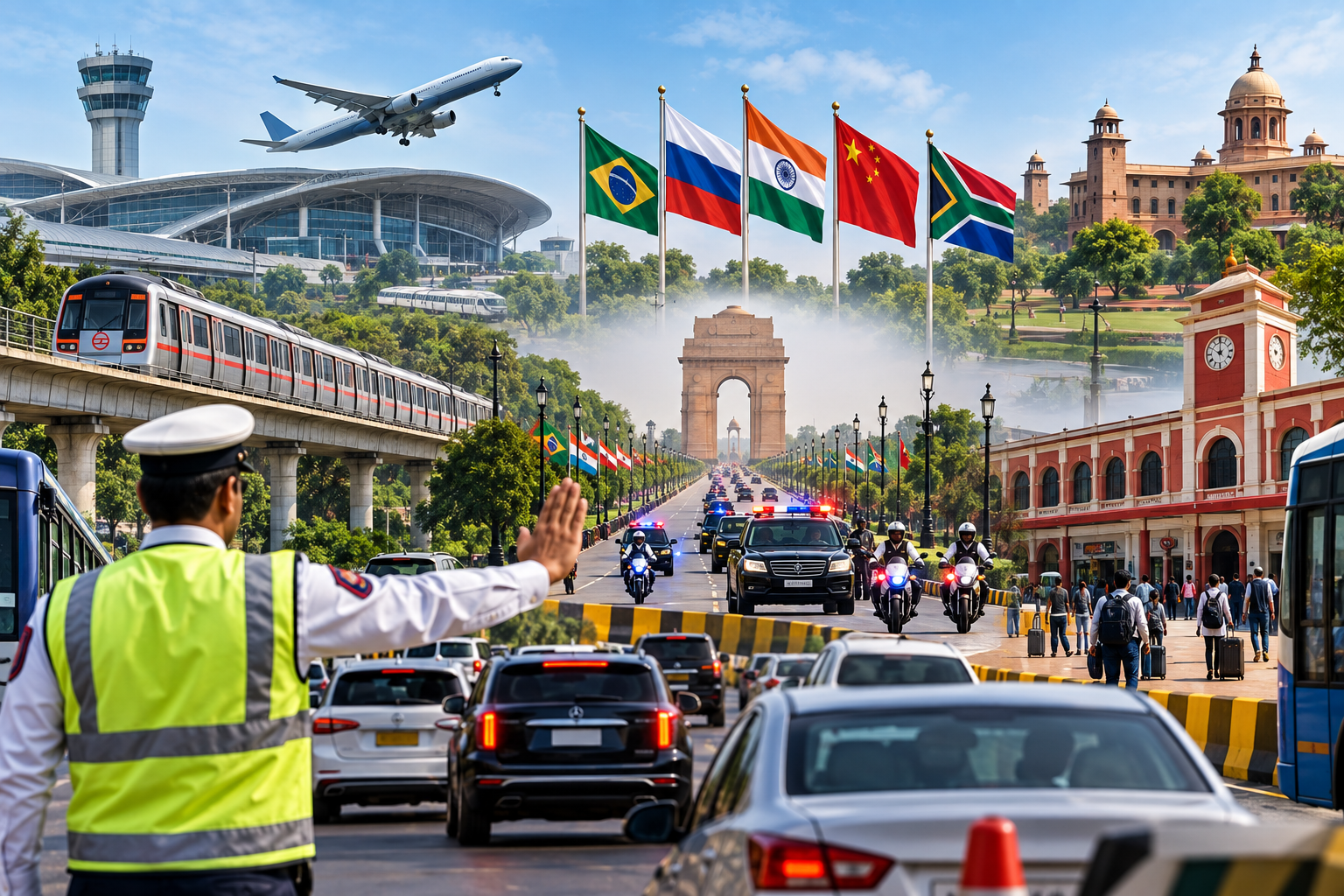
Delhi Traffic Police announces extensive restrictions and diversions from September 11-13; commuters advised to use Metro, plan journeys early and follow official updates
Delhi is set for heightened traffic and security arrangements as the 18th BRICS Leaders’ Summit takes place in the national capital from September 11 to 13. With senior leaders, diplomats, officials and international delegations expected to attend the summit, the Delhi Traffic Police has announced extensive road regulations, diversions and alternate routes across the city.
Traffic arrangements will particularly affect important corridors connecting central Delhi, diplomatic areas, major railway stations and Indira Gandhi International Airport (IGI). The authorities have advised commuters to plan their journeys in advance and check official traffic updates before leaving.
The police has also cautioned that traffic arrangements could change depending on the movement of dignitaries and evolving security requirements.
More Than 35 Roads to Face Restrictions
Traffic will be regulated on more than 35 roads during the summit period. Several major roads in and around central and south Delhi have been included in the advisory.
The affected stretches include Sardar Patel Marg, Mother Teresa Crescent, Teen Murti Marg, Akbar Road, Tees January Marg, Rajesh Pilot Marg, Subramaniam Bharti Marg, Mathura Road and Moti Lal Nehru Marg.
Other important roads include Dr Zakir Hussain Marg, Africa Avenue Road, Satya Marg, Shanti Path, Janpath, Ashoka Road, Barakhamba Road, Tolstoy Marg, Ranjeet Singh Flyover, Niti Marg, Panchsheel Marg, Kemal Ataturk Marg and APJ Abdul Kalam Road.
Traffic restrictions could also affect Press Enclave Road, Lal Bahadur Shastri Marg, Josef Broz Tito Marg and Lala Lajpat Rai Marg.
22 Major Diversion Points Identified
The traffic advisory identifies 22 diversion points where vehicles may be redirected depending on the movement of VIP convoys and security arrangements.
Major points include Dr Dinesh Nandini Dalmia Chowk, Ram Charan Aggarwal Chowk, Mir Dard Chowk, Kasturba Gandhi Marg-Outer Circle, Janpath-Connaught Place, Patel Chowk and the RML Hospital roundabout.
Other important diversion locations include Vande Matram Marg-Simon Bolivar Marg, Dhaula Kuan Flyover, Moti Bagh Flyover, Lodhi Road and Mandir House.
Commuters passing through these areas should expect changes in normal traffic patterns and avoid unnecessary travel wherever possible.
New Delhi Railway Station: Alternate Routes
Passengers travelling to New Delhi Railway Station have been provided with multiple alternative routes.
From ISBT Kashmiri Gate, commuters can take:
Boulevard Road → Rani Jhansi Marg → DBG Road → Panchkuian Road → Outer Circle, Connaught Place.
From Ashram Chowk, an alternative route is:
Ring Road → Raj Ghat → JLN Marg.
Another option is:
Vande Matram Marg → Dr Ambedkar Marg → Panchkuian Road → Outer Circle, Connaught Place.
Passengers with trains scheduled during the summit should reach the station well ahead of departure time, as road diversions and security checks could increase travel time.
Old Delhi Railway Station: Routes for Passengers
For passengers travelling to Old Delhi Railway Station, the traffic police has suggested the following alternatives.
From ISBT Kashmiri Gate:
Ring Road → Hanuman Mandir → S.P. Mukherjee Marg.
From Ashram Chowk:
Ring Road → Raj Ghat → Hanuman Mandir → S.P. Mukherjee Marg.
Another alternative route is:
Vande Matram Marg → Dr Ambedkar Marg → Rani Jhansi Marg → Rani Jhansi Flyover → Boulevard Road → Lothiyan Marg.
Travellers should check traffic conditions before beginning their journey, particularly during periods when diplomatic convoys are expected.
Hazrat Nizamuddin Railway Station: Suggested Routes
For passengers heading towards Hazrat Nizamuddin Railway Station, one recommended route from South Delhi is:
AIIMS → Ring Road → Ashram Chowk → Mathura Road.
Commuters approaching from the Kashmiri Gate side can use:
ISBT Kashmiri Gate → Ring Road → Raj Ghat → Ring Road → Ashram Chowk → Mathura Road.
Since Mathura Road is among the important corridors affected by the summit arrangements, passengers should keep additional travel time in hand.
IGI Airport Travel: Metro Gets Priority
The Delhi Traffic Police has strongly recommended that passengers travelling to IGI Airport use the Metro during the summit period.
The recommendation comes as airport-bound roads could experience traffic regulation, diversions and temporary restrictions during VIP movements.
Passengers should check their airline and terminal details before leaving home and avoid relying on normal travel times. Those travelling during peak security movement windows should leave considerably earlier.
Airport Routes From Gurugram
Passengers travelling from Gurugram to Terminals 3, 4 and 2 can use:
NH-48 → Rao Gajraj Singh Marg → Old Delhi Gurugram Road → UER-II → Service Road → T3 Terminal Road.
For Terminal 1, the suggested route is:
NH-48 → under Mahipalpur Flyover → T3 Road.
Another option for Terminal 1 is:
NH-48 → Mahipalpur Flyover → NH-48 → Ulan Batar Marg → T1 Road.
Airport passengers from Gurugram should factor in additional time for possible diversions and security-related traffic controls.
Airport Routes From Dwarka
For commuters travelling from Dwarka, the suggested route towards the airport is:
Sector-22, Dwarka Road → UER-II, including the new tunnel towards Terminal 3.
This route is expected to provide an alternative connection for passengers travelling towards the airport from western Delhi and Dwarka.
Airport Route From New and South Delhi
Passengers travelling to the airport from New Delhi and South Delhi can use:
Ring Road → AIIMS Chowk → Moti Bagh Chowk → RTR Marg → under Shankar Vihar Flyover → Sanjay T-Point → Service Road → NH-48 → under Mahipalpur Flyover → Rangpuri → T3 Road.
Because several of these corridors could experience security-related traffic management, passengers should check the latest advisory before starting their journey.
Airport Route From West Delhi
Commuters from West Delhi can take:
Punjabi Bagh Chowk → Ring Road → Raja Garden Chowk → Najafgarh Road → Pankha Road → Dabri → Dwarka Road → Road No. 224 → Dabri-Gurugram Road → Sector-22, Dwarka Road → UER-II → Service Road → NH-48 → T3 Terminal Road.
The route provides an alternative connection towards the airport while avoiding some of the more heavily controlled central Delhi corridors.
Airport Route From North and East Delhi
Passengers travelling from North and East Delhi can follow:
ISBT Kashmiri Gate → Rani Jhansi Flyover → Rohtak Road → Punjabi Bagh Chowk → Raja Garden Chowk → Najafgarh Road → Pankha Road → Dabri → Dwarka Road → Road No. 224 → Dabri-Gurugram Road → Sector-22, Dwarka Road → UER-II → Service Road → NH-48 → T3 Terminal Road.
Commuters should allow extra time because traffic volumes may increase on alternative routes as vehicles are diverted away from restricted roads.
Motorcade Rehearsal to Affect Thursday Evening Traffic
Commuters travelling on Thursday should also account for the Motor Carcade Rehearsal scheduled from 7:45 PM to 10:00 PM.
The rehearsal could temporarily affect traffic movement along the designated convoy corridor. The police has advised residents and commuters to check traffic arrangements before beginning their evening journeys.
Metro Services to Remain Operational
The Delhi Metro is expected to remain operational at all stations during the summit period. The traffic police has therefore encouraged commuters to use public transport wherever possible.
Metro travel could be particularly useful for people travelling towards central Delhi, railway stations and airport-connected areas, where road movement may be affected by VIP convoys.
Bus services may be diverted during VIP movements, while taxis and autorickshaws could also face restrictions or diversions in controlled zones.
Parking Restrictions Around Controlled Roads
The traffic advisory also includes strict restrictions on roadside parking.
Parking within 200 metres of controlled roads has been prohibited, and commuters have been instructed to use authorised parking facilities.
People travelling through restricted zones should avoid stopping unnecessarily on roads, as parked vehicles could create additional congestion and security concerns.
Restrictions on Commercial Vehicles
The advisory states that non-destined commercial vehicles will not be permitted to enter Delhi during the relevant restriction period.
The measure is aimed at reducing unnecessary traffic volumes and ensuring smoother movement for essential services and diplomatic convoys.
Emergency and medical vehicles will receive priority, while essential supplies and utility operations are expected to continue.
Commuters Advised to Plan Ahead
The traffic restrictions are expected to create longer travel times, particularly around central Delhi, airport routes and major railway-station corridors.
Commuters should:
-
Check official Delhi Traffic Police updates before travelling.
-
Prefer Metro services wherever practical.
-
Leave early for airports and railway stations.
-
Keep digital and physical travel documents readily available.
-
Follow instructions from traffic personnel.
-
Avoid unnecessary travel through controlled zones.
-
Use designated parking facilities only.
-
Keep emergency corridors clear.
-
Allow additional time for diversions and security checks.
Traffic Arrangements May Change at Short Notice
The Delhi Traffic Police has emphasised that the arrangements are subject to change depending on security requirements and the movement of visiting dignitaries.
This means that even a route listed as an alternative could experience temporary restrictions during the movement of a high-level delegation.
Travellers should therefore treat the routes as planned alternatives rather than guaranteed congestion-free corridors.
BRICS Summit Puts Delhi Mobility Infrastructure in Focus
The extensive traffic arrangements underline the scale of the international event and the logistical requirements involved in hosting multiple high-level delegations in the national capital.
For ordinary commuters, the key challenge will be navigating temporary restrictions while maintaining access to airports, railway stations, offices, hospitals and residential areas.
The Delhi administration and traffic authorities are expected to maintain close coordination throughout the summit to balance security requirements with the movement of the general public.
For passengers travelling between September 11 and 13, early planning, Metro usage and regular monitoring of official traffic advisories will be the most effective ways to minimise delays.