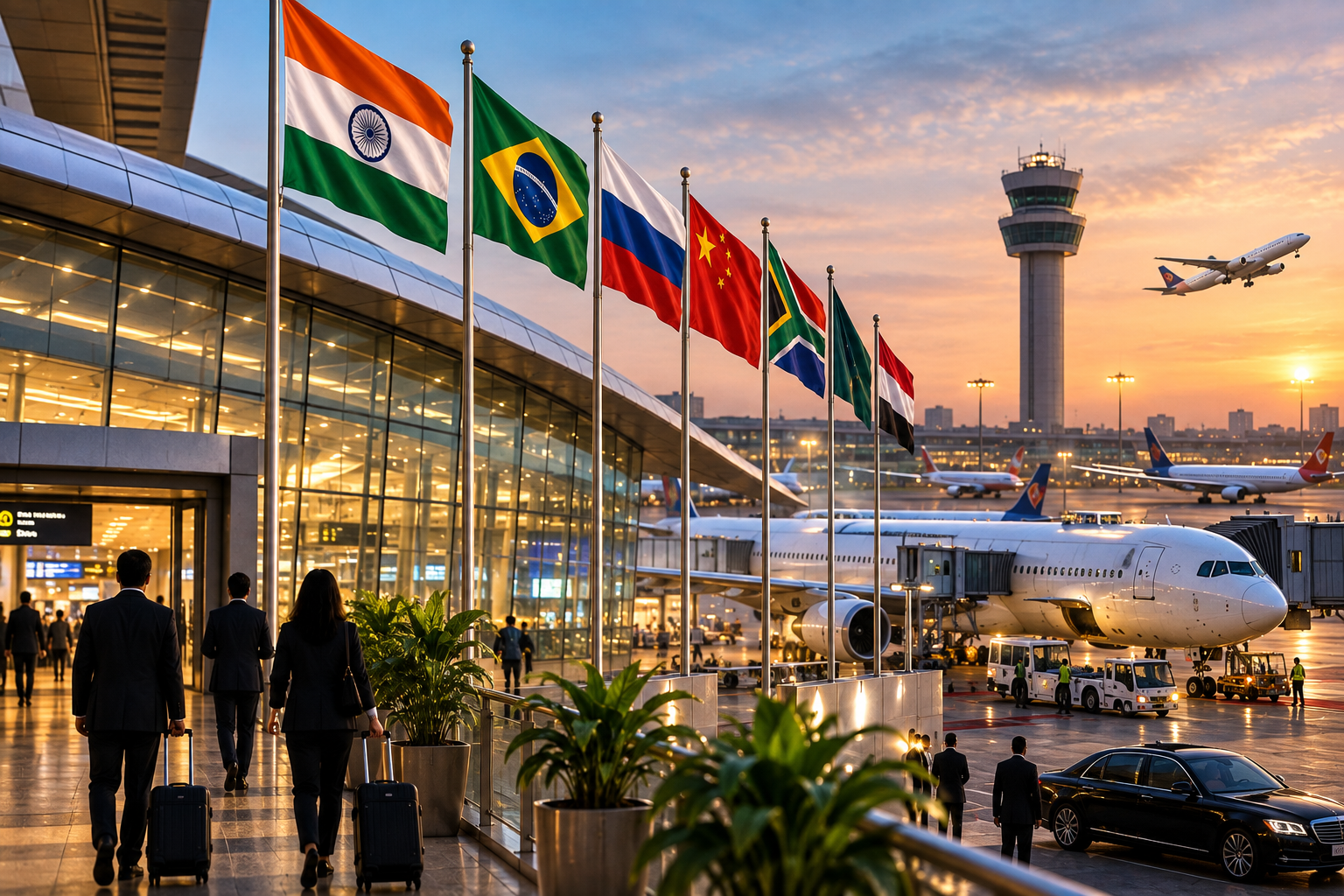
Converted Terminal 3 facility to increase annual international passenger-handling capacity by 50% to 31 million
Delhi Airport has begun the phased opening of Pier C at Terminal 3 for international flight operations ahead of the 18th BRICS Leaders’ Summit, scheduled to be held in New Delhi from September 11 to 13. The facility, operated by GMR Group-controlled Delhi International Airport Limited (DIAL), is expected to provide additional capacity and operational flexibility during the high-profile international event.
The airport began progressively activating Pier C from Wednesday night. Initially, the facility will handle international arrivals, while both arrivals and departures are expected to operate from the pier from Thursday evening.
Once fully operational, the converted pier will increase Delhi Airport’s annual international passenger-handling capacity by 50 per cent to approximately 31 million passengers.
Terminal 3 shifts towards international operations
Pier C was previously used for domestic flights. It has now been converted into an international facility as part of Delhi Airport’s broader plan to accommodate rising international aviation demand.
With the change, Terminal 3 will have three piers dedicated to international operations and one pier for domestic flights. Earlier, Piers A and B handled international flights, while Piers C and D were used for domestic operations.
A pier is an extension of the main terminal building that provides aircraft parking positions and passenger boarding facilities. The conversion of Pier C will allow the airport to use its existing infrastructure more efficiently without relying entirely on the construction of a new terminal facility.
The converted facility is also expected to improve Terminal 3’s ability to handle next-generation and wide-body aircraft, which are commonly used on long-haul international routes.
Capacity expansion comes ahead of major global event
The BRICS Summit is expected to bring heads of government, senior officials, business representatives and international delegations from member and partner countries to the national capital. The main venue for the summit will be Bharat Mandapam in Central Delhi.
The additional international-handling capacity is expected to help Delhi Airport manage the increase in scheduled and special flights during the summit. It will also provide greater flexibility in allocating aircraft parking bays, boarding gates, immigration facilities and ground-handling resources.
DIAL said its preparedness plan has been developed in coordination with the Central Industrial Security Force, Bureau of Civil Aviation Security, airlines, ground-handling agencies, immigration authorities and customs officials.
Pradeep Panicker, chief executive officer of DIAL, said the airport had undertaken extensive preparations to manage the expected increase in international traffic while maintaining safety, security and passenger-service standards.
The airport operator said its teams were working round the clock to ensure smooth operations and a seamless experience for passengers, dignitaries and international visitors.
International passenger traffic expected to recover
The conversion of Pier C was completed earlier in 2026, but its operational launch was delayed following a sharp decline in international traffic after the US-Iran conflict began in late February. With international traffic expected to recover, the facility was scheduled to be activated around September.
Between April and July 2026, Delhi Airport handled 19.5 million domestic passengers, representing an 8.1 per cent year-on-year increase. During the same period, international passenger traffic stood at 6.9 million, up 0.9 per cent compared with the corresponding period of the previous year.
The figures indicate that domestic traffic continues to grow at a faster pace, while international passenger volumes are gradually recovering. The activation of Pier C will allow the airport to respond more effectively to future growth in international travel.
Domestic operations gradually moved to other terminals
Delhi Airport has been gradually reallocating domestic operations to other terminals to create more space for international flights at Terminal 3.
As part of this strategy, Air India and Air India Express shifted select domestic operations to Terminal 2 from October 26, 2025. The move was partly linked to the ongoing expansion and reconfiguration of Terminal 3.
The redistribution of domestic flights is intended to improve the utilisation of available terminal infrastructure and support Delhi Airport’s long-term objective of becoming a stronger international aviation gateway.
The airport’s strategy also reflects the changing nature of India’s aviation market, where international connectivity is becoming increasingly important due to rising outbound tourism, business travel, overseas education and growing economic engagement with global markets.
Long-term importance for Delhi Airport
The opening of Pier C is not limited to the immediate requirements of the BRICS Summit. It forms part of DIAL’s longer-term effort to strengthen Delhi Airport’s international passenger-handling capabilities.
The facility is expected to help the airport accommodate more international flights, improve the allocation of terminal resources and provide greater flexibility during peak travel periods. It could also support the introduction of additional long-haul routes and improve the airport’s ability to handle wide-body aircraft.
For airlines, additional international gates and aircraft parking positions could reduce operational pressure during periods of high demand. For passengers, the expansion is expected to improve the availability of international check-in, immigration, boarding and arrival facilities as traffic increases.
However, the success of the expansion will depend not only on additional capacity but also on the efficiency of security checks, immigration processing, baggage handling, ground services and passenger movement within the terminal.
GMR Airports expands its aviation footprint
DIAL is part of GMR Airports Limited, which operates a growing portfolio of airports in India and overseas. The company said its airport assets handled more than 121 million passengers during FY26.
Its portfolio includes airports in Delhi, Hyderabad, Goa, Nagpur, Bidar and Visakhapatnam in India, along with Medan Airport in Indonesia.
The expansion of Delhi Airport’s international capacity strengthens GMR Airports’ position in India’s aviation infrastructure sector. As passenger traffic rises and international connectivity expands, airport operators are expected to benefit from increased aeronautical revenue as well as non-aeronautical businesses such as retail, food and beverages, parking, lounges, advertising and commercial real estate.
The operationalisation of Pier C therefore represents both an immediate logistical response to the BRICS Summit and a strategic investment in Delhi Airport’s future role as a major international aviation hub.