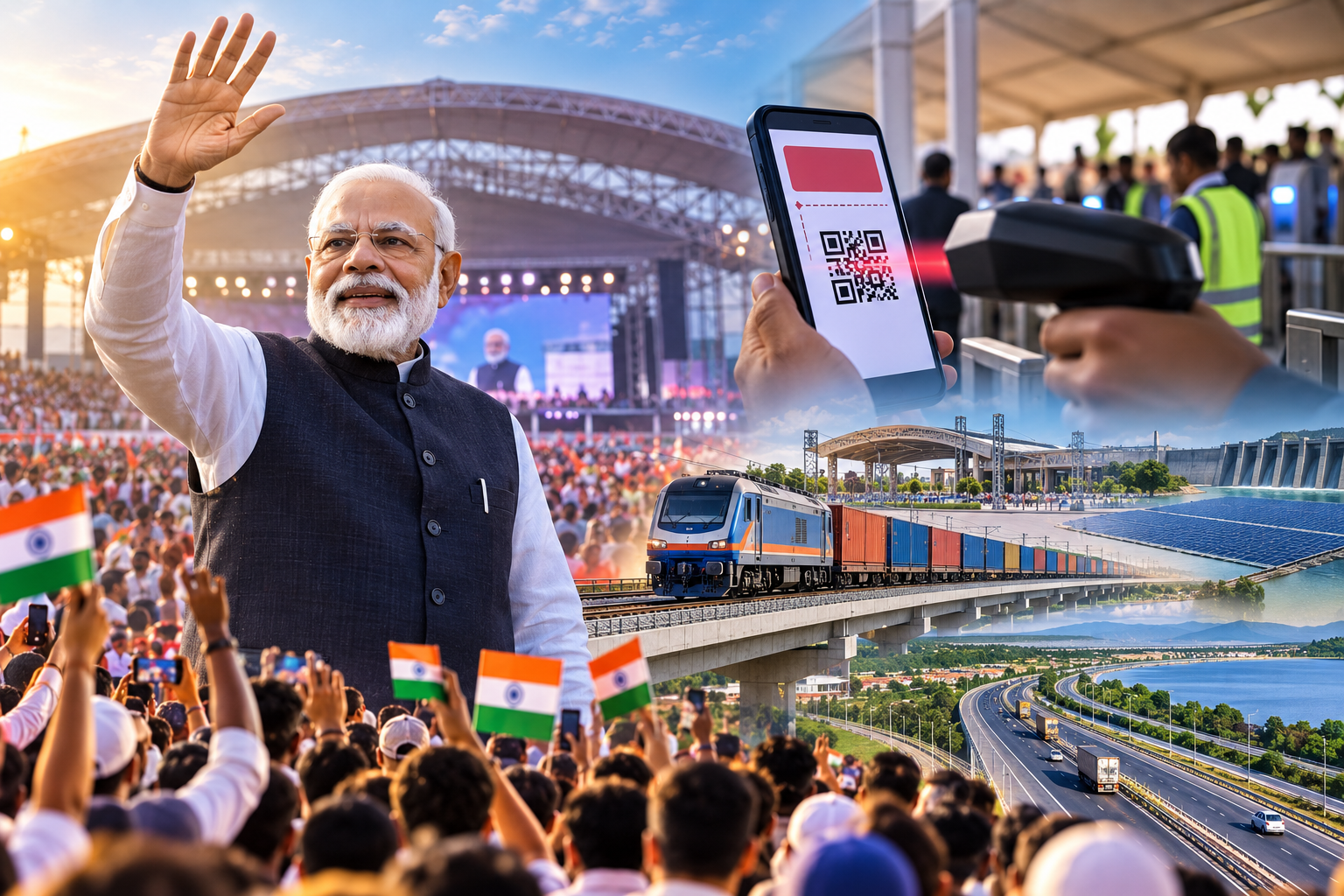
‘NaMo for Viksit Bharat’ Programme Draws Strong Public Response as Major Infrastructure Projects Worth Over ₹35,000 Crore Take Centre Stage
Prime Minister Narendra Modi’s upcoming public programme in Vadodara has received an overwhelming response, with all available registrations filling up within an hour of the event being listed on BookMyShow. More than 42,000 people were subsequently placed on the waiting list, underlining the strong public interest in the programme.
The event, titled ‘NaMo for Viksit Bharat’, is being organised through a digital registration system managed by the Vadodara Municipal Corporation. Citizens were allowed to register free of charge through the ticketing platform, marking an unusual use of a private digital service for managing participation in a major government event.
Registered attendees will receive electronic M-tickets through their BookMyShow accounts. Each ticket will carry a live QR code that will be scanned at the venue for entry verification. Registration, security checks, seating arrangements and crowd movement are also expected to be managed digitally, helping authorities reduce queues and improve access control.
The programme will bring together citizens, students, professionals, educators, entrepreneurs, industry representatives and members of civil society around the vision of a developed India by 2047. The strong response has added considerable attention to the event even before the Prime Minister’s arrival.
Major Infrastructure Projects on the Agenda
During the programme, Prime Minister Modi is scheduled to inaugurate, dedicate and lay the foundation stones for development projects worth more than ₹35,000 crore. A key highlight will be the dedication of three sections of the Western Dedicated Freight Corridor to the nation.
The three sections together cover approximately 326 route kilometres and have been developed at a cost of more than ₹20,700 crore. The corridor is expected to strengthen freight connectivity between industrial centres in northern and western India and major ports, including the Jawaharlal Nehru Port.
Improved freight movement could help reduce transportation time, lower logistics costs and ease pressure on existing railway routes. The corridor is also expected to support faster movement of export-import cargo and improve the efficiency of India’s supply-chain network.
New Freight and Passenger Services
The Prime Minister will also flag off freight train services from New Sanand, New Makarpura, New Umbergaon and New JNPT in Mumbai. These services are expected to improve the movement of industrial goods and strengthen links between manufacturing clusters and ports.
A new passenger train service between Tanda Road and Vadodara’s Pratapnagar will also be launched. In addition, the Jobat-Tanda Road railway line will be dedicated to the nation, improving rail connectivity for remote and tribal areas of Alirajpur and adjoining regions.
The programme also includes foundation stones for railway projects covering around 329 kilometres at a combined cost of more than ₹9,700 crore. Three highway projects worth approximately ₹1,780 crore are also part of the development agenda.
Gujarat Projects and Wider Development Agenda
Several Gujarat-focused projects are expected to be included in the programme, covering urban infrastructure, renewable energy, housing and water supply. These include the second phase of the Vadodara ring road, a 110 MW floating solar project at Kadana Dam and a new municipal corporation office.
Housing projects under the Pradhan Mantri Awas Yojana and a water supply project covering 11 villages are also expected to be inaugurated. Together, these initiatives are aimed at improving urban services, strengthening regional connectivity and supporting long-term economic activity.
The Vadodara programme forms part of the Prime Minister’s wider visit to Gujarat and Maharashtra. After the Vadodara engagements, Modi is scheduled to travel to Mumbai for the Global Fintech Fest, where emerging technologies such as artificial intelligence, tokenisation and quantum technologies in financial services are expected to receive attention.
Market Outlook
The infrastructure announcements could create long-term opportunities for companies involved in railways, freight logistics, construction, engineering, renewable energy, highways and urban development. Improved freight connectivity may also benefit manufacturers and exporters by reducing transportation bottlenecks and improving access to ports.
However, investors should assess the actual impact of such projects through order inflows, execution progress, payment cycles, debt levels and profitability. While large government infrastructure spending can support sectoral growth, the market impact will depend on timely implementation and the ability of companies to convert project opportunities into sustainable earnings.