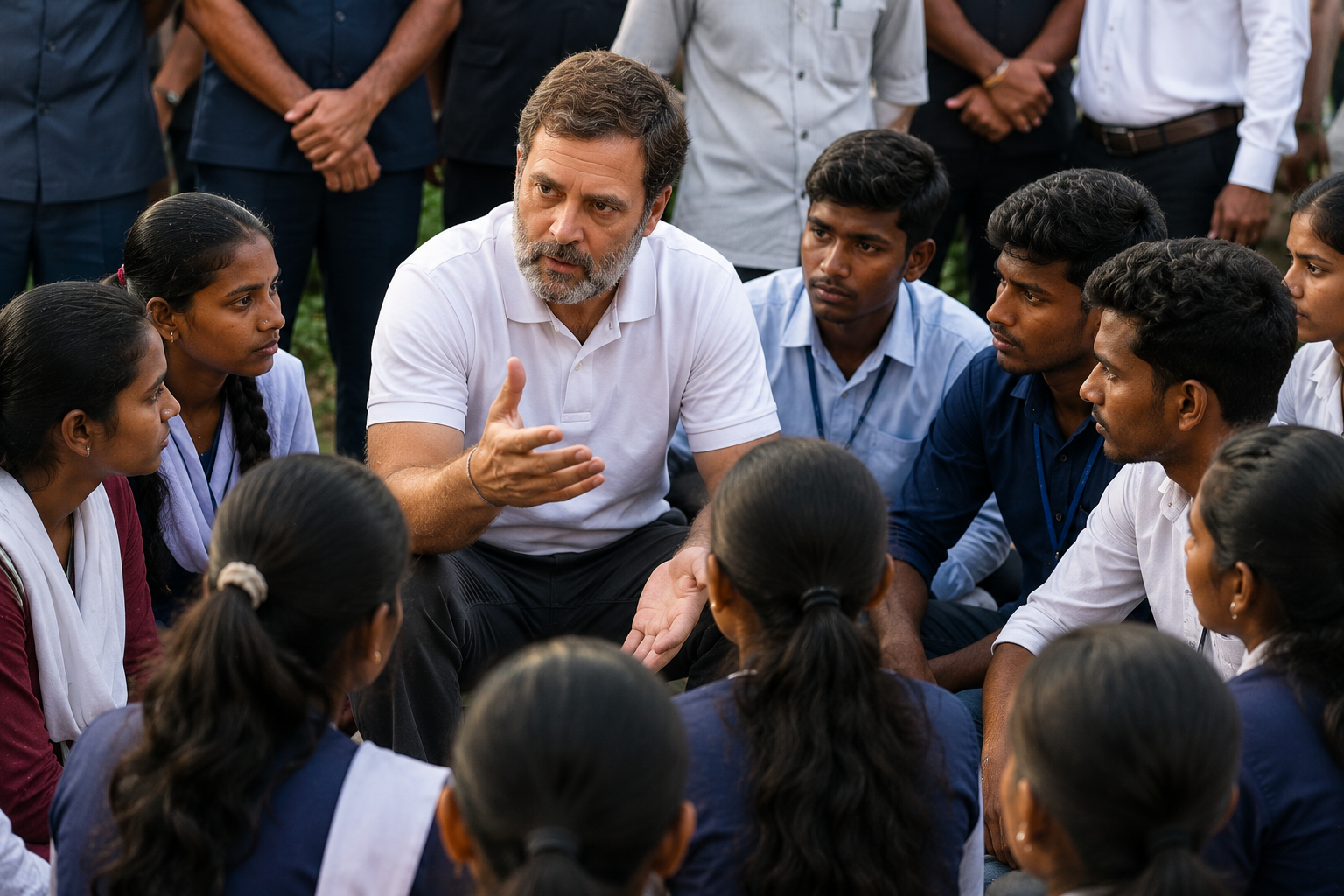
Congress Leader Meets Tribal Students In Nashik, Raises Concerns Over Ashram School Conditions And Educational Facilities
Congress MP and Leader of Opposition in the Lok Sabha Rahul Gandhi met a delegation of tribal students during his visit to Nashik and said education should be treated as a right of every student in India rather than a privilege.
The students, including those who were reportedly observing a hunger strike, raised a range of concerns relating to their education and the condition of ashram schools serving tribal communities.
Gandhi said students from marginalised communities should not be neglected by the system and should receive the support and assistance required to pursue their education in a safe and respectful environment.
The interaction has brought renewed attention to the quality of educational infrastructure available to tribal students and the challenges faced by residential schools in providing both academic and basic living facilities.
Tribal Students Protest Over Multiple Demands
The delegation of tribal students discussed several issues concerning their educational facilities and institutional conditions.
Some students were reportedly on hunger strike as part of their protest, seeking attention to their demands and urging authorities to take action.
A key concern raised during the protest involved the condition of ashram schools, which provide education as well as residential facilities for students belonging to tribal communities.
These institutions are particularly important in areas where students may live far away from conventional schools and face difficulties travelling long distances every day.
Rahul Gandhi Listens To Students’ Concerns
During his interaction, Gandhi said he listened carefully to the problems and demands raised by the students.
The Congress leader subsequently emphasised the need for students to have access to a safe, respectful and conducive learning environment.
He said students from marginalised communities require greater attention from the system and should receive every possible form of support.
His comments placed the focus on both access to education and the quality of the environment in which students receive that education.
‘Education Is Not A Privilege’
Gandhi reiterated his position that education should be available to every student as a right.
In his remarks, he stressed that education should not depend on a student's social or economic background.
The Congress leader's statement also highlighted the additional support required by marginalised communities to ensure that formal access to schools translates into meaningful educational opportunities.
The issue is particularly significant for students who depend on government-supported residential institutions for both education and accommodation.
Ashram Schools Play Important Role In Tribal Education
Ashram schools serve a specific purpose in tribal education by combining classroom instruction with residential facilities.
For students living in remote or geographically isolated areas, such institutions can reduce the difficulties associated with travelling long distances to school.
Students may depend on these institutions for accommodation, meals, sanitation, healthcare and other basic services in addition to classroom education.
This makes the quality and maintenance of residential facilities an important component of the overall educational experience.
Infrastructure Conditions Can Affect Students’ Education
The condition of educational infrastructure can directly influence the learning environment.
Students require functional classrooms, adequate study facilities, electricity, drinking water, sanitation, learning materials and access to qualified teachers.
For residential schools, additional requirements include safe accommodation, nutritious food, healthcare and appropriate recreational facilities.
Any shortcomings in these areas can make it difficult for students to concentrate on their studies and can potentially affect attendance and retention.
Tribal Students Face Multiple Barriers
Students from tribal communities can face several challenges that are less pronounced in more developed urban areas.
Geographical remoteness can make access to schools and colleges difficult.
Household financial constraints can also influence whether students are able to continue their education.
Limited transportation, inadequate digital connectivity and shortages of educational resources can further widen the gap between students in remote communities and those in better-connected areas.
Addressing these challenges requires support extending beyond classroom education.
Residential Education Can Reduce Geographic Barriers
One of the principal advantages of residential education is that it allows students from distant villages and remote areas to remain closer to their educational institutions.
This can reduce travel-related barriers and provide students with a structured environment for study.
However, residential education also creates a greater responsibility for institutions because students spend a significant portion of their daily lives on campus.
The availability of clean accommodation, food, healthcare and security therefore becomes as important as the quality of classroom teaching.
Hunger Strike Highlights Students’ Sense Of Urgency
The reported hunger strike by some students indicates the urgency with which the protesting group is seeking attention to its concerns.
Student-led protests can bring public visibility to issues that may otherwise remain confined to individual institutions or local communities.
The immediate responsibility now lies with the relevant authorities to examine the demands, verify the concerns and determine what corrective measures may be required.
The outcome of discussions between the students and authorities could determine whether the protest is resolved.
Government Responsibility For Educational Facilities
Government authorities have an important role in ensuring that institutions serving disadvantaged communities meet appropriate educational and infrastructure standards.
This includes ensuring adequate funding as well as effective implementation and monitoring.
Simply allocating funds does not guarantee improvements unless the money reaches the intended institutions and is used efficiently.
Regular inspections and transparent reporting can help identify infrastructure gaps and ensure that corrective action is taken.
Need For Better Monitoring Of Ashram Schools
Residential educational institutions require continuous monitoring because students depend on them for multiple aspects of daily life.
Authorities can assess institutions based on classroom infrastructure, hostel conditions, sanitation, drinking water, food quality, healthcare, teacher availability and student safety.
Student feedback can also provide valuable information about conditions that may not always be visible through administrative reports.
A stronger monitoring mechanism could help authorities identify problems before they become major grievances.
Education And Social Mobility Closely Linked
Access to quality education can have a significant influence on social mobility.
Students who receive adequate education and skills are more likely to access higher education, formal employment and better income opportunities.
For tribal communities, education can play an important role in reducing long-standing socioeconomic disadvantages.
Improving educational outcomes can therefore have benefits that extend beyond individual students to their families and communities.
Education Is Also A Human-Capital Investment
From an economic perspective, education represents an investment in human capital.
A better-educated population can contribute to higher productivity, improved employment outcomes and greater participation in emerging industries.
As India continues to expand sectors such as technology, manufacturing, healthcare, services and infrastructure, access to quality education will become increasingly important for building a skilled workforce.
Ensuring that students from remote and disadvantaged communities are included in this growth is therefore an important long-term policy objective.
Digital Education Could Expand Access
Technology can also play a role in improving educational access for students in remote areas.
Digital classrooms, online learning resources and internet connectivity can supplement traditional teaching where specialised educational resources are limited.
However, digital education cannot fully replace basic infrastructure.
Reliable electricity, internet connectivity, devices, teachers and appropriate learning environments are necessary for technology-based education to work effectively.
A combination of physical and digital infrastructure could therefore provide better outcomes.
Scholarships And Financial Support Remain Important
Financial assistance can help students from economically weaker households continue their education.
Scholarships, hostel facilities, educational materials and other forms of assistance can reduce the financial burden on families.
Such support can become particularly important at higher levels of education, when expenses associated with transportation, accommodation and study materials increase.
Ensuring that eligible students receive benefits without unnecessary administrative delays can improve educational continuity.
Quality Of Teachers Is Equally Important
Infrastructure alone cannot deliver good educational outcomes.
The availability of qualified and motivated teachers is critical to ensuring that students receive effective instruction.
Remote schools can sometimes face difficulties in attracting and retaining specialised teaching staff.
Improving teacher availability, training and professional support could therefore be an important component of strengthening tribal education.
Education Can Support Employment Opportunities
Better education can improve students' access to employment opportunities outside traditional local occupations.
Skill development, vocational training and higher education can help students participate in India's expanding formal economy.
For tribal youth, access to these opportunities can potentially improve household incomes and reduce dependence on limited local employment options.
The educational system therefore has an important role in connecting students with the wider economy.
Rahul Gandhi Also Interacts With Maharashtra Congress Leaders
During his visit, Gandhi also met district-level leaders of the Maharashtra Congress.
He urged party leaders and workers to remain committed to the party's ideology and to work towards ensuring justice for people.
The political engagement took place alongside his interaction with tribal students.
The visit consequently combined organisational discussions with attention to a local education-related issue.
Tribal Welfare Could Remain A Political Focus
Tribal welfare is likely to remain an important subject in political and policy discussions.
Issues involving education, healthcare, employment, land rights, infrastructure and social welfare frequently influence political debates concerning tribal communities.
The concerns raised by students in Nashik provide another example of how educational infrastructure can become a wider public-policy issue.
Political parties may continue to use such issues to demand greater accountability and stronger implementation of welfare programmes.
Need For Long-Term Educational Planning
Improving tribal education requires sustained planning rather than short-term responses to individual protests.
Authorities need to assess the availability of schools, residential facilities, teachers and educational resources across different regions.
Infrastructure investment should also be aligned with changes in population, enrolment and local educational demand.
Long-term planning can help prevent recurring shortages and ensure that educational facilities remain adequate as communities develop.
Student Welfare Must Remain Central
The welfare of students in residential institutions extends beyond academic performance.
Students require a secure environment in which they can study, sleep, eat and participate in extracurricular activities.
Health and hygiene standards are particularly important because students spend extended periods within residential campuses.
A comprehensive approach to student welfare can improve both educational outcomes and the overall experience of children and young people from disadvantaged communities.
Public Accountability Can Improve Outcomes
Greater transparency in the operation of educational institutions can help improve accountability.
Publishing information on infrastructure, enrolment, staffing and expenditure can make it easier for authorities, parents and communities to identify gaps.
Grievance mechanisms can also give students a formal channel to report problems.
Such systems can reduce the need for prolonged protests by providing mechanisms through which concerns can be addressed before they escalate.
Broader Economic Significance
The issue of tribal education has implications for India's broader economic development.
India's future growth will depend partly on its ability to create a workforce that can participate across a range of industries and services.
If students from marginalised communities lack access to quality education, a significant pool of potential human capital may remain underutilised.
Improving educational access can therefore contribute to more inclusive economic growth.
Market Outlook
The developments surrounding the tribal students' protest are primarily a social, educational and political issue, and the immediate impact on financial markets is expected to remain limited.
However, education policy has important long-term economic implications. Increased investment in school infrastructure, residential facilities, digital education, scholarships, teacher availability and skill development can strengthen human capital and improve workforce participation over time.
For investors, the broader economic impact could become relevant if governments increase spending on education infrastructure and associated areas such as construction, technology, transportation, healthcare and digital connectivity.
The immediate focus will remain on how authorities respond to the students' demands and whether improvements are made to ashram schools. Over the longer term, stronger educational infrastructure for tribal and marginalised communities could support more inclusive growth, higher employability and improved productivity.