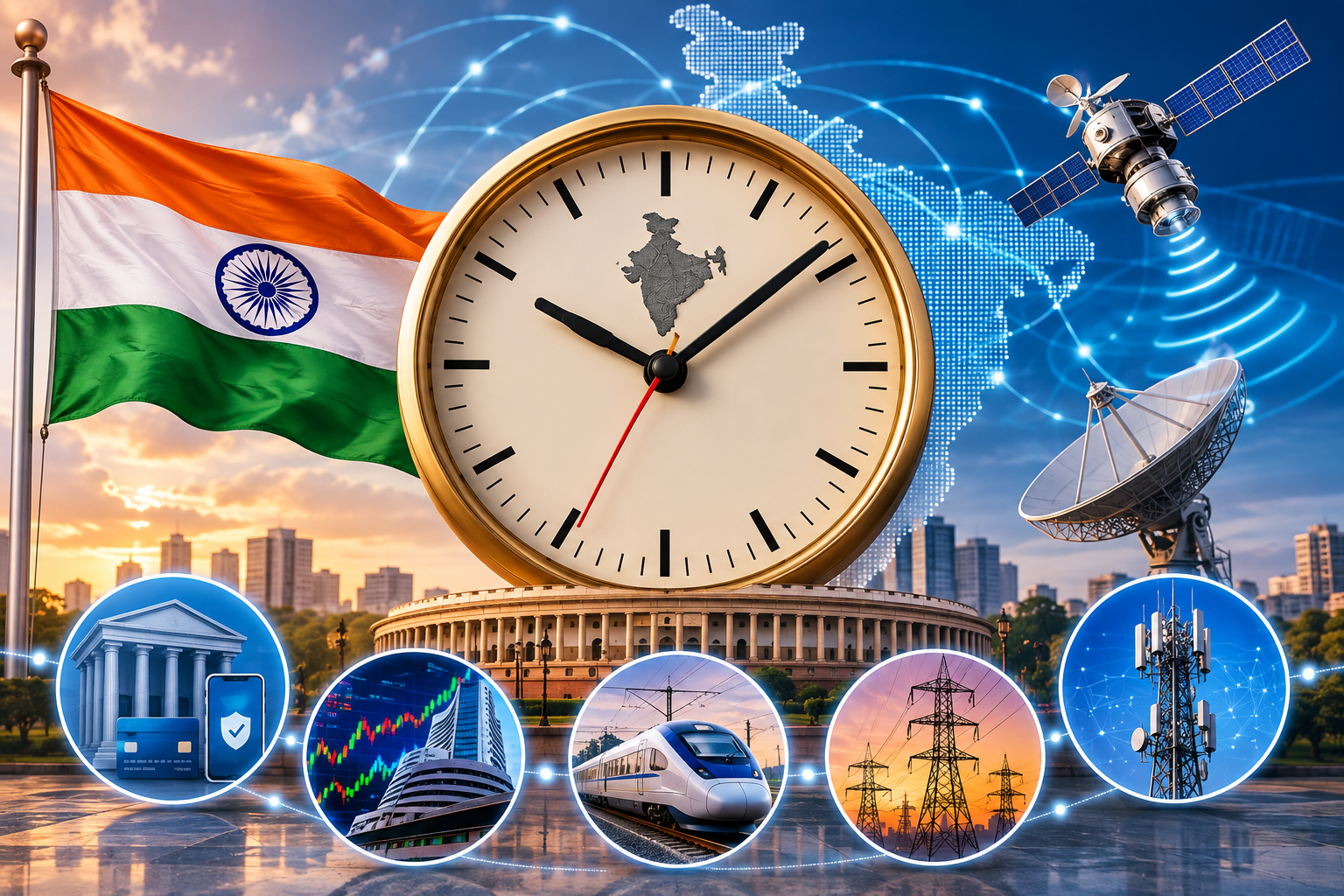
New Rules to Bring Banks, Stock Exchanges, Telecom Networks, Power Systems and Transport Under a Common Time Reference
The Government of India has moved to establish Indian Standard Time (IST) as the single official time reference for official and commercial activities, creating a common framework for accurate and synchronised timekeeping across the country.
The Department of Consumer Affairs notified the Legal Metrology (Indian Standard Time) Rules, 2026, on August 27. The rules will come into force 180 days after publication in the Official Gazette, meaning the new framework is expected to become operational in early 2027.
The move is aimed at strengthening the reliability of India's critical infrastructure by requiring government institutions and specified commercial and regulated sectors to synchronise their systems with authorised Indian timing sources.
The initiative is particularly significant for sectors where even tiny differences in system clocks can affect transactions, communications, network operations, infrastructure management and the ability to establish the precise sequence of events.
Why India Needs a Common Time Reference
India already follows IST nationwide, so the new rules do not introduce a new time zone or change the country's existing clock.
Instead, the government is seeking to ensure that the digital systems and devices operating across the country use a common and accurately traceable source of time.
Modern economic activity increasingly depends on timestamps.
A digital payment may pass through several systems before completion. A stock-market transaction can involve multiple orders and matching engines operating within fractions of a second. Telecom networks need synchronised infrastructure, while electricity grids require accurate records to identify and analyse faults.
If different systems operate with slightly different clocks, establishing the exact sequence of events can become difficult.
The government's objective is therefore to create a more consistent and reliable national timing architecture.
Stock Exchanges and Capital Markets Among Key Users
The financial sector is expected to be one of the most important beneficiaries of accurate national time synchronisation.
Stock exchanges, brokers, banks and other financial institutions process large volumes of transactions electronically. Precise timestamps are important for establishing the sequence in which orders and transactions occur.
As India's capital markets become increasingly automated, high-frequency and technology-driven, the importance of accurate time synchronisation is expected to increase further.
A common and traceable timing reference can potentially help improve:
-
Order sequencing
-
Transaction timestamps
-
Audit trails
-
Dispute resolution
-
Regulatory reporting
-
System-event analysis
-
Synchronisation between financial infrastructure
The development of a domestic timing network therefore has significance beyond simply displaying the correct time.
Digital Payments and Banking Systems
India's rapidly expanding digital-payment ecosystem is another area where accurate timekeeping is important.
Banking systems and digital-payment platforms rely on timestamps to record when transactions are initiated, processed and completed.
A consistent timing reference can help institutions reconcile transactions across multiple systems and investigate technical failures or disputed transactions.
For financial institutions, the move could also strengthen the reliability of digital records and operational logs.
Telecom Networks to Require Accurate Synchronisation
Telecommunications is another sector where time synchronisation plays an important technical role.
Modern mobile and internet networks consist of interconnected systems that need to coordinate their operations accurately.
The government's framework will require regulated sectors such as telecommunications to ensure that operational systems can trace their time to authorised Indian sources.
This could encourage greater adoption of domestic timing infrastructure across telecom networks and other communications systems.
Power Systems Need Precise Timekeeping
Electricity networks are also highly dependent on accurate timestamps.
When a failure occurs within a power network, operators need to determine precisely what happened and in what order.
Accurate time records can assist in:
-
Identifying the sequence of grid events
-
Analysing equipment failures
-
Coordinating grid operations
-
Investigating outages
-
Improving system reliability
As India's electricity infrastructure becomes increasingly interconnected and digitally managed, precise synchronisation is likely to become even more important.
Railways, Airports and Transport Infrastructure
The framework also covers time-sensitive transportation infrastructure.
Railway systems, airports and other transport networks depend on coordination between multiple operational systems.
A common timing reference can help improve synchronisation across scheduling, signalling, communication and other technology systems.
For critical transport infrastructure, accurate timestamps can also be valuable when investigating operational incidents.
Government and Legal Records
Government departments and public institutions will also come under the new framework.
They will be required to display IST on relevant timekeeping devices and synchronise systems using approved Indian timing sources.
Accurate time records can be important for government databases, official communications, regulatory filings and legal documentation.
The standardisation of time across government systems is therefore expected to reduce inconsistencies between different departments and institutions.
CSIR-NPL Will Remain India's National Timekeeper
The CSIR-National Physical Laboratory (CSIR-NPL) serves as India's national timekeeper and maintains the country's reference for Indian Standard Time.
The government is now expanding the infrastructure needed to distribute this reference more widely.
Instead of relying on individual organisations to independently obtain and maintain accurate time, the new system aims to create a nationally coordinated network through which authorised institutions can access and synchronise with Indian Standard Time.
Five Regional Laboratories to Strengthen Time Dissemination
To expand the national timing infrastructure, time dissemination laboratories are being established at five Regional Reference Standard Laboratories (RRSLs).
These are located in:
-
Ahmedabad
-
Bengaluru
-
Bhubaneswar
-
Faridabad
-
Guwahati
The facilities are being developed in collaboration with CSIR-NPL and ISRO.
The regional network is expected to improve the availability and reliability of India's domestic time reference across different parts of the country.
White Rabbit Technology Brings High-Precision Synchronisation
One of the key technologies being used in the initiative is White Rabbit, a high-precision synchronisation technology designed to distribute extremely accurate time across connected systems.
A White Rabbit technology-based IST dissemination network was commissioned at the Bengaluru laboratory in July 2026.
The network has already demonstrated secure transmission of IST to the National Stock Exchange's Chennai facility.
The development is particularly relevant to financial-market infrastructure, where even very small differences in timestamps can become important when large numbers of transactions are processed electronically.
NavIC Could Reduce Dependence on Foreign Timing Sources
The new framework also recognises Navigation with Indian Constellation (NavIC) and other approved Indian timing sources for reliable dissemination of IST.
NavIC is India's satellite-navigation system, and its integration into the broader timing ecosystem could strengthen the country's domestic capabilities.
The use of Indian timing sources could also reduce reliance on foreign satellite signals and external time servers for critical infrastructure.
This gives the initiative a broader strategic dimension, particularly as digital infrastructure becomes increasingly important to the functioning of the economy.
What Will Change for Businesses?
The new rules mean affected organisations will need to review their existing time-synchronisation arrangements.
Government departments and public institutions will need to ensure that their systems display IST and use approved sources for synchronisation.
Regulated sectors including:
-
Banking
-
Capital markets
-
Telecommunications
-
Power
will need to ensure that their operational systems can trace their timing to authorised Indian sources.
For some organisations, compliance may require changes to servers, network equipment, software, clocks and timing systems.
180-Day Transition Period Gives Businesses Time to Prepare
The government has provided a transition period before the rules become mandatory.
Since the rules will take effect 180 days after publication in the Official Gazette, implementation is expected in early 2027.
The transition period will give businesses and government institutions time to:
-
Audit their current timing systems
-
Identify external timing dependencies
-
Upgrade hardware and software where necessary
-
Establish connections with approved Indian timing sources
-
Test synchronisation systems
-
Develop internal compliance procedures
Sector-specific accuracy standards and compliance advisories are expected to provide further guidance.
Will Consumers Notice Any Immediate Change?
For consumers, there is unlikely to be any visible change in their daily lives.
India will continue to follow the same IST that it currently uses.
The major change will occur behind the scenes, within the technological infrastructure supporting banking, financial markets, telecom networks, electricity systems, transportation and government services.
In simple terms, the government is not changing India's time. It is working to ensure that India's critical digital systems agree on exactly what that time is.
Why the Move Matters for India's Digital Economy
India's digital economy has expanded rapidly, increasing the importance of reliable digital infrastructure.
From UPI transactions and online banking to stock-market trading, mobile communications and cloud-based services, millions of processes now depend on systems accurately recording when an event occurred.
As the economy becomes more dependent on interconnected technology, reliable time synchronisation becomes an important part of infrastructure resilience.
The government expects the new framework to support:
-
Accurate banking and digital-payment timestamps
-
Better coordination of financial-market systems
-
Reliable telecom and internet operations
-
Improved power-grid monitoring
-
Better transport coordination
-
Accurate government records
-
Improved emergency response
-
Stronger traceability of digital events
Potential Impact on Technology and Infrastructure Companies
The implementation of the new framework could create additional demand for technologies and services associated with precision timing, network synchronisation, telecom infrastructure, data centres, cybersecurity, satellite technology and critical infrastructure.
Companies supplying timing equipment, network infrastructure and related technology could potentially benefit from increased investment.
However, the extent of the commercial opportunity will depend on the detailed sector-specific requirements and the scale of infrastructure upgrades businesses are required to undertake.
Strategic Significance for India
The initiative is also significant from a technological sovereignty perspective.
Critical infrastructure increasingly relies on accurate timing, and dependence on external timing sources can create operational and strategic vulnerabilities.
By developing a domestic ecosystem involving CSIR-NPL, regional reference laboratories, ISRO, NavIC and high-precision synchronisation technologies, India is strengthening its ability to independently maintain and distribute a reliable national time reference.
This could become increasingly important as India expands its digital infrastructure, financial markets, telecommunications networks, smart grids and other technology-intensive systems.
Implementation Will Be the Key Test
The success of the initiative will ultimately depend on implementation.
Large financial institutions, telecom operators and other critical infrastructure providers may already operate sophisticated timing systems. Smaller businesses and institutions could require additional technical support and investment to comply with the framework.
Clear technical standards, sector-specific guidelines and adequate transition support will therefore be important.
The government will also need to ensure that authorised timing sources remain highly reliable, secure and accessible to the organisations covered by the rules.
India's Time Infrastructure Gets a Strategic Upgrade
The government's decision to establish IST as the common reference for official and commercial systems represents a significant upgrade to India's national timing infrastructure.
While ordinary consumers may not notice any immediate difference, the implications for financial markets, banking, telecom, power, transport and government systems could be substantial.
The combination of CSIR-NPL's national timekeeping role, regional dissemination laboratories, ISRO's capabilities, NavIC and White Rabbit technology is designed to create a more accurate, secure and domestically controlled timing ecosystem.
With the rules expected to take effect in early 2027, businesses and institutions now have a transition period to prepare their systems and ensure compliance.
Market Outlook
The move is unlikely to create an immediate broad-based market impact, but it could generate long-term opportunities across precision timing, telecom equipment, data centres, cybersecurity, satellite technology and digital infrastructure.
For investors, the more important development will be the emergence of sector-specific implementation requirements and the corresponding technology spending by banks, financial-market institutions, telecom operators, power companies and government agencies.
India's growing dependence on digital infrastructure means that accurate and secure time synchronisation is becoming a critical component of the country's technology backbone. The new IST framework could therefore mark an important step towards building a more resilient and self-reliant digital economy.