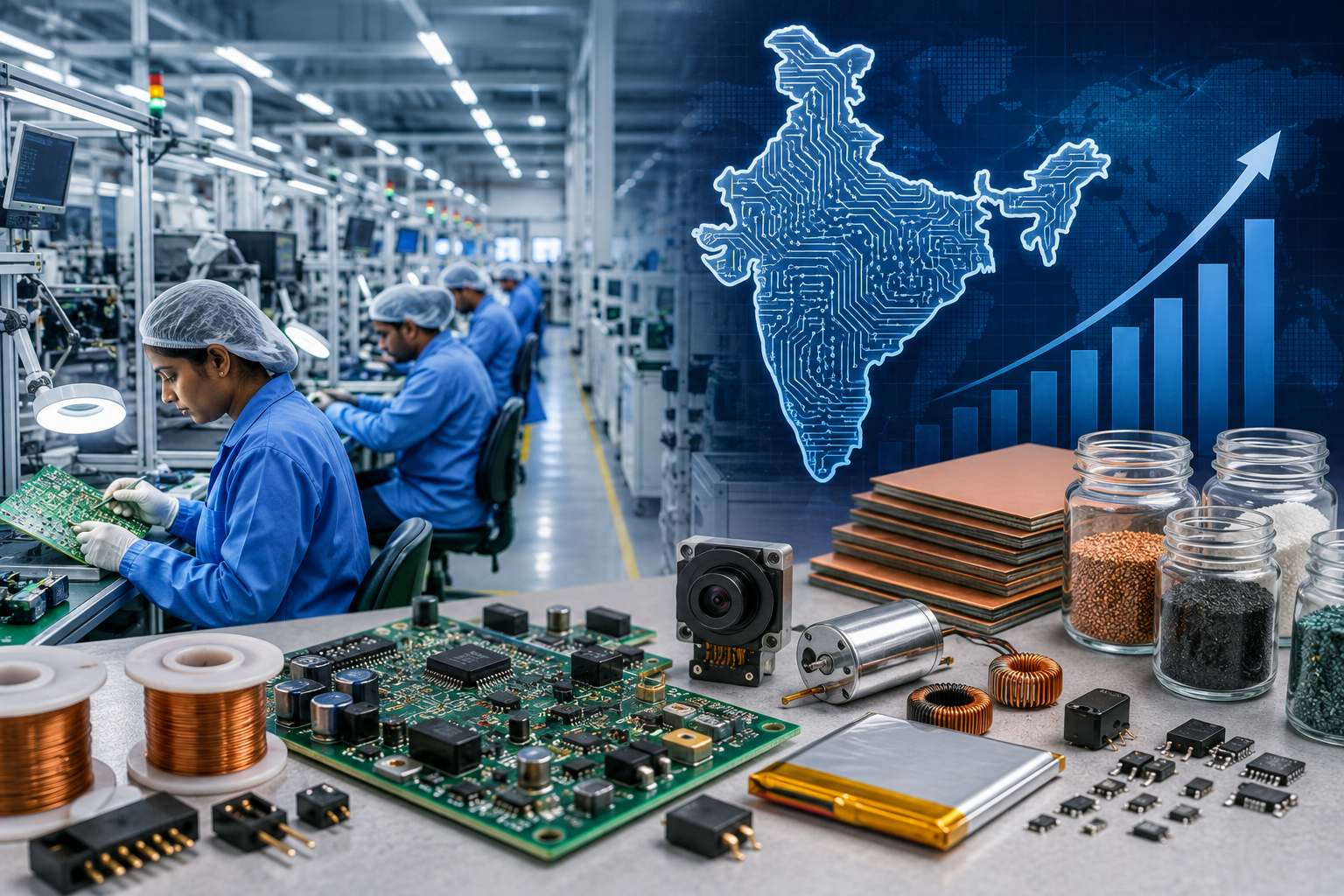
India’s electronics manufacturing strategy enters a deeper phase
India’s electronics manufacturing story is moving beyond assembly lines and into the more complex layers of the supply chain.
Over the past several years, policy support and rising domestic demand have helped India expand its presence in finished electronics, particularly smartphones. The next challenge is to manufacture more of the components, materials and sub-assemblies that go into those products within the country.
The Electronics Component Manufacturing Scheme (ECMS) is emerging as a key policy initiative in this transition. Its broader objective is to increase domestic value addition, reduce import dependence and create a supplier ecosystem capable of supporting both Indian manufacturers and global electronics companies.
The challenge, however, is much larger than setting up factories. India must build the scale, technology, raw-material supply, engineering capabilities and supplier networks required to compete with established manufacturing hubs such as China.
ECMS approvals gather momentum
Earlier this month, the Ministry of Electronics and Information Technology (MeitY) approved 31 additional electronics manufacturing projects worth ₹6,844 crore under the ECMS.
The projects cover 10 states and 20 product categories, including filters, coils, speakers and battery materials. With these approvals, the total number of projects cleared under the scheme has reached 106.
The projects are expected to generate approximately ₹82,243 crore in production and 9,588 direct jobs.
More importantly, several projects represent proposed domestic manufacturing of components that India has historically sourced substantially from overseas.
This marks a shift in policy focus — from simply attracting manufacturers of finished products to developing the industrial base that supports those manufacturers.
The next challenge is domestic value addition
India has already demonstrated that it can become a major electronics assembly destination. Smartphone production is a prominent example.
However, assembly is only one part of the value chain.
A smartphone, laptop, electric vehicle or industrial electronics product can be assembled in India while several high-value components continue to be imported.
The real measure of localisation will therefore be how much of the product's:
-
Components
-
Materials
-
Sub-assemblies
-
Engineering
-
Testing
-
Design
-
Technology
can be developed domestically.
ECMS is intended to address this gap by encouraging investments further upstream in the supply chain.
Investment is becoming easier, but competitiveness remains difficult
Industry experts believe ECMS has been structured to recognise the different economics of different component businesses.
A large PCB fabrication facility, for example, may require a substantially different investment profile from a camera-module production line.
The use of turnover-linked, capital-expenditure-linked and hybrid incentives allows support to be tailored to individual segments rather than applying a single formula across the industry.
This can reduce the initial financial barrier for companies considering investments in India.
But government incentives alone cannot create a globally competitive industry.
Once manufacturing facilities are operational, companies still have to compete on cost, quality, productivity, technology and delivery reliability.
China’s ecosystem advantage remains formidable
China's biggest advantage is not simply lower manufacturing costs. It is the depth of its entire electronics ecosystem.
Decades of manufacturing have created dense networks of component suppliers, raw-material producers, logistics providers, equipment manufacturers and specialised service companies.
Indian manufacturers are still developing these networks.
According to industry estimates cited in the source report, Indian component manufacturing can carry a 14-18 per cent cost disadvantage compared with mature manufacturing clusters.
Several factors contribute to this gap, including:
-
Higher input costs
-
Cost of capital
-
Logistics expenses
-
Import dependence
-
Lower production volumes
-
Smaller supplier networks
-
Limited manufacturing experience in advanced components
This means India's immediate challenge is not merely to replicate individual factories but to replicate the ecosystem effect that makes established manufacturing clusters highly efficient.
Scale could become the biggest competitive test
Scale is particularly important in electronics because manufacturing facilities often require substantial upfront investments.
When production volumes are low, fixed costs are distributed across fewer units, making each component more expensive.
Large manufacturing clusters have the opposite advantage. Higher volumes allow companies to spread fixed costs, negotiate cheaper input prices and improve manufacturing yields.
India therefore needs to create enough domestic and export demand to allow its component manufacturers to achieve competitive scale.
This could take several years.
The success of ECMS will consequently need to be measured not just by the amount of investment announced but by capacity utilisation, production volumes, exports and productivity.
The supplier network must extend beyond Tier-1 companies
A strong electronics ecosystem cannot consist only of large component manufacturers.
It needs a broad network of:
Raw-material suppliers → Tier-3 suppliers → Tier-2 component makers → Tier-1 suppliers → OEMs → global customers.
This network allows manufacturers to source inputs quickly and competitively.
For India, developing this lower-tier ecosystem could be particularly important.
If a major component manufacturer still has to import a large percentage of its inputs, domestic production may not generate the expected reduction in overall supply-chain costs.
The emergence of smaller Indian suppliers could therefore be just as important as the establishment of large factories.
Technology could prove harder than capital
Capital is necessary to establish manufacturing capacity, but technology is often the more difficult barrier.
Advanced components require specialised production processes, intellectual property, engineering knowledge and years of manufacturing experience.
Indian companies remain dependent on imported technology and know-how in several high-value segments.
Technology partnerships, joint ventures and licensing arrangements can help bridge the initial gap, but they do not necessarily create independent technological capabilities.
The long-term objective will need to be the development of Indian intellectual property and engineering capabilities.
Imported raw materials remain a major vulnerability
Another challenge is the availability of specialised raw materials.
Industry participants have highlighted dependence on overseas sources for areas including:
-
Speciality chemicals
-
Laminates
-
Copper-clad materials
-
Battery materials
-
Metallised films
-
Rare-earth-based products
-
Advanced electronic materials
This creates a paradox.
A component may be manufactured in India, but a significant portion of its underlying value could still originate outside the country.
Such dependence can expose manufacturers to geopolitical disruptions, currency fluctuations, freight costs and international supply shortages.
ECMS is also moving upstream
The inclusion of upstream materials within the ECMS framework is therefore strategically significant.
Products such as copper-clad laminates, metallised films, anode materials and rare-earth permanent magnets can form the foundation for multiple downstream industries.
Developing these capabilities domestically could increase value addition while improving supply-chain resilience.
However, upstream manufacturing often requires specialised technology and stringent quality standards. India will need to develop both manufacturing capacity and technical expertise in these areas.
Localisation is progressing faster in simpler components
The initial wave of localisation is naturally concentrated in components where the technological barriers are relatively manageable.
These include:
-
Enclosures
-
Wire harnesses
-
Coils
-
Speakers
-
Filters
-
Sensors
-
Standard PCBs
-
Other electro-mechanical components
These segments can provide Indian manufacturers with an opportunity to build expertise, develop supplier relationships and increase production volumes.
The more difficult question is whether this experience can eventually be translated into technologically advanced categories.
Advanced electronics remain a tougher challenge
High-density and advanced multilayer PCBs, sophisticated passive components and display technologies require significantly higher capital expenditure and technical expertise.
These industries also depend on a wider ecosystem of specialised chemicals, materials, machinery and testing infrastructure.
India's ability to move into these areas will determine whether it can transition from being primarily an assembly destination to becoming a full-spectrum electronics manufacturing hub.
Auto components provide a useful comparison
India's auto-component industry demonstrates how a domestic supplier ecosystem can develop over time.
Large vehicle manufacturers created consistent demand, which encouraged suppliers to invest in manufacturing capabilities and quality systems.
Over several decades, Tier-1 companies developed relationships with Tier-2 and Tier-3 suppliers, creating a deeper industrial ecosystem.
Electronics could follow a similar path, although technological cycles are much faster.
The growing electronics content in automobiles makes this comparison even more relevant. Modern vehicles increasingly require semiconductors, sensors, electronic control systems, connectivity modules, displays and battery-related electronics.
Demand visibility can unlock supplier investment
One of the biggest risks for component manufacturers is uncertainty around future demand.
Setting up a specialised production facility can require substantial investment. If volumes remain uncertain, companies may hesitate to commit capital.
Long-term manufacturing programmes from major OEMs can change this equation.
Greater visibility on orders can allow suppliers to invest in machinery, tooling, technology and capacity with greater confidence.
This is why deeper cooperation between OEMs and suppliers could become an important part of India's localisation strategy.
OEM-supplier collaboration needs to improve
Localisation can become more effective when suppliers are involved at the product-design stage.
Instead of designing a product overseas and subsequently attempting to source its components locally, companies can work with Indian suppliers from the beginning.
This can help identify:
-
Components that can be localised
-
Required technology investments
-
Potential cost reductions
-
Domestic material alternatives
-
Manufacturing constraints
-
Opportunities for design-led production
Such collaboration could gradually move Indian companies from contract manufacturing towards higher-value engineering and product development.
R&D will determine the next phase
Government incentives can encourage factories to be built, but they cannot by themselves create technological leadership.
The next phase of India's electronics strategy will therefore require greater emphasis on research and development.
Potential areas include:
-
Semiconductor technologies
-
Advanced PCBs
-
Battery materials
-
Sensors
-
Power electronics
-
Displays
-
Advanced manufacturing equipment
-
Electronic materials
-
Testing and reliability technologies
Greater collaboration between universities, research institutions, OEMs and manufacturers could help build a domestic engineering talent pool.
From subsidy-led growth to productivity-led growth
A critical test for ECMS will come when companies have to compete with limited or no policy support.
A sustainable manufacturing business must ultimately be able to survive on its own economics.
That requires improvements in:
Productivity + quality + technology + scale + supply-chain efficiency = global competitiveness.
If incentives merely encourage companies to establish capacity without achieving competitive production costs, localisation may remain dependent on government support.
If incentives instead help companies reach sufficient scale and develop capabilities that subsequently reduce costs, they can act as a catalyst for a self-sustaining ecosystem.
Exports could provide the missing scale
India's large domestic market can provide the initial demand required for component manufacturing, but exports could become essential for achieving global scale.
A component manufacturer that supplies only the Indian market may eventually face volume constraints.
Exporting to global electronics manufacturers can significantly expand the addressable market.
It can also encourage Indian suppliers to meet international standards in quality, cost, reliability and delivery.
For multinational companies pursuing supply-chain diversification, a domestic ecosystem capable of serving both India and overseas markets could make the country more attractive as a manufacturing base.
Logistics and infrastructure remain important
Even highly efficient factories cannot remain competitive if logistics costs are excessive.
India will need efficient industrial clusters with reliable:
-
Power supply
-
Water and utilities
-
Roads and ports
-
Warehousing
-
Testing facilities
-
Customs processes
-
Industrial infrastructure
Cluster development can reduce transportation time and allow multiple suppliers to operate in close proximity.
This is one area where policy coordination across central and state governments could have a meaningful impact.
Electronics self-reliance does not mean eliminating imports overnight
The goal of localisation should not necessarily be interpreted as eliminating all imports.
Some highly specialised components may remain more efficiently sourced internationally.
The more practical objective is to reduce excessive dependence in strategically important areas while ensuring that Indian manufacturers have multiple sources of supply.
A diversified supply chain can improve resilience without requiring every component to be manufactured domestically.
Geopolitical shifts create an opportunity
Global electronics supply chains are undergoing structural changes as companies seek greater diversification.
Geopolitical tensions, trade restrictions and supply-chain disruptions have encouraged manufacturers to consider alternatives to excessive concentration in a single geography.
India has an opportunity to benefit from this shift.
However, global companies will ultimately choose manufacturing locations based on cost, reliability, infrastructure, supplier availability and technological capability.
Policy support can help India enter the competition, but sustained competitiveness will determine whether investment remains.
The real test begins after the factory opens
The number of ECMS approvals provides an encouraging indication of investor interest.
But approvals, announced investments and factory construction are only early indicators.
The more important questions will be:
-
How quickly will projects reach commercial production?
-
What capacity utilisation will they achieve?
-
How much domestic value addition will they generate?
-
How much will import dependence decline?
-
Can Indian suppliers achieve global quality standards?
-
Will they become export competitive?
-
Can they survive after incentives reduce?
The answers to these questions will determine whether India's electronics manufacturing strategy produces a genuine structural transformation.
India’s electronics opportunity is bigger than assembly
India has already demonstrated that it can attract large-scale electronics assembly.
The next challenge is considerably more ambitious: building the industrial ecosystem behind the assembly line.
ECMS is helping create momentum by encouraging investment in components, materials and supporting industries. The emerging projects could strengthen domestic supply chains and create new opportunities for Indian manufacturers.
But China and other established Asian manufacturing hubs retain major advantages in scale, technology and supplier density.
India's success will therefore depend on whether policy support can evolve into a self-sustaining ecosystem driven by scale, innovation, R&D, supplier depth and global competitiveness.
The transition from assembly to component manufacturing has begun. The bigger question is whether India can turn this initial investment wave into a durable electronics manufacturing advantage that extends from raw materials and components all the way to globally competitive finished products.