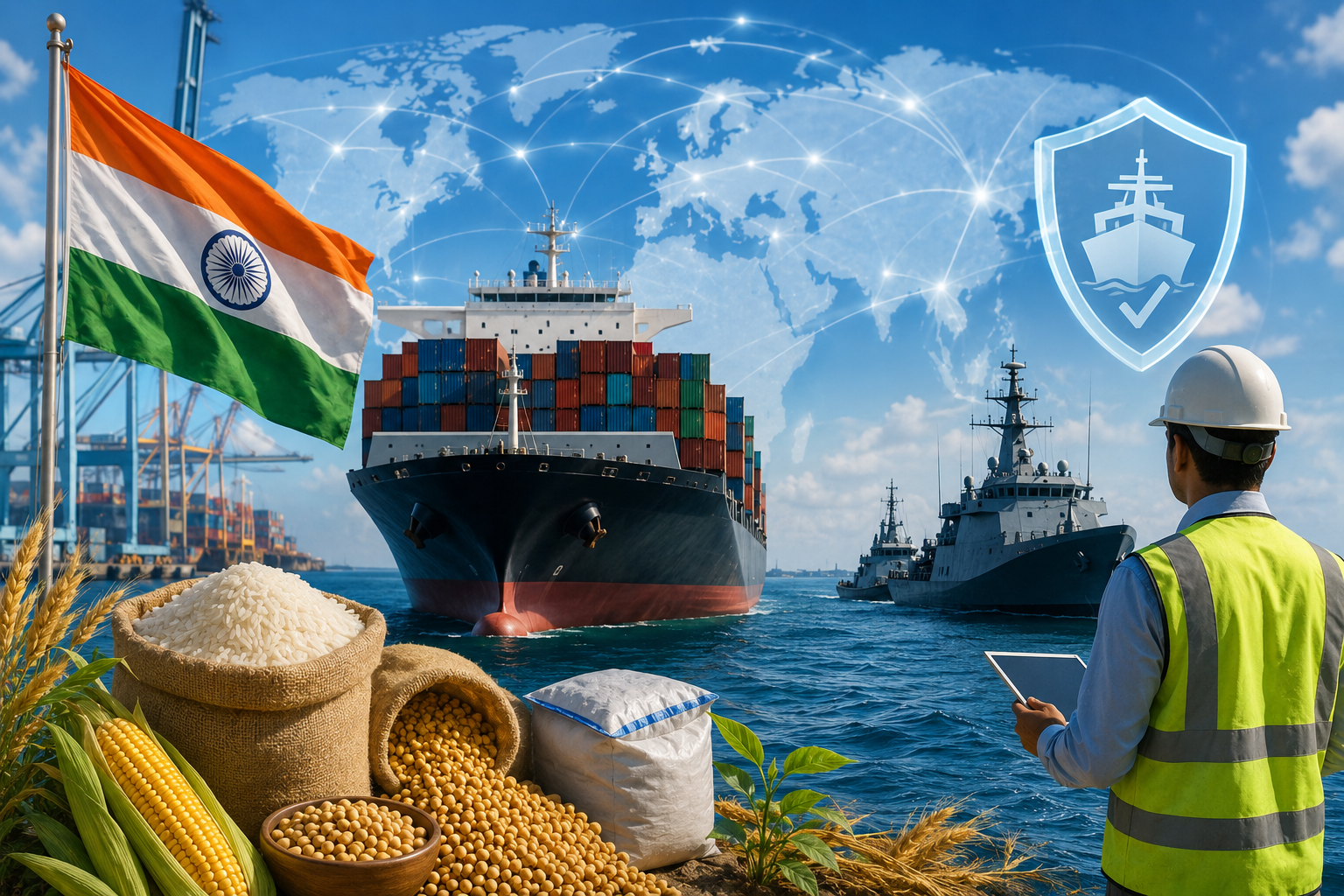
Maritime disruptions threaten food, fertiliser and fuel supplies
India has called for stronger international cooperation to protect critical sea lanes, warning that disruptions to commercial shipping can have consequences far beyond conflict zones.
Addressing a high-level United Nations Security Council debate on food security and armed conflicts, India's Permanent Representative to the UN, Ambassador Harish Parvathaneni, said safe and predictable maritime routes are essential for the uninterrupted movement of food, fertilisers, fuel and other critical commodities.
The warning comes as geopolitical tensions continue to put pressure on major global shipping corridors, including the Strait of Hormuz and the Red Sea.
India links maritime security with food security
India highlighted the growing relationship between maritime security and global food supplies. According to the country's representative, armed conflicts can disrupt energy markets, fertiliser supplies, shipping networks, humanitarian logistics and agricultural trade simultaneously.
Such disruptions can quickly spread across borders through higher transportation costs, supply shortages and increased commodity prices.
Developing countries that depend heavily on imports are particularly vulnerable because they have fewer alternatives when major shipping routes are disrupted.
Critical sea lanes need international protection
India stressed that the international community must work collectively to protect important maritime routes and related infrastructure.
The focus, according to India, should be on ensuring that commercial vessels and humanitarian shipments can continue to operate safely and without unnecessary restrictions.
Freedom of navigation and the safety of commercial shipping should remain protected in accordance with international law, India said.
A prolonged disruption to major sea lanes could increase freight, insurance and logistics costs, ultimately feeding into the prices of food, fuel and other essential goods.
Strait of Hormuz remains a major concern
The Strait of Hormuz has emerged as one of the most important pressure points for global energy and commodity markets.
UN Secretary-General Antonio Guterres said the waterway carries around one-fifth of global oil supplies and a substantial share of global fertiliser trade.
Any sustained restriction on shipping through the route could therefore affect energy prices, fertiliser availability and transportation costs across several economies.
For large importing nations such as India, developments affecting the route are particularly significant because changes in global crude oil and fertiliser prices can influence domestic inflation and the cost structure of several industries.
Red Sea disruptions add to supply-chain pressure
The Red Sea remains another critical component of the global shipping network.
Attacks and security risks affecting commercial vessels in the region have forced shipping companies to reconsider routes and, in some cases, take longer alternatives.
Longer shipping routes can increase fuel consumption, transit times, freight rates and insurance costs.
For agricultural commodities, these additional expenses can eventually translate into higher landed costs for importing countries.
India calls for safe humanitarian access
India said the immediate priority of the UN Security Council should be to reduce the humanitarian consequences of conflicts.
This includes facilitating safe, rapid and unimpeded humanitarian access and supporting de-confliction arrangements wherever required.
India also cautioned that sanctions and other international measures should not unintentionally interfere with humanitarian assistance or legitimate food and agricultural trade.
The objective, it said, should be to prevent humanitarian requirements from becoming collateral damage of geopolitical disputes.
Global hunger remains a major concern
The UN debate also highlighted the scale of the global food-security challenge.
UN Secretary-General Guterres said 2025 recorded the highest number of armed conflicts since World War II, while global acute hunger also remained at exceptionally high levels.
At least 266 million people were facing acute food insecurity, according to the figures cited at the debate.
The UN has identified conflict and violence as major drivers of food insecurity across several of the world's most vulnerable regions.
India calls for stronger supply-chain resilience
India advocated a broader strategy to make food and agricultural supply chains more resilient.
This includes strengthening domestic agricultural production, diversifying import sources, improving storage capacity and upgrading logistics infrastructure.
India also called for greater cooperation between governments, international financial institutions, regional organisations and development agencies.
Such measures could reduce dependence on a limited number of suppliers or transport corridors and help countries respond more effectively to sudden geopolitical disruptions.
Affordable fertilisers crucial for developing economies
India stressed the importance of ensuring predictable and affordable access to fertilisers, quality seeds, agricultural technology and concessional financing.
Fertiliser prices are closely linked to energy and transportation costs. Consequently, disruptions in oil and gas markets can have a direct impact on agricultural production costs.
Higher input prices can eventually affect food prices, particularly in countries where farmers have limited capacity to absorb increases in production expenses.
India advocates climate-resilient agriculture
India also highlighted the need to strengthen climate resilience in agriculture.
The country called for greater adoption of climate-resilient crops and agricultural practices, arguing that food security should not depend excessively on a narrow group of staple crops.
Millets, for example, can play a greater role in diversified food systems because of their resilience to certain climatic conditions and their nutritional value.
Greater support needed for small and marginal farmers
India emphasised the importance of supporting small and marginal farmers, particularly across developing economies.
Improving farm productivity, access to technology, financing and quality inputs can strengthen domestic food production while supporting rural incomes.
A stronger domestic agricultural base can also reduce a country's vulnerability to sudden interruptions in international supply chains.
India warns against dependence on a single production model
India cautioned against excessive dependence on any single agricultural production or supply model.
Geopolitical tensions, economic coercion and disruptions to international trade can expose highly concentrated supply chains to significant risks.
Diversification across suppliers, production regions, crops and transportation routes can therefore become an important component of national food-security strategies.
Trade remains critical to global food security
India also stressed the importance of open, transparent and rules-based trade in food and agricultural inputs.
While strengthening domestic production is important, international trade remains essential for balancing regional shortages and surpluses.
Stable trade flows can help countries manage temporary production shocks caused by conflicts, extreme weather events or other disruptions.
Maritime stability has wider economic implications
The discussion at the UN underlines how closely interconnected maritime security, energy markets, agriculture and inflation have become.
A disruption in a major shipping corridor can trigger a chain reaction: higher freight costs can raise commodity prices, expensive fuel can increase agricultural and manufacturing costs, and shortages of fertilisers can eventually affect future crop production.
For India and other developing economies, maintaining reliable access to global trade routes is therefore not only a foreign-policy or maritime-security issue but also an important economic and food-security priority.