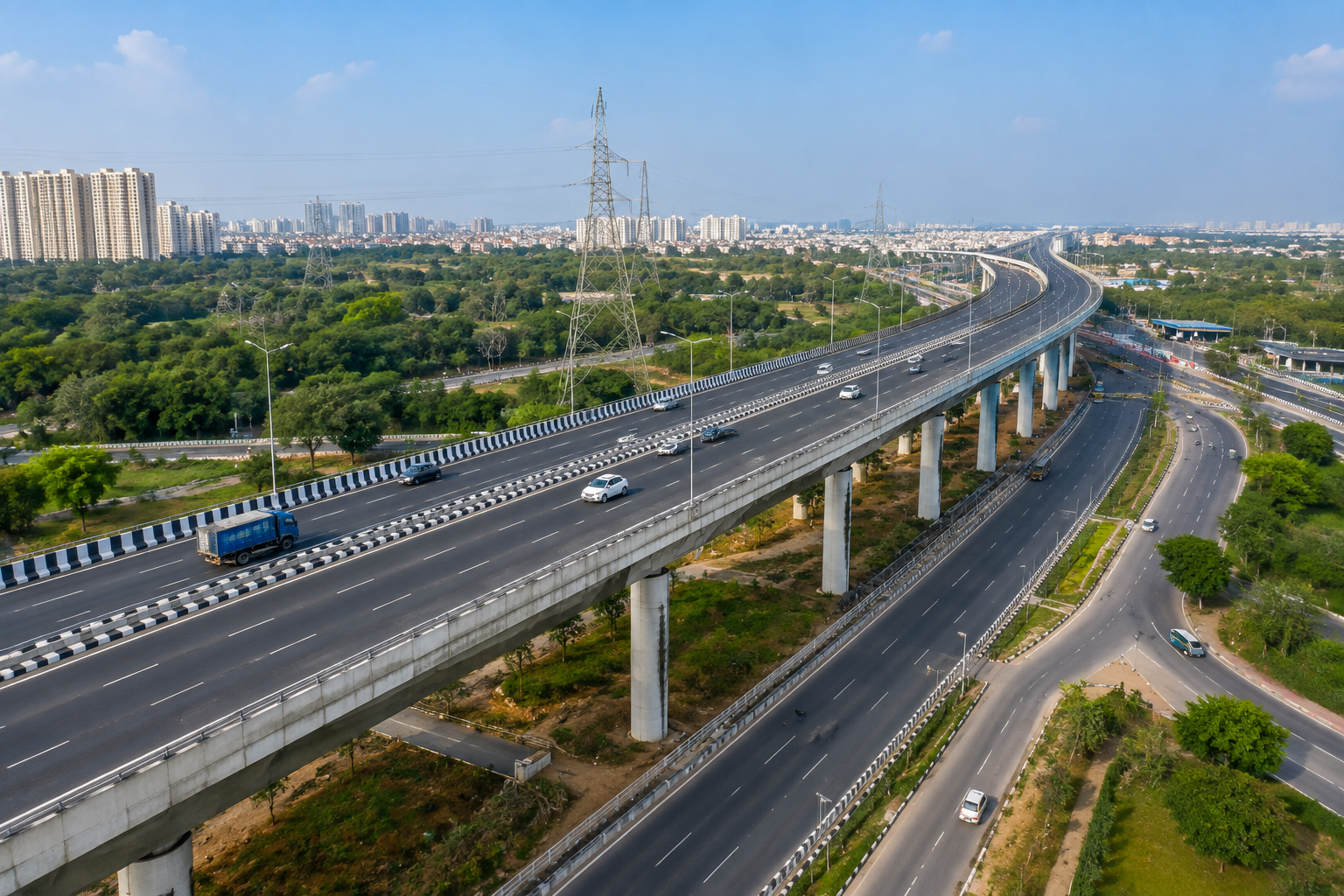
9-km elevated stretch creates a direct Delhi connection to the Delhi-Mumbai Expressway, improving access to Faridabad, Ballabhgarh, Sohna and key NCR corridors
A major milestone in Delhi-NCR's road infrastructure has been achieved with the opening of a 9-km stretch connecting the DND Flyway with Jaitpur for trial traffic. The new section provides a direct link between Delhi and the Delhi-Mumbai Expressway network, potentially reducing travel time for motorists heading towards Faridabad, Ballabhgarh, Sohna and destinations further south.
The trial run began on August 22. Nearly 8.5 km of the 9-km section is elevated, making the project a significant addition to Delhi's access-controlled road network.
The National Highways Authority of India (NHAI) is expected to use the trial period to monitor traffic movement, assess road safety and identify any operational issues before formally commissioning the corridor. No toll is being charged during the trial period.
What is the DND-Jaitpur expressway link?
The newly operational stretch is part of the larger 59-km DND-Faridabad-KMP corridor, which connects the DND Flyway with the Kundli-Manesar-Palwal (KMP) Expressway and the Delhi-Mumbai Expressway.
The project was developed to provide a faster, access-controlled alternative to conventional roads connecting Delhi with Faridabad and southern Haryana.
The DND-Jaitpur section was one of the important remaining links needed to establish a more direct connection between Delhi and the Delhi-Mumbai Expressway.
Route details: How the new road connects Delhi with the expressway
The broad connectivity chain can be understood as:
DND Flyway → DND-Faridabad corridor → Jaitpur → Jaitpur-KMP interchange → Delhi-Mumbai Expressway
From this network, motorists can travel towards Faridabad, Ballabhgarh, Sohna and further destinations in Haryana and Rajasthan.
The connection also creates additional route options for motorists coming from parts of Noida and Ghaziabad.
Which areas are likely to benefit the most?
The new route is expected to benefit commuters and commercial traffic travelling between several important NCR locations.
South Delhi
Residents and commuters from areas around the southern part of Delhi can access Faridabad and the expressway network without depending exclusively on existing congested corridors.
Faridabad and Ballabhgarh
The corridor is particularly significant for Faridabad, providing a faster connection towards Delhi and the wider expressway network.
Industrial and commercial areas around Ballabhgarh could also benefit from improved access to long-distance freight routes.
Noida and Ghaziabad
Motorists from Noida and Ghaziabad can potentially use the expanded road network to reach the Delhi-Mumbai Expressway through connected NCR corridors.
This could provide alternatives to some heavily congested routes through central and southern Delhi.
Sohna and Gurugram
The connection provides better access towards Sohna and the southern Haryana road network, improving connectivity with the Delhi-Mumbai Expressway.
How much time can the new route save?
The new road could reduce travel time between DND and Faridabad to around 20 minutes, compared with journeys that can take more than 30 minutes through conventional routes, particularly when traffic is heavy.
Actual travel times, however, will depend on traffic conditions, entry and exit points and the operational arrangements adopted after the trial period.
The biggest potential advantage is not simply the reduction in distance but the ability to travel on an access-controlled road with fewer interruptions from local traffic and junctions.
Relief for Ashram-Badarpur and Mathura Road
The opening could provide an alternative to the heavily used Ashram-Badarpur corridor and Mathura Road.
These routes carry significant commuter and commercial traffic between Delhi and Faridabad. During peak hours, congestion can substantially increase travel time.
If a meaningful portion of traffic shifts to the new expressway, pressure on these existing corridors could gradually reduce.
The impact is likely to become clearer after the trial phase, once motorists begin using the new connection regularly.
Why the elevated section is important
Nearly 8.5 km of the 9-km stretch is elevated.
An elevated alignment allows the project to pass through densely developed areas while reducing the requirement for large-scale ground-level crossings and intersections.
It also allows through traffic to move independently of several local roads below.
For Delhi and the surrounding NCR, where available land for major new highways is limited, elevated infrastructure provides a way to add high-capacity road links without requiring an entirely new ground-level corridor.
Direct access to the Delhi-Mumbai Expressway
The most important strategic advantage of the new section is that it brings the Delhi-Mumbai Expressway directly into Delhi's road network.
The expressway was originally conceived as a major high-speed corridor connecting the Sohna region with Jawaharlal Nehru Port near Mumbai. Its Delhi-side connectivity was subsequently expanded through the DND Flyway.
With the DND-Jaitpur connection now undergoing trials, motorists in Delhi have a more direct route into the larger expressway system.
This could be particularly useful for long-distance journeys where avoiding urban congestion can significantly improve overall travel time.
Connectivity towards Jaipur and Rajasthan
Once connected to the wider expressway network, motorists can access routes towards Jaipur, Sawai Madhopur and other destinations in Rajasthan.
For travellers starting in Delhi, the advantage is that they can join the controlled-access network much earlier instead of spending a significant portion of the journey travelling through congested urban roads.
This is also important for freight movement between Delhi-NCR and Rajasthan.
What happens after the trial period?
The trial period gives NHAI an opportunity to evaluate how the road performs under real traffic conditions.
Authorities can assess:
-
Traffic volume and vehicle mix
-
Lane discipline
-
Interchange performance
-
Road markings and signage
-
Safety-related issues
-
Traffic merging and diverging points
-
Congestion at entry and exit locations
-
Integration with existing Delhi and Faridabad roads
Any deficiencies identified during the trial can be addressed before the road is formally commissioned.
The trial period is therefore an important stage before the corridor moves into regular commercial operations.
Toll charges during the trial
Motorists using the stretch during the trial period are not being charged toll.
The toll arrangement applicable after formal commissioning will depend on the final operational and tolling framework.
Motorists should therefore check official notifications and road signage once regular commercial operations begin.
Delhi-Mumbai Expressway and Vadodara connectivity
The DND-Jaitpur opening is only one part of the larger Delhi-Mumbai Expressway development.
The next major milestone is the expansion of operational connectivity towards Vadodara.
Officials have indicated that the Delhi-Mumbai Expressway is expected to become operational up to Vadodara by December 2026.
Once the relevant sections are completed, Delhi will have a substantially longer access-controlled connection towards western India.
The entire Delhi-Mumbai corridor, however, comprises multiple stretches, and individual sections are progressing at different stages.
Noida airport connectivity gets another boost
The new road infrastructure is also being developed alongside major connectivity projects around Noida International Airport at Jewar.
The DND-Faridabad-Sohna Access Controlled Highway is intended to improve connectivity between:
Delhi → Faridabad → Gurugram → Noida → Sohna → Noida International Airport
An additional elevated connection between Faridabad and Noida International Airport has also been proposed as part of the broader road network.
The development of these links could eventually create a more integrated high-speed road system across the NCR.
What it means for Noida and Greater Noida commuters
For motorists from Noida and Greater Noida, the importance of the new connection extends beyond Delhi-Faridabad travel.
The expanding network provides additional options for reaching southern Haryana, Rajasthan and the Delhi-Mumbai Expressway.
As more connecting roads become operational, commuters could have greater flexibility to choose routes based on congestion, destination and travel time.
Benefits for logistics and freight movement
The impact of the project is not limited to passenger vehicles.
Delhi-NCR is one of India's largest consumption, manufacturing and logistics markets. Large volumes of goods move daily between warehouses, industrial clusters, distribution centres, ports and urban markets.
Improved expressway connectivity can help logistics operators by potentially reducing:
-
Transit times
-
Fuel consumption
-
Vehicle idling
-
Delivery uncertainty
-
Congestion-related delays
-
Dependence on city roads
The connection with the Delhi-Mumbai Expressway could therefore strengthen Delhi-NCR's links with major industrial and commercial centres in western India.
Potential impact on real estate and development
Large-scale road infrastructure can also influence development patterns around connected corridors.
Areas that gain faster access to major highways can become more attractive for:
-
Warehousing
-
Logistics parks
-
Industrial facilities
-
Commercial developments
-
Residential projects
-
Data centres and other infrastructure-intensive businesses
Faridabad, Ballabhgarh, Sohna and areas around major expressway interchanges could therefore see increased interest as the wider network becomes operational.
However, the actual impact on land values and development will depend on connectivity to local roads, availability of utilities, zoning regulations and the pace of surrounding infrastructure development.
Why the project matters for Delhi-NCR
The DND-Jaitpur connection is more than another road opening. It is part of a broader effort to create an interconnected, access-controlled road network across the NCR.
The emerging network is gradually linking Delhi, Faridabad, Gurugram, Sohna, Noida, Greater Noida and Jewar with major national highways and expressways.
For commuters, this means more route choices. For businesses, it can improve logistics connectivity. For the region, it can help integrate residential, industrial and commercial centres that have historically been separated by congested urban roads.
Key route details at a glance
| Particular | Details |
|---|---|
| New stretch | DND Flyway–Jaitpur |
| Length | Around 9 km |
| Elevated portion | Around 8.5 km |
| Larger corridor | 59-km DND-Faridabad-KMP link |
| Connection | Jaitpur-KMP interchange |
| Key destinations | Faridabad, Ballabhgarh, Sohna |
| Trial run | Started August 22 |
| Toll during trial | No toll |
| Wider network | Delhi-Mumbai Expressway |
| Expected benefit | Faster Delhi-NCR connectivity and reduced congestion |
A larger expressway network is taking shape
The opening of the DND-Jaitpur stretch fills a significant gap in Delhi's connection to the Delhi-Mumbai Expressway.
The immediate benefit is improved access to Faridabad and southern NCR, while the longer-term impact could be much broader as additional expressway and airport links become operational.
With projects connecting Delhi, Faridabad, Gurugram, Noida, Sohna and Jewar progressing alongside the Delhi-Mumbai corridor, the NCR is gradually developing a more integrated high-speed road network designed to support both daily commuting and long-distance passenger and freight movement.