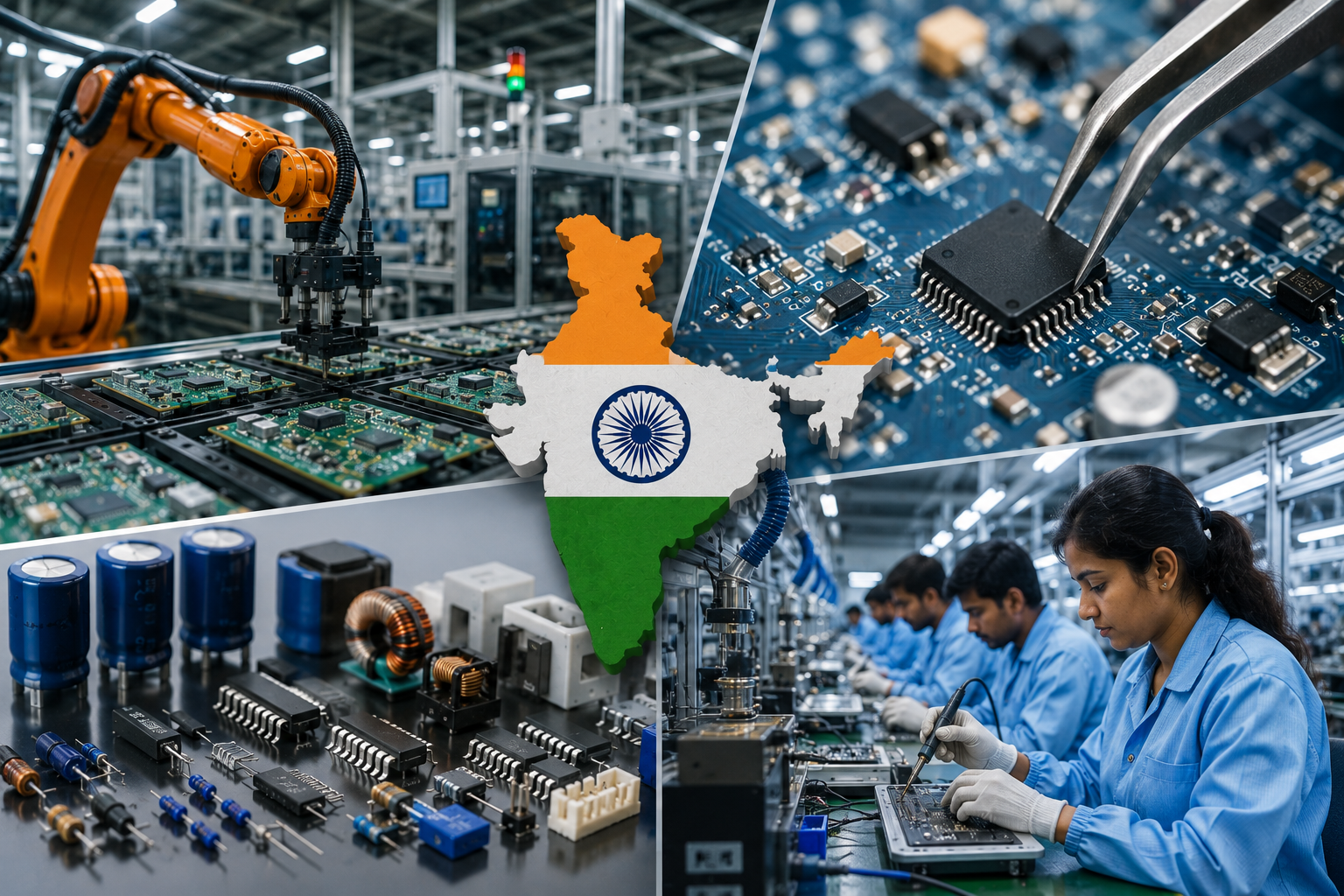
India’s Electronics Manufacturing Faces the Real Test Beyond Incentives
India has made significant progress in electronics manufacturing over the past decade, but the country’s next challenge is far more complex: building a globally competitive component ecosystem that can survive without subsidies and tariff protection.
The government has committed substantial financial support to domestic electronics components manufacturing through the Electronics Components Manufacturing Scheme (ECMS), approved in 2025 and provided with a ₹40,000-crore allocation in the Union Budget 2026-27.
The scheme provides turnover-linked, capital expenditure and hybrid incentives for a range of products, including display and camera modules, printed circuit boards, passive components, electro-mechanical components, lithium-ion cells and other critical inputs.
However, the long-term success of the policy will not be measured simply by the number of factories established or the amount of investment announced. The bigger test will be whether Indian manufacturers can eventually compete with established global supply chains on cost, scale, quality, technology and reliability once government support begins to taper.
India’s Component Base Remains Relatively Shallow
India has developed a strong electronics assembly industry, particularly in smartphones, but domestic component manufacturing has not expanded at the same pace.
Electronic components accounted for roughly 9 per cent of India's electronics production in 2023-24, while domestic value addition in mobile phones remained around 18-20 per cent, according to industry data cited in the source material.
This means a substantial portion of the value embedded in products manufactured in India continues to come from imported components.
The gap becomes particularly important as India attempts to move from an assembly-led manufacturing model towards deeper participation in global value chains.
Building a component industry requires not just individual factories but a network of suppliers, raw-material producers, specialised equipment makers, logistics providers, testing facilities and technology partners.
Why Indian Components Can Cost More
Indian manufacturers face several structural disadvantages compared with established manufacturing hubs such as China, Taiwan, South Korea and parts of Southeast Asia.
Higher industrial electricity costs, logistics expenses, fragmented supplier networks, shortages of specialised skills and regulatory complexities can increase the cost of manufacturing.
Prof Mahendra Chouhan, president of IMC Chamber of Commerce and Industry, has pointed to relatively high industrial power costs and India's dependence on imported electronic inputs as important competitiveness challenges.
The issue is particularly significant in semiconductors and advanced electronic components, where Indian manufacturers still depend heavily on overseas suppliers.
A manufacturer producing a component locally may therefore continue to rely on imported raw materials, machinery, specialised chemicals or intermediate components.
As a result, simply moving the final manufacturing process to India does not necessarily create a cost advantage.
China’s Advantage Goes Beyond Low-Cost Manufacturing
The competitive challenge from China is not limited to cheaper labour or individual factory economics.
China has spent decades building a dense manufacturing ecosystem in which raw-material suppliers, component manufacturers, assemblers, logistics providers and end-product companies operate within an integrated supply chain.
Large production volumes allow manufacturers to spread fixed costs across millions of units. Proximity between suppliers can reduce transportation and inventory expenses, while established relationships with global customers can shorten product-development cycles.
For India, recreating this ecosystem will take time.
The objective of government incentives is therefore not simply to make Indian factories profitable immediately. It is also to help create the scale and supplier network necessary for long-term competitiveness.
What the ECMS Can Achieve
The Electronics Components Manufacturing Scheme is designed to address some of these structural gaps.
Its incentives are aimed at encouraging investment in areas where India has historically remained dependent on imports.
The scheme covers components such as:
-
Display and camera modules
-
Printed circuit boards
-
Passive components
-
Electro-mechanical components
-
Lithium-ion cells
-
Other specialised electronic inputs
The policy can reduce the initial financial burden faced by manufacturers entering capital-intensive industries.
For companies establishing new production lines, the early years can involve substantial expenditure on machinery, technology, product development, testing and customer qualification before meaningful commercial volumes are achieved.
The First Few Years Could Be the Most Difficult
Component manufacturing typically requires a longer gestation period than simple assembly.
Manufacturers need to develop products, qualify them with customers, meet stringent quality standards and achieve sufficient production volumes.
Bharath Krishna Rao, CEO and co-founder of Emobi, has noted that this process can take anywhere from one year to five years or more depending on the component and customer requirements.
This is where government support can play an important role.
Incentives can reduce the initial risk and give manufacturers time to build capacity and establish relationships with customers.
But the objective should ultimately be to move the company from subsidy-supported competitiveness to market-driven competitiveness.
Scale Will Determine the Next Phase
Scale could be the single most important factor determining whether Indian component manufacturers can survive after incentives decline.
A component factory operating at low utilisation will struggle to compete against an established overseas manufacturer operating at significantly higher capacity utilisation.
Higher volumes can reduce fixed costs per unit, improve bargaining power with suppliers and justify investments in automation and research.
This creates a broader ecosystem challenge.
Component manufacturers need large customers, while end-product manufacturers need reliable domestic component suppliers.
If domestic demand remains insufficient, component producers may struggle to achieve economies of scale. At the same time, manufacturers of finished products may continue importing components because overseas suppliers offer lower prices and proven quality.
Component Makers and End-Product Manufacturers Must Grow Together
Pranav Chopra, CTO and co-founder of AC manufacturer Optimist, has argued that component manufacturers and equipment manufacturers need to develop alongside each other.
A domestic component industry cannot thrive if there are not enough local companies purchasing those components.
The ecosystem therefore needs to develop across multiple layers:
Raw materials → sub-components → components → assemblies → finished products → domestic and export markets
If one part of the chain remains weak, manufacturers may continue depending on imports.
This is why incentives aimed at only one factory or one component category may not be sufficient to create genuine localisation.
What Happens When Tariffs Come Down?
Tariffs provide another layer of protection for domestic manufacturers.
When imported components become more expensive because of customs duties, Indian manufacturers receive additional room to establish their businesses.
However, tariffs can also create unintended consequences.
If Indian manufacturers still depend on imported raw materials or intermediate components, higher duties on finished products may protect one part of the supply chain while simultaneously increasing costs elsewhere.
For this reason, tariff protection cannot be the permanent foundation of competitiveness.
The eventual objective has to be a manufacturing ecosystem capable of competing with imported products even when tariff advantages are reduced.
Solar Manufacturing Offers an Important Lesson
India's solar industry demonstrates both the potential and limitations of industrial policy.
Government incentives, production-linked schemes and import duties have helped encourage domestic solar manufacturing capacity.
However, the deeper supply chain continues to face significant import dependence, particularly for upstream materials such as polysilicon and wafers.
This illustrates a central issue for electronics as well: local production of the final component is only one stage of self-reliance.
If critical inputs remain imported, domestic manufacturers can still be vulnerable to global supply disruptions, currency movements and changes in trade policy.
Can Indian Manufacturers Compete Without Tariff Protection?
Eventually, the answer will depend on whether companies can lower their structural costs.
Experts identify several requirements:
Lower Energy Costs
Competitive electricity prices are critical for energy-intensive manufacturing operations.
Better Logistics
Faster and cheaper movement of raw materials and finished products can significantly improve manufacturing economics.
Stronger Supplier Networks
India needs deeper Tier-2 and Tier-3 supplier ecosystems so manufacturers do not have to import every critical input.
Skilled Workforce
Advanced electronics manufacturing requires specialised engineering, production and quality-control skills.
Technology and R&D
Indian companies will need to move beyond manufacturing established products and develop proprietary technologies and processes.
Higher Capacity Utilisation
Factories need sufficient order volumes to operate efficiently and recover large upfront investments.
Exports Will Be the Ultimate Competitiveness Test
The domestic market can provide an initial customer base, but global exports will provide a much tougher test.
An Indian component manufacturer protected by tariffs may be competitive within India without necessarily being competitive internationally.
Export markets remove much of that protection and force companies to compete against established suppliers on price, quality, delivery reliability and technological capability.
A sustained rise in component exports would therefore provide a stronger indication that India's manufacturing ecosystem has achieved genuine competitiveness.
Global Companies Could Accelerate India’s Ecosystem
Foreign manufacturers and global electronics companies could play an important role in developing domestic suppliers.
Joint ventures, technology partnerships and local sourcing agreements can help Indian manufacturers acquire manufacturing expertise and meet international quality standards.
Global companies can also provide access to established supply chains and export markets.
For India, attracting such investments is therefore not just about creating factories. The larger objective is to integrate domestic suppliers into global manufacturing networks.
Subsidies Should Create a Path to Independence
A successful incentive programme should ideally follow a progression:
Investment → Capacity Creation → Customer Qualification → Scale → Efficiency → Export Competitiveness → Reduced Dependence on Incentives
If a manufacturer remains dependent on subsidies after reaching commercial scale, the policy has not fully solved the competitiveness problem.
In contrast, if incentives help companies reach efficient production levels and establish stable customer relationships, the support can create a self-sustaining manufacturing ecosystem.
India’s Electronics Opportunity Is Larger Than Smartphones
Smartphones have demonstrated India's ability to attract large-scale electronics manufacturing.
The next opportunity is to replicate that success across the wider electronics ecosystem.
This includes:
-
Semiconductor-related components
-
Printed circuit boards
-
Camera modules
-
Display components
-
Passive components
-
Battery cells
-
Power electronics
-
Automotive electronics
-
Industrial electronics
-
Telecom equipment
Building these capabilities could substantially increase domestic value addition and reduce India's vulnerability to global supply disruptions.
The Challenge Is Moving From Assembly to Value Creation
India's electronics story has so far been heavily influenced by assembly-led manufacturing.
The next stage requires a deeper shift towards design, components, materials, intellectual property and advanced manufacturing.
This transition will not happen overnight.
Factories need time to reach scale, suppliers need time to develop, workers need specialised training and companies need to establish global customer relationships.
Government support can accelerate this process, but market forces will eventually determine which manufacturers survive.
What Could Determine Success Over the Next Five Years?
The most important indicators to watch will be domestic value addition, capacity utilisation, component exports, import dependence, localisation of raw materials, private-sector R&D spending and the emergence of Tier-2 and Tier-3 suppliers.
A rise in domestic production accompanied by falling import dependence would indicate genuine progress.
By contrast, rising factory capacity with continued dependence on imported components would suggest that India is expanding manufacturing without sufficiently deepening the value chain.
Market Outlook
India's electronics manufacturing opportunity remains significant, particularly as global companies diversify supply chains and seek alternatives to concentrated manufacturing bases.
For investors, the longer-term opportunity could extend beyond companies assembling finished products to businesses supplying components, electronics materials, industrial equipment, automation solutions, batteries, power electronics and specialised manufacturing technologies.
The near-term trajectory, however, is likely to remain closely linked to government incentives, domestic demand and global trade conditions. As subsidies and tariff protection gradually become less important, companies with scale, strong customer relationships, efficient manufacturing, technological capabilities and deeper localisation are likely to be better positioned for sustained growth.
The key market signal will therefore be whether India's component industry can convert policy-led capacity creation into cost-efficient, export-oriented and globally competitive manufacturing.