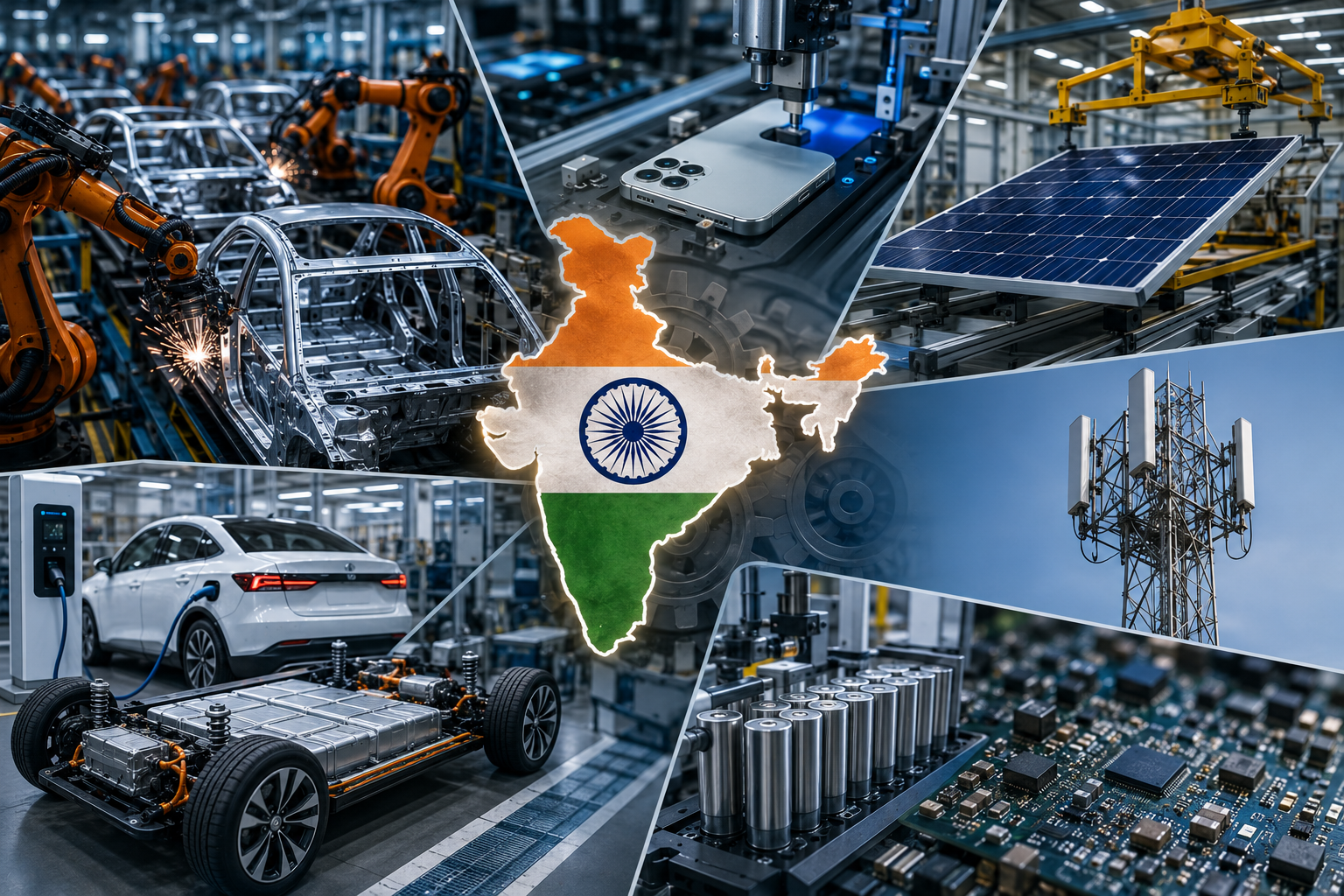
From Assembly to Value Addition, India’s Manufacturing Story Enters a New Phase
India’s manufacturing ambitions are increasingly moving beyond simply producing finished goods domestically. The focus is now shifting towards building deeper supply chains, manufacturing critical components locally and increasing the share of domestic value added across industries.
From automobiles and smartphones to solar modules, electric vehicles and telecom equipment, India has made significant progress in expanding manufacturing capacity. However, the degree of self-reliance varies sharply across sectors.
A recent NITI Aayog-Crisil assessment highlights this distinction. While some industries have developed mature supplier ecosystems and are increasingly integrated into global value chains, others continue to depend heavily on imported components, raw materials and advanced technologies.
The emerging challenge for India is therefore not just “Made in India”, but ensuring that a larger portion of the value embedded in those products is also created within the country.
Automobiles Lead India’s Localisation Drive
Among major manufacturing sectors, automobiles and auto components have developed one of the deepest domestic ecosystems.
India has a large network of component manufacturers supplying both domestic automobile companies and global original equipment manufacturers. Localisation initiatives, technology partnerships and joint ventures with international companies have helped domestic suppliers move up the value chain.
Indian auto-component exports reached around $7.5 billion in FY2025, reflecting the growing global competitiveness of domestic suppliers.
The next phase is expected to focus on advanced automotive technologies, including electric powertrains, batteries, advanced electronics and other next-generation vehicle components.
The government's Production Linked Incentive scheme for automobiles requires eligible advanced automotive technology products to achieve at least 50 per cent domestic value addition. By March 2026, the scheme had attracted around ₹44,326 crore of investment and generated approximately 67,820 jobs.
This existing supplier ecosystem gives automobiles a significant advantage over sectors that are still developing their component manufacturing base.
Smartphones: Manufacturing Success, But Components Remain a Weak Link
India's smartphone industry represents one of the country's biggest manufacturing success stories of recent years.
Around 99.2 per cent of mobile phones used in India are now manufactured domestically, while the country has emerged as the world's second-largest mobile phone manufacturer by volume.
Smartphones also became India's largest individual export commodity in FY2025-26, highlighting the rapid expansion of India's electronics manufacturing capabilities.
However, domestic assembly should not be confused with complete self-reliance.
An evaluation of the mobile manufacturing PLI scheme showed domestic value addition at around 23 per cent in FY2023-24. This means a substantial portion of the economic value of a smartphone still originates from imported components.
Components Become the Next Battleground
India's policy focus is consequently shifting towards components such as printed circuit boards, camera modules, display components and other electronic sub-assemblies.
The Electronics Component Manufacturing Scheme is designed to encourage companies to establish these capabilities domestically.
If successful, the shift could allow India to capture significantly more value from its rapidly expanding electronics exports rather than remaining primarily a final-assembly destination.
Solar Manufacturing Expands Rapidly, But Upstream Dependence Remains
Solar manufacturing capacity has grown dramatically over the past decade.
India's solar module manufacturing capacity increased from around 2.3 GW in 2014 to approximately 172 GW by March 2026. The expansion reflects strong domestic demand, government incentives and the country's broader renewable-energy ambitions.
However, significant weaknesses remain further upstream.
According to the NITI Aayog-Crisil assessment, India remains almost entirely dependent on imports for polysilicon. Import dependence is also above 90 per cent for wafers, above 60 per cent for solar cells and above 40 per cent for modules.
This highlights an important distinction: India has developed substantial module manufacturing capacity, but the deeper solar supply chain is still being built.
Government Pushes Into Wafers and Ingots
The next stage of the solar manufacturing strategy is expected to focus on ingots, wafers and other upstream materials.
A proposed pathway under the Approved List of Models and Manufacturers framework aims to encourage domestic ingot and wafer manufacturing from June 2028.
Building these capabilities could reduce exposure to global supply disruptions while increasing domestic value addition in India's rapidly expanding solar industry.
Electric Vehicles: Vehicle Production Advances, Battery Supply Chain Lags
India's EV industry is another sector where domestic manufacturing is expanding rapidly.
Electric vehicle sales increased around 25 per cent year-on-year in FY2026 to approximately 2.45 million units, according to Federation of Automobile Dealers Associations data.
Domestic companies have expanded EV assembly and manufacturing capabilities, but batteries remain one of the industry's biggest supply-chain vulnerabilities.
India continues to rely heavily on imported lithium-ion batteries and critical minerals, exposing manufacturers to international commodity prices, geopolitical risks and changes in global trade policy.
Battery Manufacturing Becomes Critical
The government's ₹18,100-crore PLI scheme for Advanced Chemistry Cells aims to establish 50 GWh of domestic battery manufacturing capacity.
By May 2026, 40 GWh had been awarded to four beneficiaries, while one 1.4 GWh facility with 1.4 GWh capacity had been established.
The development of a domestic battery ecosystem could eventually have implications beyond automobiles, including energy storage systems and renewable-energy integration.
However, domestic production of critical minerals and battery materials remains an important longer-term challenge.
Telecom Equipment Still Has a Significant Import Gap
Telecom equipment presents a more difficult localisation challenge.
Indian manufacturers have increased production of optical fibre cables, routers, switches and customer-premises equipment. Yet several critical components remain heavily import-dependent.
Semiconductors, RF modules, integrated circuits and processors continue to account for a significant share of imported inputs.
According to the NITI Aayog-Crisil assessment, localisation remains particularly low in several advanced telecom products.
| Telecom Product | Approx. Domestic Localisation |
|---|---|
| 4G/LTE base stations | 4% |
| 5G base stations | 5% |
| Switches | 3% |
| GPON optical network terminals | 12% |
The low localisation levels demonstrate that increasing final-product manufacturing alone does not necessarily create a complete domestic technology ecosystem.
Telecom Trade Deficit Highlights the Challenge
India's telecom equipment exports remain relatively modest at around $0.6-$1 billion annually, while imports are estimated at approximately $4-$5 billion.
This gap indicates that domestic production has not yet translated into broad-based competitiveness across the entire telecom equipment value chain.
The development of semiconductor manufacturing, chip design, advanced electronics and specialised components will therefore be crucial if India wants to become a major global telecom manufacturing hub.
Critical Components Are the Next Big Manufacturing Opportunity
Across these sectors, a common pattern is emerging.
India has become increasingly successful at producing or assembling the final product, but the deeper layers of the supply chain often remain dependent on imports.
This creates opportunities for domestic manufacturers involved in:
-
Electronic components
-
Semiconductor manufacturing
-
Auto components
-
Battery cells and materials
-
Solar wafers and cells
-
Power electronics
-
Industrial machinery
-
Telecom components
-
Advanced materials
-
Precision engineering
The expansion of these industries could also create a multiplier effect, with domestic suppliers supporting multiple manufacturing sectors simultaneously.
Why Domestic Value Addition Matters
Higher domestic value addition can provide several economic benefits.
A stronger local supply chain can reduce India's exposure to international shipping disruptions, currency fluctuations and geopolitical tensions. It can also improve supply reliability for manufacturers and potentially create higher-skilled employment.
For exporters, greater localisation could make India less vulnerable to disruptions in global supply chains while enabling domestic companies to capture a larger share of the value generated by exports.
At the same time, localisation must remain economically competitive. Producing components domestically at significantly higher costs than global suppliers could weaken India's export competitiveness.
Scale Alone Will Not Define Manufacturing Success
India's manufacturing transformation is therefore entering a more complex phase.
The first stage was largely about attracting factories and increasing production capacity. The next stage is about building the ecosystem around those factories.
Automobiles currently appear to have one of the strongest domestic supplier networks. Electronics has achieved extraordinary scale but still has significant component gaps. Solar has rapidly expanded module capacity while remaining dependent on upstream imports. EVs are gaining momentum but face challenges in batteries and critical minerals. Telecom manufacturing continues to struggle with deep localisation of advanced equipment.
The success of India's manufacturing strategy will increasingly depend on whether these gaps can be closed without making domestic production uncompetitive.
Policy Support Shifts Towards Deeper Supply Chains
The government's manufacturing incentives are increasingly being directed towards components and upstream capabilities rather than only finished products.
PLI schemes, electronics-component incentives, battery manufacturing programmes and efforts to develop domestic semiconductor and solar supply chains are part of this broader transition.
The objective is gradually shifting from manufacturing in India to building manufacturing ecosystems in India.
That distinction could determine how much value India captures from the next phase of global supply-chain diversification.
Market Outlook
The manufacturing theme could remain important for Indian equities as companies expand capacity, localise components and benefit from government incentives and global supply-chain diversification.
Auto components, electronics manufacturing, industrial equipment, renewable-energy manufacturing and battery-related businesses could remain key areas to watch as domestic value addition increases.
However, the pace of localisation, execution of new manufacturing projects, input costs and global competitiveness will remain important factors for investors. Companies with established supplier ecosystems, strong technology capabilities and improving domestic value addition could be better positioned as India's manufacturing strategy moves from scale to deeper self-reliance.