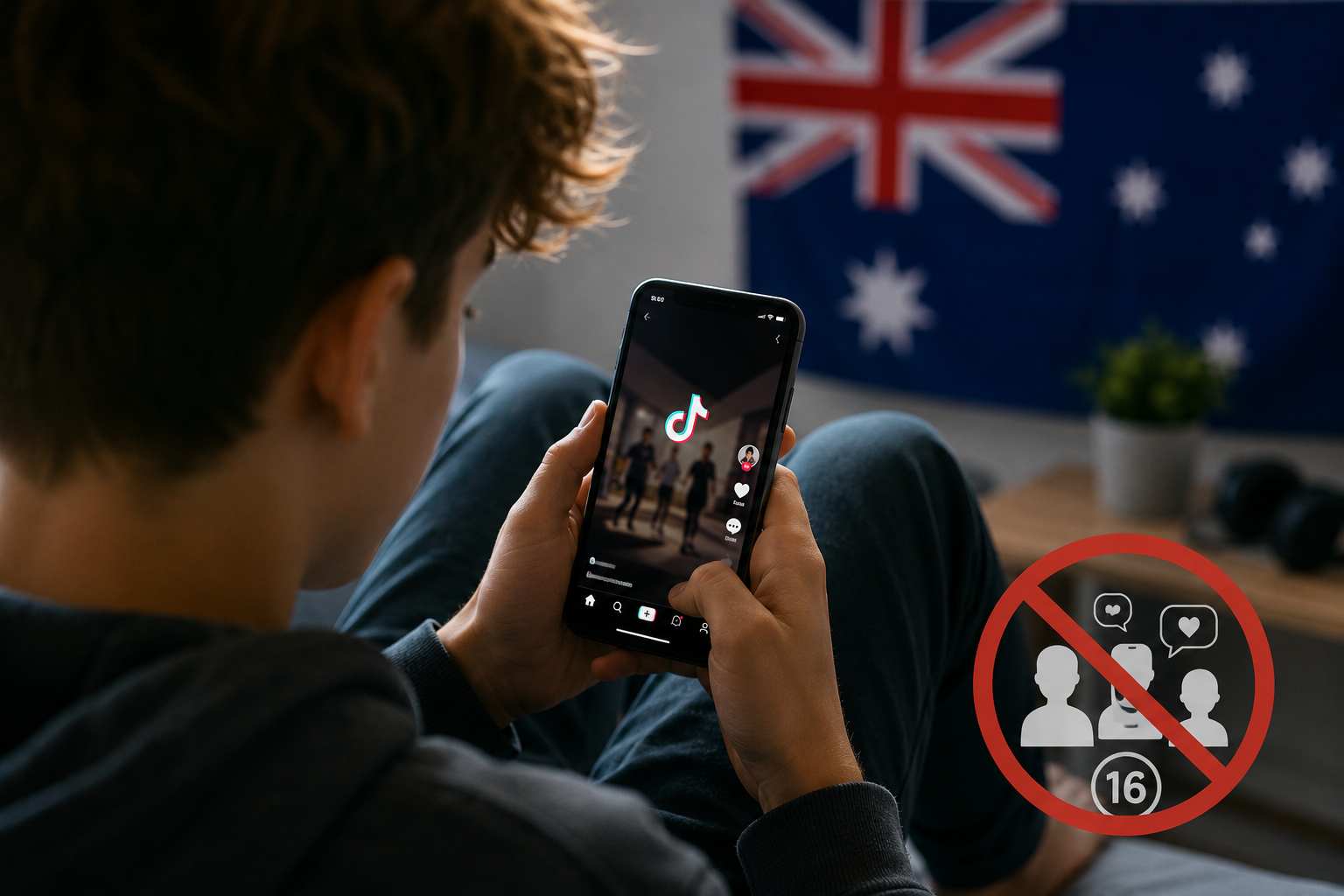
TikTok usage among Australian 13-to-15-year-olds has nearly returned to pre-ban levels, raising fresh questions over age verification, enforcement and the effectiveness of Australia's landmark social-media restrictions
Australia's ambitious attempt to restrict social-media access for children under 16 is facing a major test, with new data suggesting that teenagers are gradually returning to platforms such as TikTok.
Eight months after the country's under-16 social-media restrictions came into force, 26 per cent of children aged 13 to 15 were using TikTok last month, according to data from parental-control technology company Qustodio. The figure is only one percentage point below the level recorded before the restrictions were introduced.
The development has renewed debate over whether platform bans can deliver lasting reductions in children's social-media usage, particularly when young users can potentially circumvent age controls or move to services that remain accessible.
TikTok usage rebounds after initial impact
Australia introduced its landmark restrictions in December with the objective of preventing children below 16 from accessing major social-media platforms.
The rules place responsibility on technology companies to take reasonable measures to prevent underage users from accessing covered services. Platforms that fail to comply can face significant penalties.
The restrictions initially resulted in a substantial decline in children's access to TikTok and other affected services. However, Qustodio's latest data indicate that usage has gradually recovered.
Yasmin London, a global online safety expert at Qustodio, said the company's data showed an immediate decline after the rules were implemented, followed by a gradual recovery for several services.
The development suggests that the initial reduction in access may not necessarily translate into a permanent change in children's online behaviour.
Why are teenagers returning to restricted platforms?
The rebound could be linked to several factors.
Some teenagers may be entering incorrect birth dates when creating accounts, while others could be finding ways around location or age restrictions. The use of virtual private networks, alternative accounts and different devices could also make enforcement more difficult.
Another challenge is that age-verification technologies are still evolving.
Platforms must determine whether users are under 16 while also avoiding excessive collection of sensitive personal information. More rigorous identity checks could improve enforcement but may raise concerns about privacy, cybersecurity and data retention.
The result is a difficult balancing act between child protection and user privacy.
Instagram and Snapchat also see recovery
TikTok is not the only social-media platform experiencing a recovery in usage among younger Australians.
Qustodio's data show that Instagram and Snapchat also experienced declines after the restrictions were introduced, followed by signs of increasing usage.
Although their usage levels remain different from TikTok, the trend indicates that children's overall demand for social networking has not disappeared.
For policymakers, this distinction is important. Restricting access to individual platforms may reduce usage temporarily, but it may not eliminate the underlying demand for communication, entertainment and social interaction.
WhatsApp gains users as teenagers shift platforms
One of the clearest examples of changing online behaviour is WhatsApp.
The messaging service, owned by Meta, is not currently covered by Australia's under-16 social-media restrictions. Qustodio found that its usage among children aged 13 to 15 increased from 27 per cent before the restrictions to 36 per cent afterward.
The shift suggests that some young users may be moving their digital activity toward services that remain available.
This creates a significant policy challenge. If teenagers simply migrate from restricted platforms to unrestricted messaging or social services, the overall amount of time they spend online may not decline substantially.
Age verification becomes the centre of the debate
Australia's experience has placed age verification at the centre of the global discussion about children's social-media access.
A simple age declaration is relatively easy to bypass, while stronger systems may require additional information or technology.
Platforms could potentially use combinations of identity verification, age estimation and behavioural signals. However, each approach comes with trade-offs.
Collecting government identification documents, biometric information or other sensitive data could itself create privacy and security concerns. On the other hand, weak verification mechanisms may make the restrictions difficult to enforce.
The Australian model is therefore likely to become an important test case for how governments can establish effective age assurance without creating a new digital privacy problem.
Qustodio data provide a useful but limited picture
The latest findings are based on anonymised information from around 19,000 Australian families using Qustodio's parental-control software.
The company measured whether children had unblocked access to specific applications and used those services at least once a month for more than five consecutive minutes.
However, the dataset does not cover every Australian household.
Because the research focuses on devices with Qustodio's parental-control software installed, actual usage among the wider population could be different. The data should therefore be viewed as an indicator of changing behaviour rather than a complete measurement of Australia's teenage social-media population.
Australia increases pressure on technology companies
The Australian government has already indicated that it expects social-media companies to strengthen their compliance efforts.
In June, authorities said platforms were not doing enough to enforce the age restrictions. The government has also proposed increasing the maximum penalty for violations to A$99 million and expanding the enforcement powers available to the country's online safety regulator, eSafety.
No social-media platform has been fined for violating the restrictions so far.
The possibility of substantially higher penalties could increase pressure on companies to invest more heavily in age-assurance technology and compliance systems.
Global governments are watching Australia's experiment
Australia's policy has attracted significant attention from governments considering similar measures.
More than two dozen governments are implementing, examining or proposing policies aimed at limiting children's access to social-media platforms.
New Zealand, for example, has also announced plans involving restrictions on social-media access for younger users.
Australia is consequently being closely observed as a potential blueprint for other countries.
If the country can demonstrate sustained reductions in underage access, its approach could encourage governments elsewhere to adopt similar rules. If teenagers continue to bypass restrictions, policymakers may need to rethink whether platform-specific bans are sufficient.
The debate is about more than social-media access
Supporters of Australia's restrictions argue that children require stronger protection from potentially harmful online environments.
Concerns include exposure to inappropriate content, cyberbullying, addictive design features, online harassment and other risks associated with prolonged social-media use.
The policy therefore attempts to shift more responsibility onto technology companies rather than placing the entire burden on parents.
Critics, however, question whether blanket restrictions can be effectively enforced and whether they could push young people toward less-regulated digital environments.
The rise in WhatsApp usage illustrates how restrictions on one part of the digital ecosystem can potentially alter user behaviour elsewhere.
Technology companies face growing regulatory scrutiny
The Australian developments come amid broader international scrutiny of major social-media companies and their impact on younger users.
Technology platforms are increasingly being challenged over issues including children's privacy, addictive design, content moderation and the psychological impact of prolonged engagement.
Several legal actions in the United States have also alleged that social-media companies' platform designs can contribute to harm among young users.
As governments increase oversight, technology companies are likely to face greater expectations to prove that their systems are capable of identifying and protecting underage users.
Will Australia's ban produce a lasting impact?
The latest data do not necessarily mean that Australia's policy has failed. The restrictions have produced an initial decline in access, and enforcement measures are still developing.
However, the return of TikTok usage to almost pre-ban levels demonstrates the difficulty of sustaining such restrictions.
The effectiveness of Australia's model will ultimately depend on whether authorities and technology companies can prevent circumvention, strengthen age verification and ensure that young users do not simply migrate to alternative services.
Australia's social-media policy enters a crucial phase
The country's under-16 social-media restrictions have become one of the world's most closely watched experiments in regulating children's online activity.
The latest Qustodio data suggest that teenagers remain highly motivated to access social platforms despite regulatory restrictions. TikTok's near return to its pre-ban usage level, along with increased use of unrestricted services such as WhatsApp, highlights the adaptability of young users in a rapidly changing digital environment.
For other governments considering similar policies, Australia's next phase could provide an important lesson: introducing a ban may be relatively straightforward, but ensuring sustained compliance across a complex and constantly evolving digital ecosystem is far more difficult.