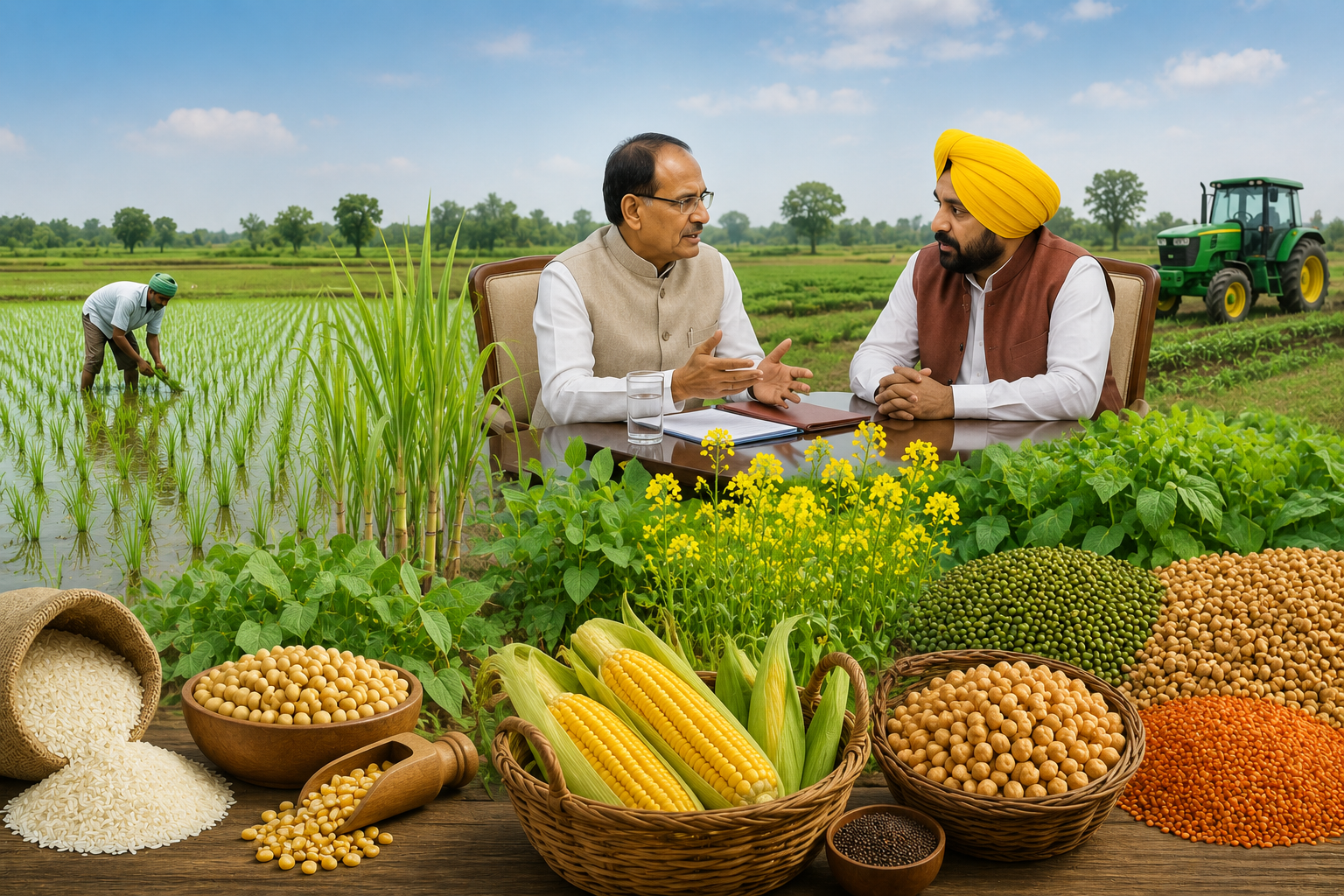
Shivraj Singh Chouhan Holds Key Talks With Punjab CM Bhagwant Mann on Sustainable Agriculture Strategy
Union Agriculture Minister Shivraj Singh Chouhan on Wednesday strongly advocated for accelerated crop diversification in Punjab during a high-level meeting with Chief Minister Bhagwant Mann in New Delhi.
The meeting focused on the growing need to reduce Punjab’s heavy dependence on paddy cultivation and promote more sustainable agricultural alternatives capable of preserving groundwater resources, improving soil health, and ensuring long-term income stability for farmers.
According to Chouhan, the discussions were “highly positive, constructive, and solution-oriented,” with crop diversification emerging as the most critical issue.
The Centre’s renewed push comes amid rising environmental concerns linked to water-intensive farming practices in Punjab, one of India’s largest rice-producing states.
Centre Warns Against Overdependence on Paddy Cultivation
Punjab’s agriculture has remained heavily dependent on paddy and wheat cultivation for decades, largely supported by government procurement under the Minimum Support Price (MSP) mechanism.
While the system helped transform Punjab into a major contributor to India’s food security, policymakers and experts now warn that excessive paddy cultivation is creating serious ecological and economic challenges.
Key concerns include:
- Rapid groundwater depletion
- Declining soil fertility
- Rising electricity consumption for irrigation
- Environmental degradation
- Increasing stubble burning incidents
Experts caution that continued overexploitation of groundwater resources could severely threaten Punjab’s long-term agricultural sustainability.
Chouhan Says Punjab Can Successfully Grow Alternative Crops
During the meeting, Chouhan emphasized that Punjab’s fertile land and strong agricultural ecosystem make it highly capable of cultivating several alternative crops beyond paddy.
He noted that the state has the potential to expand cultivation of:
- Maize
- Pulses
- Oilseeds
- Vegetables
- Fruits
- Cotton
- Horticulture crops
According to the minister, diversification would not only reduce pressure on groundwater but also create new income opportunities for farmers through higher-value agriculture.
Agricultural experts believe diversified cropping patterns can help improve farm resilience against climate and market volatility.
Groundwater Crisis Remains Major Concern
Punjab has been witnessing alarming groundwater depletion over the past several years due to intensive paddy farming and free power-supported irrigation systems.
Large parts of the state have reported falling water tables, with experts warning that unsustainable extraction rates could eventually threaten agricultural productivity itself.
The Centre has repeatedly highlighted the need for:
- Water-efficient farming methods
- Micro-irrigation systems
- Reduced paddy acreage
- Sustainable crop planning
Analysts say crop diversification remains one of the most effective long-term solutions for addressing Punjab’s water crisis.
Diversification Seen as Key to Sustainable Farming
Agricultural economists believe shifting toward diversified agriculture can create multiple benefits for Punjab’s farming economy.
Potential advantages include:
- Lower water usage
- Improved soil quality
- Reduced fertilizer dependency
- Better crop rotation
- Higher value realization
- Lower environmental stress
Experts also note that diversification can help reduce the state’s dependence on a limited procurement-driven agricultural model.
Farmers Seek Assured Procurement and Market Support
Despite repeated calls for diversification, many farmers in Punjab continue to prefer paddy cultivation due to assured procurement and relatively predictable incomes.
Farmer groups have consistently argued that successful diversification will require:
- Guaranteed procurement for alternative crops
- Stable pricing mechanisms
- Better storage infrastructure
- Food processing support
- Access to export markets
Analysts say without strong policy backing and market confidence, large-scale transition away from paddy could remain difficult.
Centre Likely to Push Incentive-Based Transition
Government officials indicate that the Centre may increasingly focus on incentive-based strategies to encourage diversification.
Possible measures could include:
- Financial incentives for alternative crops
- Subsidies for drip irrigation
- Support for food processing industries
- Improved crop insurance coverage
- Infrastructure for value-added agriculture
Experts believe such initiatives could gradually encourage farmers to shift toward less water-intensive and higher-margin farming models.
Climate Change Adds Urgency to Reform
Climate experts warn that changing rainfall patterns, rising temperatures, and extreme weather events are increasing risks for traditional cropping systems.
Punjab’s paddy cultivation is particularly vulnerable due to:
- High irrigation dependence
- Heat stress
- Water scarcity
- Rising input costs
Agricultural diversification is increasingly being viewed as essential not only for economic sustainability but also for climate resilience.
Punjab’s Agriculture at a Turning Point
The discussions between the Centre and Punjab government come at a crucial time when the state’s agricultural model is facing mounting pressure from environmental, economic, and resource-related challenges.
Experts believe Punjab may need to gradually transition toward:
- Sustainable agriculture
- Precision farming
- High-value crops
- Agro-processing
- Export-oriented farming
Such changes could potentially reshape the state’s agricultural economy over the coming decade.
Stubble Burning Issue Also Linked to Paddy Dominance
Officials and environmental experts also link Punjab’s recurring stubble burning crisis to the dominance of paddy cultivation.
Short harvesting windows between paddy and wheat cycles often leave farmers with limited time to clear crop residue, leading to widespread stubble burning.
Diversification toward alternative crops could help:
- Reduce residue generation
- Lower air pollution levels
- Improve soil conditions
- Ease pressure on crop cycles
Analysts believe diversification may eventually become a key component of broader environmental reforms in North India.
Centre and State Expected to Continue Discussions
The meeting signals continued engagement between the Centre and Punjab government on long-term agricultural reforms.
Officials expect further consultations on:
- Diversification roadmaps
- Procurement mechanisms
- Water conservation strategies
- Farmer support programmes
Industry experts believe coordinated efforts between policymakers, agricultural scientists, and farmer organizations will be crucial for successfully transforming Punjab’s farming landscape.
As pressure on natural resources intensifies, crop diversification is increasingly emerging as one of the most important policy priorities for ensuring sustainable agriculture and long-term food security in India.