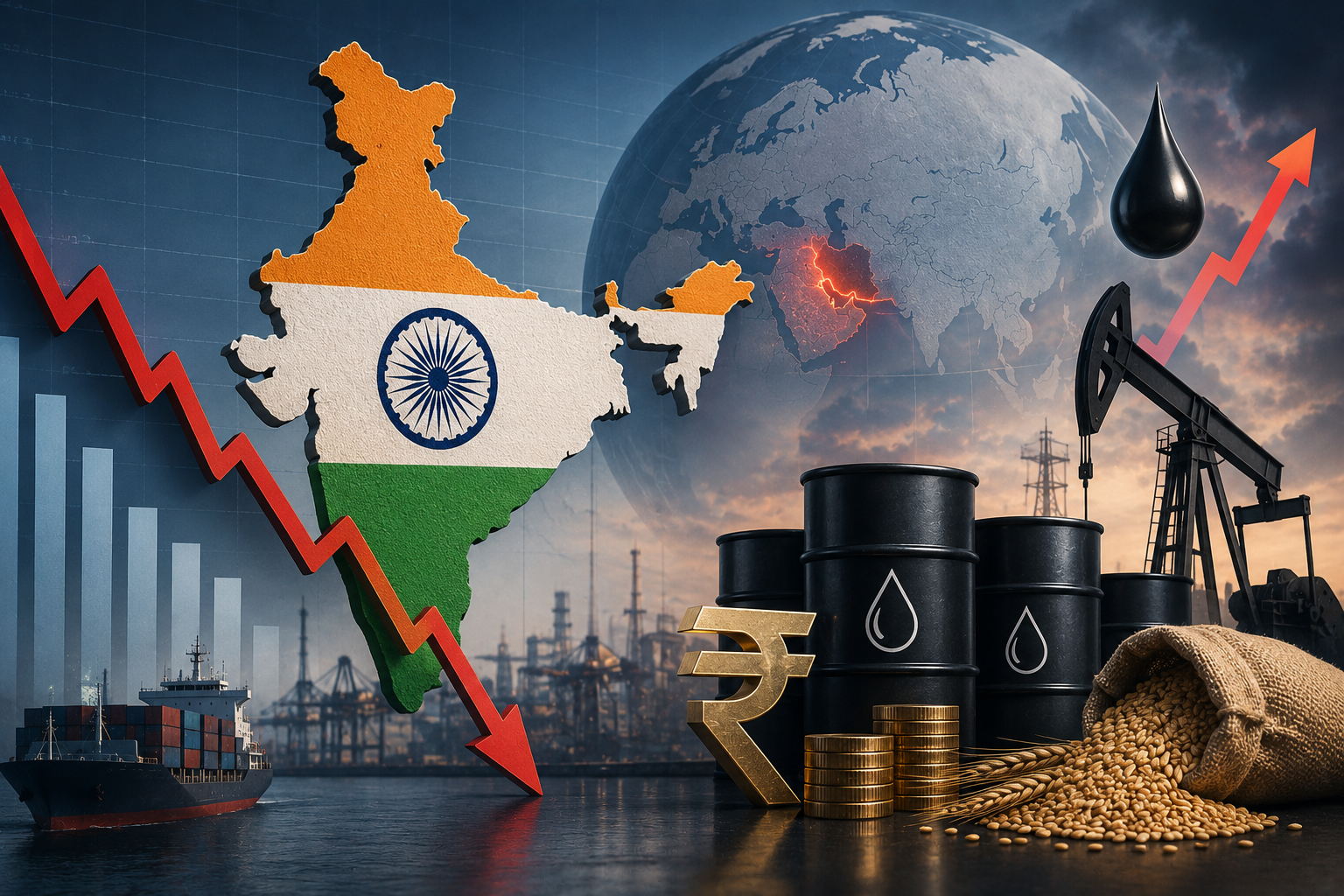
Rising Energy Costs and Geopolitical Risks Cloud India’s Economic Outlook
Global rating agency Moody's Ratings has sharply cut India’s economic growth projections for 2026 and 2027, warning that prolonged geopolitical tensions and elevated energy prices could significantly impact the country’s growth momentum.
In its latest Global Macro Outlook update, Moody’s reduced India’s GDP growth forecast for calendar year 2026 by 0.8 percentage points to 6%, while also trimming the 2027 estimate by 0.5 percentage points to 6%.
The downgrade reflects growing concerns surrounding the ongoing US-Iran conflict, disruptions in global energy supply chains and the sharp rise in crude oil prices.
India Seen as Highly Vulnerable to Oil Price Surge
Moody’s highlighted that India remains one of the most vulnerable major economies to rising oil prices because of its heavy dependence on imported crude oil and liquefied natural gas (LNG).
India’s Energy Import Dependence
- Nearly 90% of crude oil requirements are imported
- Around 60% of LPG consumption is imported
- Approximately 90% of LPG imports move through the Strait of Hormuz
The agency warned that any prolonged disruption in the Gulf region could severely impact inflation, government finances and economic activity.
Growth Forecasts Revised Sharply Lower
Moody’s now expects India’s growth trajectory to moderate considerably over the next two years.
Revised GDP Estimates
- CY2025 growth estimate: 7.5%
- CY2026 growth forecast: 6%
- CY2027 growth forecast: 6%
The downgrade reflects expectations of:
- Slower private consumption
- Weakening industrial activity
- Softer capital formation
- Tighter financial conditions
- Elevated energy and transportation costs
Analysts believe higher fuel prices could reduce consumer spending power and impact corporate profitability across sectors.
West Asia Conflict Adds Fresh Economic Risks
The prolonged confrontation between the United States and Iran continues to remain a major source of global uncertainty.
According to Moody’s, fragile ceasefire conditions, ongoing shipping disruptions and the risk of military escalation have increased concerns about energy supply stability.
The agency warned that the global economy could face another major energy and food price shock if trade routes around the Gulf region remain disrupted.
Strait of Hormuz Crisis Remains Critical
One of the biggest concerns highlighted by Moody’s is the closure and disruption risk surrounding the Strait of Hormuz — one of the world’s most important oil transit routes.
Why the Strait of Hormuz Matters
- A major portion of global crude oil shipments pass through the route
- India relies heavily on Gulf energy imports
- LPG and crude transportation could face severe disruption
Analysts believe prolonged supply bottlenecks could push crude oil prices even higher, worsening imported inflation pressures for India.
Higher Oil Prices Could Hurt Inflation and Fiscal Deficit
Moody’s warned that persistently elevated energy prices could create broad-based macroeconomic pressure across the Indian economy.
Key Economic Risks
- Rising inflation
- Higher transportation and logistics costs
- Increased fertiliser subsidy burden
- Pressure on fiscal deficit
- Widening current account deficit
- Reduced household spending
The agency also cautioned that higher fuel and fertiliser costs may strain government finances and potentially limit planned infrastructure spending.
Private Consumption and Investment Likely to Slow
According to the report, elevated energy prices are expected to weaken demand conditions across the economy.
Areas Likely to Face Pressure
- Consumer spending
- Manufacturing activity
- Industrial production
- Private sector investments
- Capital expenditure plans
Tighter liquidity conditions and higher operating costs may further impact business expansion plans over the near term.
RBI Could Face Policy Challenges
Persistently high inflation may also complicate policy decisions for the Reserve Bank of India.
If fuel inflation rises sharply, the RBI may be forced to:
- Maintain tighter monetary conditions
- Delay interest rate cuts
- Remain cautious on liquidity support
Analysts believe balancing growth and inflation could become increasingly difficult if crude oil prices remain elevated for an extended period.
Government Finances Could Come Under Pressure
The report warned that higher energy import bills and subsidy obligations could impact India’s fiscal health.
Potential Fiscal Challenges
- Increased fuel subsidy burden
- Higher fertiliser subsidy allocation
- Pressure on capital expenditure plans
- Rising import costs
This could potentially affect government spending on infrastructure and welfare programs if energy prices continue to rise.
Renewable Energy Expansion Provides Long-Term Cushion
Despite near-term challenges, Moody’s acknowledged that India continues to strengthen its renewable energy ecosystem.
India’s Evolving Energy Mix
- Coal still accounts for nearly 70% of power generation
- Solar and wind capacity continue to expand rapidly
- Renewable investments are accelerating
Analysts believe India’s long-term energy diversification strategy could gradually reduce vulnerability to imported fossil fuel shocks.
Asia-Pacific Region Faces Broad Energy Exposure
Moody’s stated that the Asia-Pacific region remains among the most exposed globally to energy supply disruptions.
However, the impact differs across countries:
Regional Exposure Comparison
- China is relatively insulated due to heavy coal and renewable usage
- India remains highly exposed to crude import dependence
- Japan and South Korea are diversifying oil sourcing
- India has increased imports of discounted Russian crude
Energy diversification efforts may help reduce long-term supply risks but may not fully offset near-term pressures.
Markets Likely to Stay Sensitive to Oil Prices
Financial markets are expected to remain highly sensitive to:
- Crude oil movement
- Geopolitical developments
- Inflation trends
- Currency fluctuations
- Central bank commentary
Analysts believe continued volatility in energy markets could impact equities, bonds and the Indian rupee over the coming months.
Long-Term Growth Story Remains Intact
Despite the downgrade, economists believe India’s structural growth story remains strong over the long term due to:
Key Long-Term Strengths
- Strong domestic consumption base
- Expanding manufacturing ecosystem
- Government infrastructure spending
- Digital economy growth
- Rising formalisation
- Renewable energy transition
However, the near-term environment remains challenging as geopolitical uncertainty and rising energy costs continue to pressure economic activity.
Outlook: India Faces Tough Near-Term Macro Environment
Moody’s latest downgrade highlights the growing risks facing emerging economies amid escalating geopolitical tensions and rising global energy prices.
While India remains one of the fastest-growing major economies globally, analysts believe policymakers will need to carefully manage:
- Inflation risks
- Fiscal stability
- Energy security
- Currency volatility
- Growth momentum
The pace of recovery will largely depend on how quickly geopolitical tensions ease and whether global energy markets stabilize in the coming quarters.