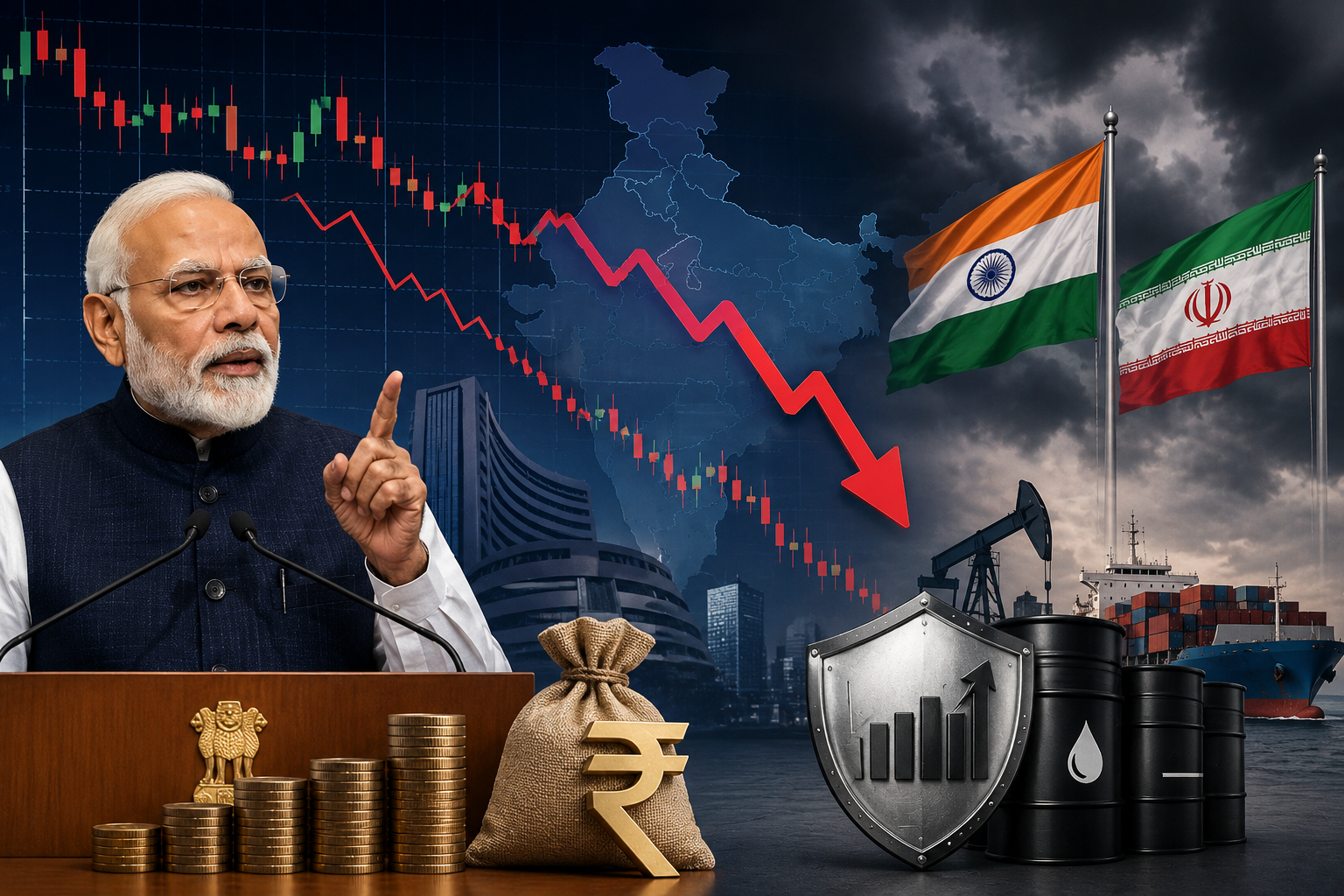
Sharp Market Correction Raises Questions Over Excessive Fear
Indian equity markets witnessed heavy volatility over the last two trading sessions after Prime Minister Narendra Modi appealed for austerity measures amid rising geopolitical tensions linked to the ongoing US-Iran conflict.
The remarks triggered concerns that the government could introduce stricter fiscal and economic measures if the West Asia crisis prolongs further. Investors responded sharply, leading to broad-based selling across benchmark indices.
However, several market experts now believe the markets may have overreacted to the development, arguing that current conditions are far from the economic stress seen during the Covid-19 crisis.
Markets Were Already Under Pressure
Analysts pointed out that investor sentiment was already fragile due to escalating geopolitical uncertainty, elevated crude oil prices and concerns over inflationary pressure.
The Prime Minister’s remarks acted as an additional trigger that intensified existing nervousness across financial markets.
The frontline indices declined sharply over the past two sessions, with the Sensex slipping significantly before recovering partially during intraday trade.
Key Factors Weighing on Markets
-
Ongoing US-Iran conflict
-
Elevated crude oil prices
-
Inflation concerns
-
Fear of widening fiscal deficit
-
Current account deficit pressure
-
Global risk-off sentiment
Experts believe the combination of these factors amplified investor fears beyond what current economic conditions justify.
Experts Say Markets Have Reacted Too Harshly
U R Bhat believes the market reaction resembles panic similar to the Covid-era uncertainty, although the present situation is fundamentally different.
According to Bhat, investors may be assigning excessive importance to the government’s austerity appeal before any actual policy measures have been announced.
He also suggested that aggressive measures such as increasing gold import duties may not materially help the economy and could instead create short-term market anxiety.
Nifty Support Levels Remain Important
Despite recent volatility, technical analysts believe the broader market structure has not broken down completely.
Key Technical Level
-
Nifty support zone: 22,180
Analysts suggest that if the index holds above this level, markets may gradually stabilize once geopolitical tensions ease.
Investors Fear Potential Policy Tightening
The major concern among investors is that the government may eventually introduce economic measures aimed at protecting India’s fiscal and current account balances if crude oil prices remain elevated for an extended period.
According to Nomura, potential policy responses could include:
Possible Measures Under Discussion
-
Higher import duty on gold
-
Temporary reduction in outward remittance limits
-
Foreign currency deposit mobilisation schemes
-
Increase in domestic fuel prices
-
Measures to discourage non-essential imports
Analysts believe the government’s messaging could be an attempt to prepare citizens for possible economic adjustments if the geopolitical crisis intensifies further.
Why Rising Oil Prices Are a Major Concern
India remains heavily dependent on crude oil imports, making sustained high oil prices a major macroeconomic challenge.
Higher crude prices could:
-
Increase inflation
-
Widen the fiscal deficit
-
Pressure the current account deficit
-
Raise transportation and logistics costs
-
Reduce consumer spending power
The risk becomes more severe if the Strait of Hormuz faces disruption, potentially impacting global oil supply chains.
Fuel Price Hike Could Impact Inflation
Analysts at Nomura warned that rising fuel prices could directly impact India’s inflation trajectory.
Inflation Sensitivity
-
Petrol and diesel hold nearly 4.8% weight in India’s CPI basket
-
A 10% fuel price increase could add nearly 0.5 percentage points to headline inflation
Higher fuel prices may also force the Reserve Bank of India to maintain a cautious monetary policy stance for longer.
Government May Adopt Gradual Approach
Brokerage firm JM Financial believes the government is unlikely to impose aggressive austerity measures immediately.
Instead, analysts expect a phased and calibrated approach if geopolitical tensions continue.
Possible Gradual Steps
-
Incremental fuel price hikes
-
Temporary reduction in Liberalised Remittance Scheme (LRS) limits
-
Moderate increase in gold import duty
-
Strategic petroleum reserve expansion
Analysts believe gradual implementation would help reduce market disruption while addressing macroeconomic pressures.
GDP Growth Could Moderate if Conflict Persists
JM Financial estimates that a prolonged conflict in West Asia could slow India’s GDP growth trajectory.
Key Economic Risks
-
GDP growth could moderate to 6–6.5%
-
Current account deficit may widen to 1.9% of GDP
-
Inward remittances could weaken
-
Imported inflation may rise
The impact would depend largely on the duration of the geopolitical conflict and movement in crude oil prices.
Domestic Economy Still Shows Resilience
Despite market volatility, experts emphasize that India’s domestic economic fundamentals remain relatively stable compared to previous global crises.
Key Strengths Supporting the Economy
-
Strong domestic consumption
-
Healthy banking system
-
Government infrastructure spending
-
Robust tax collections
-
Stable corporate earnings in key sectors
Analysts believe these factors could help cushion the economy against external shocks if geopolitical tensions do not escalate significantly.
Investors Advised to Avoid Panic Selling
Market veterans believe investors should avoid reacting emotionally to short-term geopolitical developments.
According to experts, panic-driven corrections often create opportunities in fundamentally strong businesses with long-term growth visibility.
Sectors Likely to Remain Resilient
-
Banking and financial services
-
Infrastructure
-
Capital goods
-
Defence manufacturing
-
Domestic consumption
-
Energy transition themes
Selective stock picking and disciplined investing are likely to become increasingly important in the current environment.
Outlook: Volatility May Continue, But Panic Could Ease
Analysts expect markets to remain volatile in the near term as investors closely monitor:
-
Developments in the US-Iran conflict
-
Crude oil price movement
-
Government policy response
-
Inflation trajectory
-
RBI commentary
However, experts believe the sharp market reaction may gradually cool down if geopolitical tensions stabilize and no aggressive austerity measures are introduced.
For now, market participants are likely to remain cautious, but many analysts believe the recent correction reflects fear-driven sentiment more than a deterioration in India’s long-term economic fundamentals.